Artisan makes work easier at Miramar
CUTLINE
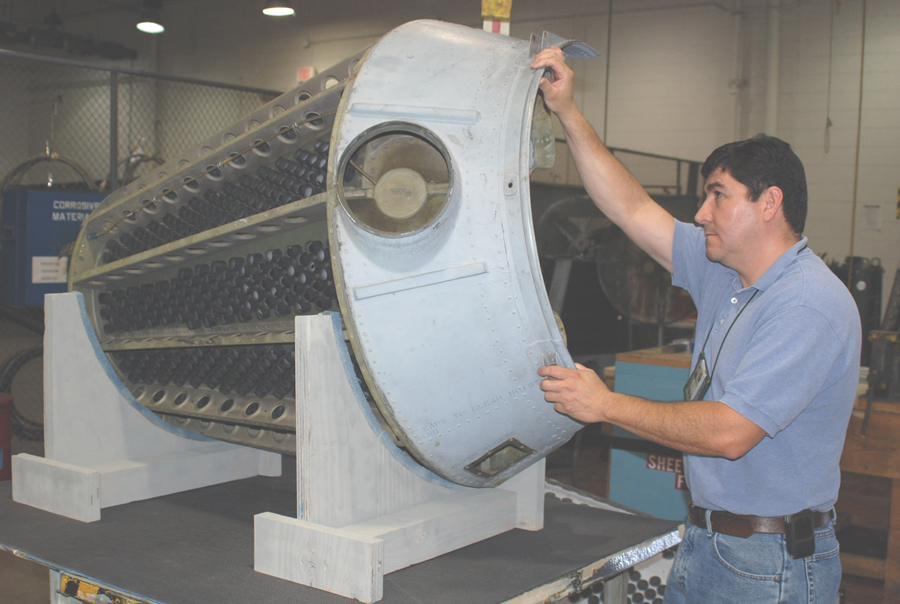
With the work stand he made in place, aviation sheet metal mechanic David Sanchez demonstrates the ease of access he’ll have to work on an engine air particle separator. Joe Feliciano
Artisan’s Ideas, Experience Makes Work Easier at Miramar
By Jim Markle
“Work smarter, not harder” is no cliché to David Sanchez.
The aviation sheet metal mechanic, who works for Fleet Readiness Center Southwest (FRCSW) on Naval Air Station North Island, created a work stand for the CH-53 Super Stallion helicopter engine air particle separator (EAPS) in June. The work stand significantly improved maintenance and repair handling ease of the separators.
The EAPS is a large air filtration system that is attached to the front of the engine cowling on the large, heavy-lift helicopters. There are three EAPS per aircraft, and their purpose is to filter out sand and other debris which may result in foreign object damage (FOD) to the engine. EAPS houses a sandwich-type construction of screens which capture any FOD as air enters. FOD is then expelled ensuring clean air goes into the engine.
When disassembled, each EAPS weighs less than 100 pounds. But the size and dimensions of the unit make it awkward to maneuver when performing repairs.
“I saw a need to position the EAPS so it’d be easier to work on. It’s just something I made up off the top of my head – I thought if I cut the wood in a manner to the shape of the EAPS, and added some foam padding, I could get it to standup in the position I needed,” Sanchez explained.
Previously, EAPS were simply laid on the ground or on a table. Artisans, with help, would turn the units to work on them. Sanchez’s work stand eliminates that need.
Sanchez joined FRCSW in August 2003. He transferred in April, from the Composite Repair Shop to Marine Corps Air Station Miramar (MCAS) and is assigned to the Marine Aviation Logistics Squadron (MALS) 16 metal shop.
“They (FRCSW) canvassed the artisans and asked if anyone was interested in a position at Miramar. They were standing up this shop focused on EAPS repair capability at the intermediate level and asked if anyone was interested in working on them. Being a former Marine, I had worked on them, and I live close to the area,” he said. The 46 year-old retired gunnery sergeant said he worked as an aircraft structural mechanic, and in his 22-year career “touched about every aircraft in the Marine Corps inventory” including F-4s, CH-53s, CH-46s, Cobras, AH-1s, and Huey helicopters, and F/A-18 Hornets.
Still working on helicopters, he is now organizing the new shop. “There are a lot of growing pains. This is a first for this command, for the Marines here, and it’s a first for me. We’re trying to establish a supply line for the needed parts, the technical support and just about the ‘whole nine yards’ of getting this off the ground,” he said.
Meanwhile, because of his expertise, Sanchez is relied upon to assist MALS 16 in other areas including fiberglass and sheet metal work. But his primary focus remains the CH-53, its backlogged EAPS and the smartest way to work on them.
“It’s really the artisans, the people doing the day-to-day work, who make the greatest impact on how this organization operates,” said Capt. Fred Cleveland, commanding officer, FRCSW. “It’s the innovativeness of artisans like David Sanchez that help to keep this command as one of the premier aviation maintenance organizations in the Navy.”
“I have some other ideas. I want to make another work stand, again, for ease of maintenance. This one would be for installing rivets where it would be easier for someone to position themselves on one side of the EAPS, and another artisan can be on the opposite side bucking (installing) the rivets. It would be easier on the body and less awkward that way,” Sanchez stated.