China Lake hosts fourth Empire Challenge
By Theresa Goldstrand, Weapons Engagement Office
and
Staci Mathews, NAWCWD Public Affairs
The Naval Air Warfare Center Weapons Division China Lake hosted the largest Empire Challenge in July with about 1,400 civilian and military personnel participating in the two-week exercise led by the National Geospatial-Intelligence Agency (NGA), partnering with the National Reconnaissance Office (NRO) and the Joint Forces Command (JFCOM).
Empire Challenge 2007 (EC07) was the fourth in a series of annual exercises aimed at demonstrating joint and coalition interoperability among intelligence, surveillance, and reconnaissance (ISR) platforms, sensors and systems. The idea of the exercise was developed after combat operations in Iraq and Afghanistan identified technical issues with the sharing of ISR information with allied countries. EC07 became a building block for allied relationships as well as the testing and evaluation of leading edge targeting and imagery hardware and software.
“This was the largest and most complex series of ISR system tests and technology demonstrations we have attempted,” said Barry O’Neal, manager of the Precision Targeting Projects Group in the Weapons Engagement Office (WEO) and coordinator of China Lake’s participation in EC07. “It combined real-time surveillance with pre-planned and non-traditional reconnaissance using a worldwide network to reach back and collaborate with our allies in their own country.”
Participating allies included Australia, Canada, Great Britain and the NATO C3 Agency. Many of the allied military personnel found China Lake’s location an ideal environment for proving out their systems prior to deployment.
“This has been one of the best exercises I have been on because everyone is on the same frequency,” said Daniel Burfoot, British Army.
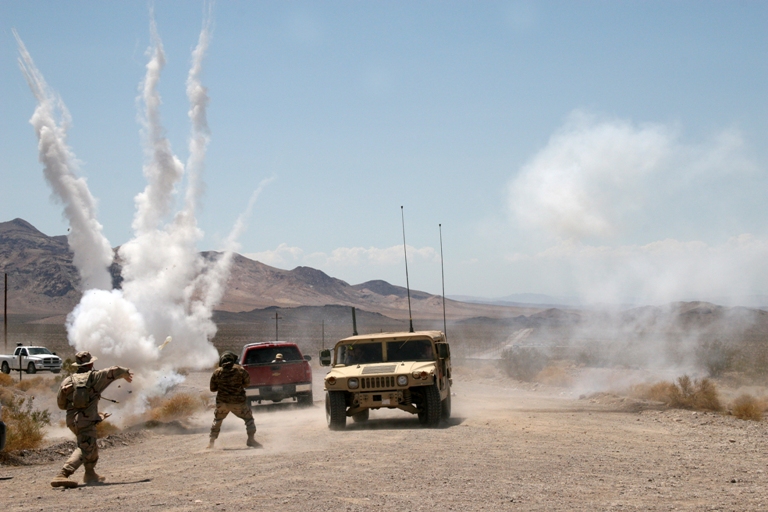
Temperatures soared between 104 and 118 degrees on the China Lake Electronic Combat Range, where Navy reservists and JFCOM personnel conducted ground operations that tested manpower and equipment simulating real-life situations in theater including convoy attacks by opposing forces, small arms fire and improvised explosive devices.
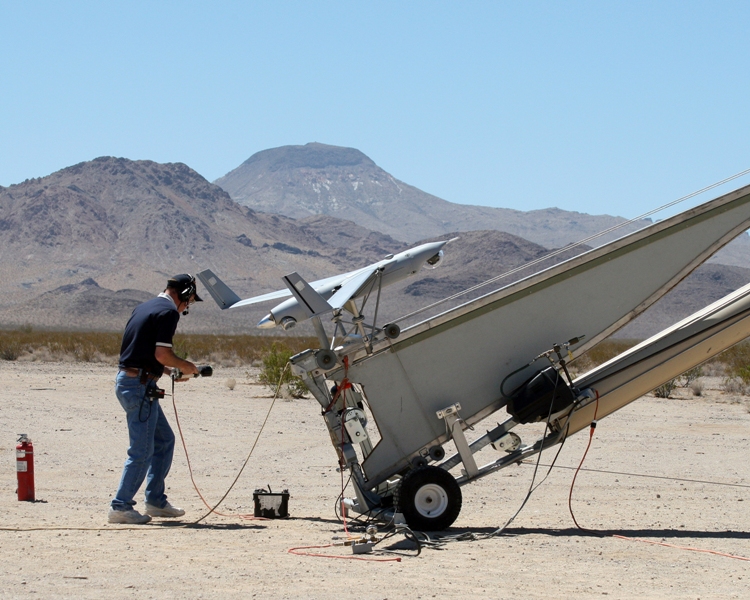
One hundred and ten sorties were flown during the nine-day event by U.S. and coalition aircraft, including the F/A-18 aircraft carrying the Shared Reconnaissance (SHARP) pod, two GR4 Tornado aircraft carrying RAPTOR pods, a British Nimrod MR-1 aircraft, and Lincoln Labs’ Paul Revere aircraft, which carried its LiMIT radar sensor and also served as the airborne communications and networking relay for the JFCOM-sponsored Adaptive Joint Collaborative Network Advanced Concept Technology Demonstration. The Scan Eagle UAV relayed its digital video to the Joint Task Force Command and Control (JTFC2) Center in Michelson Laboratory and across the network to all exercise participants.
“This Empire Challenge was significantly more complex than previous years, due to the use of cross-domain solutions between US and coalition forces, which provided seamless access to intelligence products for all participants,” said Wayne Willhite, head of WEO.
Imagery intelligence and ground moving target indicator data were data-linked real-time to U.S. and coalition ground stations located at Armitage Airfield. The data were screened and relayed via a Global Broadcast System uplink to receiving stations at RAF Marham in England, the Defense Imagery and Geospatial Office in Canberra, Australia, and the Canadian Forces Defense Headquarters in Ottawa, Canada. Analyzed and exploited intelligence data products were sent from those long distance locations back to China Lake on a secure Coalition Force Battle Laboratory network where they were reviewed and used by the Joint Task Force commander to prosecute targets and enemy units on the South Range.
“China Lake is the place to bring advanced network architectures, such as Distributed Common Ground System (DCGS) integrated backbone (DIB) and test them in live operations,” Willhite said.
Other Empire Challenge participants said China Lake was a great training location and represented the tactical environment very well.
“It was great to demonstrate technology that can save soldiers’ lives, and to interface with other technologies,” said Mitch Mitchner, co-lead for the Shot-Spotter program.
Many China Lake employees in the Range, Public Works, Facilities, Command, and Security Departments were involved in EC07. The WEO in the Weapons and Energetic Materials Department handled all the coordination between the customer and all related participants. They also stood up the JTFC2 center and the networks required to connect the various nodes providing and receiving data.
The WEO provided engineering support to work with each participating DCGS program to ensure they were integrated into the combined EC07 network. The WEO was tasked to develop and field a real-time non-traditional ISR/strike capability that was operated on both the U.S. and coalition network. This was constructed by developing software applications that closed existing gaps between intelligence, C2 and weapon systems. The JTFC2 center at China Lake was connected to the Combined Air Operations Center at Langley AFB, Va., which acted as the JFACC for the exercise.
“The support provided by over 50 naval reservists from several units is what made the big difference this year,” O’Neal said. “They made the ground-based war more realistic and gave everyone a sense of the importance of what was being accomplished while watching from the UAVs overhead. They contributed many hours in training allied military personnel on systems and procedures in the command center, standing watches, and directing non-traditional ISR missions. Their contribution was invaluable.”
More than 100 congressional staffers, senior executives, flag officers and distinguished visitors from coalition and NATO countries, the Office of the Secretary of Defense, the Joint Staff, JFCOM, Army, Air Force and Navy components received briefings and observed activities in real time in the JTF C2 Center, the ground station complex at Armitage Airfield and on the South Range during two days of visits.
The Under Secretary of Defense for Intelligence (USD(I)), Kevin Meiners, reinforced the demonstration’s benefits to the DCGS programs that each of the services brought to bear and share data via their DIB systems. Interoperability among DIB systems was a key objective of EC07. Initial reports suggest that communications and data sharing were accomplished without difficulty, once network connectivity was established.
“I was very impressed with the exercises here, but we still have a long way to go in helping each other share information,” said Canadian Brigadier General Pierre Forgues. “We have expanded on our situational awareness, which is our first step to be harmonized as one fighting force.”
Empire Challenge is scheduled to continue through fiscal 2011 under NGA sponsorship, returning to China Lake to continue the work necessary to review new technology and improve coalition interoperability in the future.
“The positive responses from the allied partners and high-level observers indicate that the series of Empire Challenge events is paying dividends and providing needed training and evaluation support to existing and emerging ISR programs and projects,” O’Neal said.
PHOTO CUTLINES
Photo by Joy Lewis
Navy reservists and Joint Forces Command personnel conduct a real-life situation in attacks by opposing forces.
Photo by Joy Lewis
A Scan Eagle unmanned aerial vehicle is prepared for launch and will relay information across the network to other Empire Challenge participants during the exercise held at China Lake.
Photo by Joy Lewis
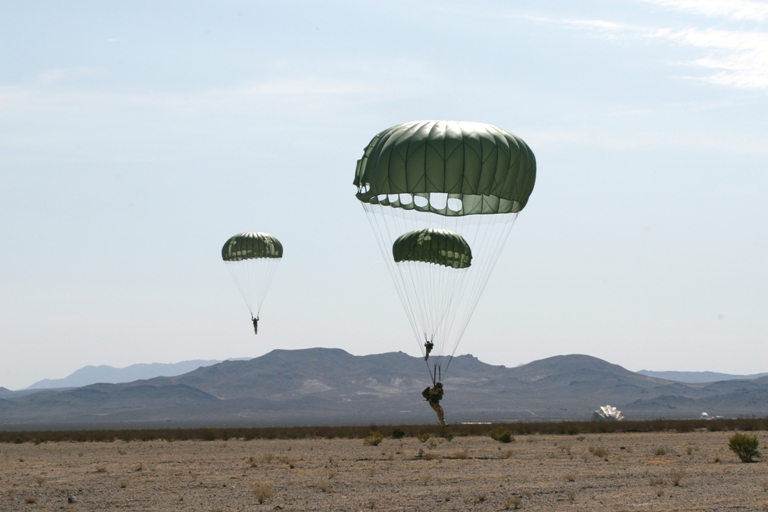
Members of the British Royal Air Force complete a parachute exercise at Echo Range during the Empire Challenge exercise at China Lake in July.