
Engineers' Science Program Big Splash With Kids
HANCOCK CUTLINE
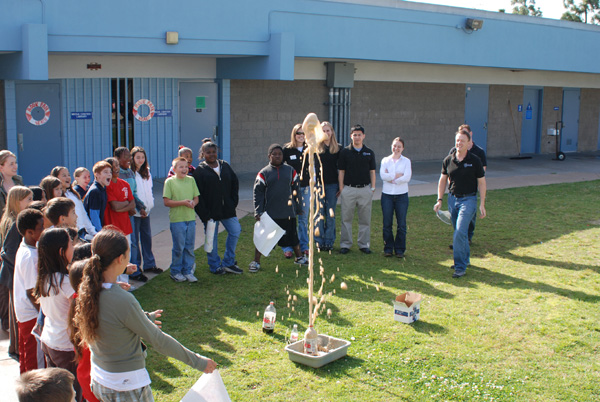
Science Enrichment Program team leader Paul Johnson (far right) watches the explosive combination of Mentos and Diet Coke with his staff and the students. Joe Feliciano
ENGINEERS’ SCIENCE PROGRAM BIG SPLASH WITH KIDS
By Jim Markle
For a select group of children from Hancock Elementary School in Tierrasanta, the excitement of a recent visit by the Navy engineers and interns from Fleet Readiness Center Southwest (FRCSW) was well worth the morning walk from their classroom to the school’s auditorium.
As part of the Navy’s Partners in Education program, FRCSW volunteers have been taking groups of the school’s fifth graders on a special field trip into the world of science through its Science Enrichment Program (SEP) for the past 16 years.
“This is my third year at the school showing the kids a little bit about science,” said SEP apprentice structures engineer Laurie Gris. “How could anyone not like doing this?”
This visit’s topic, rocketry, was kicked off by materials engineer Jennifer Hickman who used an overhead projector with visuals to provide an overview of the mechanics of explosions and projectiles. She followed with a brief discussion on the laws of physics and then a demonstration of Isaac Newton’s laws of motion, which brought a round of laughter as two students demonstrated how little force is required to generate motion.
Next, SEP team leader and chemist Paul Johnson took to the stage to introduce the children to the topic of trajectory. After explaining the role gravity plays, he used an analogy of a football field goal kicker who adjusts his approach and angle to kick the ball to achieve the desired height and path to split the uprights.
With the fundamentals of rocketry out of the way, the 22 children divided into five groups to create the tools they would use to gain first-hand knowledge of the principles taught. With help from SEP team members Dennis Tagualo, JoAnna Zanmiller, and Drew Adams, the construction and coloring of large, paper bull’s eye targets and rockets (empty film canisters) began.
“This is radical,” commented Andrew, 11, “We never get to make stuff like this in other classes.”
Targets were paced off and taped to the floor. Next, the rockets were placed in their wooden launch pads and the precise task of estimating trajectory for a bull’s eye followed. Fueled with water and Alka-Seltzer, launching of the first rocket was eagerly counted down “3-2-1”. And so the excitement escalated as the launchings began at will.
“I saw this done in Balboa Park once. But there weren’t any bull’s eyes there to shoot at,” recalled Unica, 11.
After the last rocket landed, the children followed the SEP team to the school courtyard where an explanation of propulsion was followed by a very active demonstration using “Mentos” candy and Diet Coke.
Johnson explained that the rough surface of the Mentos candy has so many minute nooks and crannies that an incredible number of bubbles will form inside of them when the candy is dropped in a bottle of soda. Consequently, the soda’s compressed carbon dioxide gas is released so quickly that the pressure propels it out of the bottle not unlike a geyser. To the great delight of the children, the last two-liter soda reached a height of approximately seven feet.
“Our goal is just to give the kids a taste of the excitement that’s possible with science,” Johnson said. He added the SEP team provides 12 demonstrations per year at Salt Creek Elementary School in Chula Vista and Willow Elementary School in San Ysidro.