Depot machinist saves co-worker's life
By Gary Rice
It could have been a terrible tragedy, possibly resulting in the loss of an employee’s life at the Naval Air Systems Command (NAVAIR) Depot Cherry Point. But a lucky break and the quick reaction of someone who knew what to do saved the day.
“It all happened very quickly,” Machine Shop Supervisor George Bates said. “It was Nov. 4, and I was sitting in my office eating lunch like I normally do. I was eating celery, and when I took the last bite, I just breathed in at the wrong time, and the piece of celery lodged down in my throat. I couldn’t get it free, and I couldn’t breathe in or out. It didn’t take me long to realize I was in serious trouble.”
Bates remembered he had seen Machinist John Sherman sitting in the next office, and unable to call for help, he began pounding on his desktop to get Sherman’s attention. If that failed, he thought he would try to make it to the hallway where someone might see him, but it is unlikely he could have gotten that far.
“I just happened to be in there making a phone call,” Sherman said. “Any other day I would have been sitting out in the shop eating lunch. I heard George coughing, then I heard banging noises. I knew something was going on, so I said ‘gotta go’ and hung up the phone.”
“He didn’t hesitate to come to my assistance,” Bates said. “He got around behind me and started doing the Heimlich maneuver.”
“I saw George leaning forward on his desk, and he was choking,” Sherman said. “I reached around, put my fist in my palm, and pulled up on his diaphragm. I started to worry after the first four tries failed, but the fifth time did the trick, and I was very relieved when he said he was OK.”
“It didn’t come out, it went down,” Bates said. “But either way didn’t matter to me. I’m just glad it dislodged, and I’m especially glad John was there.”
NAVAIR Depot Cherry Point provides maintenance, engineering, and logistics support on a variety of aircraft, engines, and components for all branches of the U.S. armed forces. Employing almost 4,000 people, the depot is the only source of repair within the continental United States for many jet and rotary wing engines. It is the Navy’s center of excellence for rotary wing aircraft, providing engineering and logistics support for all Navy helicopters.
A Chief Boiler Technician in the Naval Reserve, Sherman received training on the Heimlich maneuver on numerous occasions throughout his military career.
“The last time was in 1996,” he said. “I believe they call it the abdominal thrust now.”
“I don’t care what they call it,” Bates said. “I’m living proof it really works. There was nothing I could do, and I was in a bind. I actually saw a tunnel of darkness closing in around me, and I felt like I was going to pass out. I knew I wasn’t long for this world. That office is usually empty during lunchtime, so it was lucky for me John was in the right place at the right time and knew what to do. He saved my life, and I’m extremely grateful to him.”
NAVAIR provides advanced warfare technology through the efforts of a seamless, integrated, worldwide network of aviation technology experts. From professional training to carrier launch, sensor data to precision targeting, aircraft and weapons development to successful deployment, and real-time communication to aircraft recovery, NAVAIR provides dominant combat effects and matchless capabilities to the American warfighter.
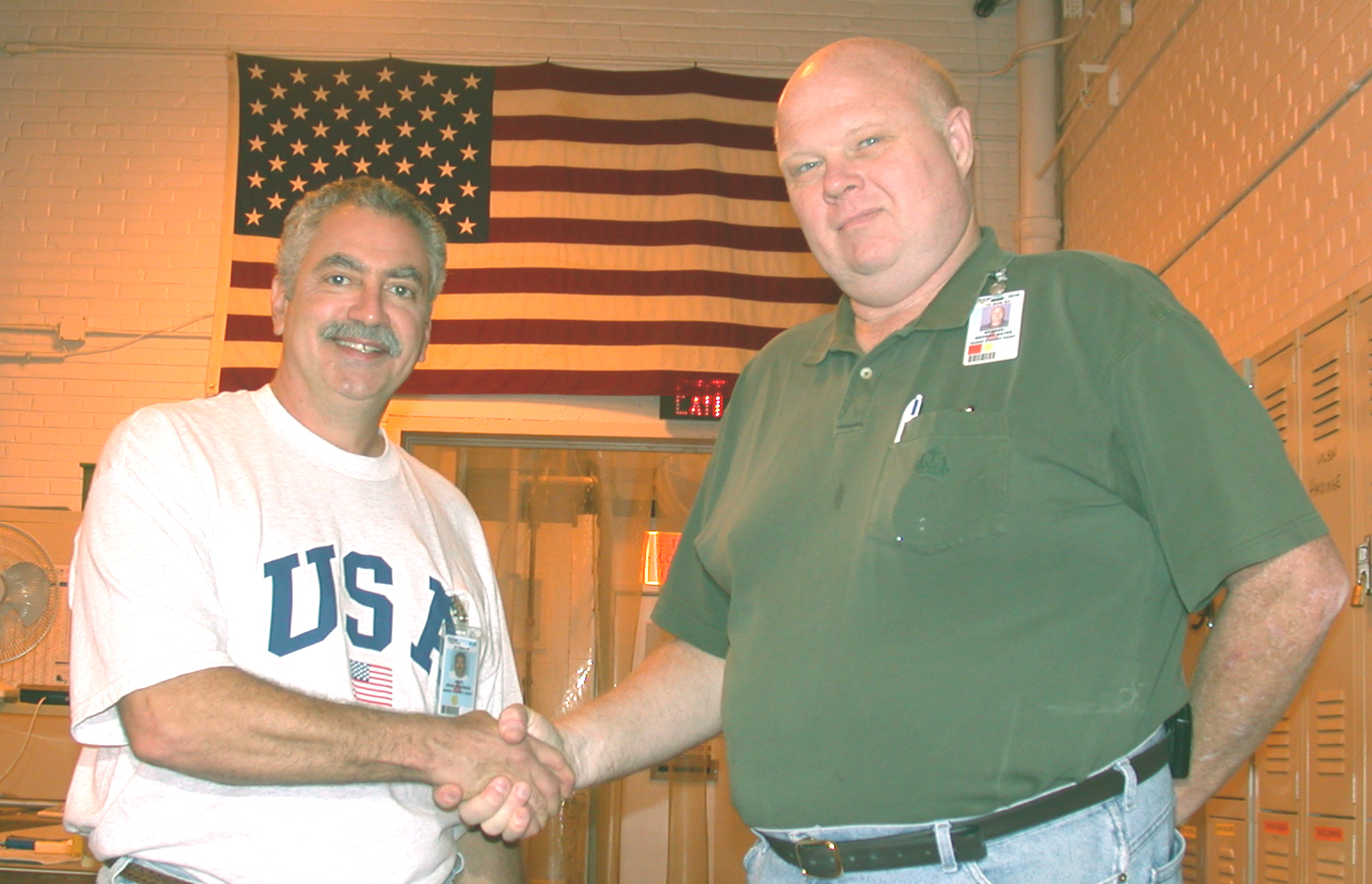
Photo Caption: In the NAVAIR Depot Cherry Point Machine Shop, Machine Shop Supervisor George Bates (right) shakes the hand of Machinist John Sherman, the man he credits with saving his life during a lunchtime choking incident at the depot Nov. 4. (Photo by Gary Rice)