
NAVAIR Pax River lab helps archaeologists
By Joan C. Phillips
NAVAIR Aircraft Division Public Affairs
The Becker Lab, located at the Naval Air Systems Command Patuxent River, MD, features some of the most technically advanced analysis equipment available, operated by skilled scientists and technicians. While the lab’s primary mission is helping NAVAIR provide advanced warfare technologies to the American Warfighter, when the state’s Maryland Archaeological Conservation Lab heard of the lab’s capabilities, they were interested in learning how they could benefit from this Navy resource.
This first contact was the beginning of new and unusual work for the lab under a Commercial Service Agreement between the MAC Lab and the Becker Lab. The project will help archaeologists shed light on the way people lived in early America.
“We will be analyzing 17th century clay pipes to determine where the clay came from,” says Kyle Russell, the NAVAIR Aircraft Division analytical chemist in charge of this project. “These samples will be used to determine if the clay pipes were made in the area where they were found or imported from somewhere else.”
The CSA between the MAC lab and NAVAIR is an instrument that allows industry and other agencies to purchase services from the Navy that are unique and not commercially available elsewhere. Frequently, the service provided is a unique technology or testing capability.
The Navy has statutory authorization to use its facilities to perform specific types of work for private parties. These arrangements benefit both the Navy and industry by maximizing use of Navy facilities, providing unique facilities for use by private parties, and fostering partnerships.
In this case, the partnership between NAVAIR and the state of Maryland is helping write a page of history. “This is definitely a unique venture,” says Russell, “ and while it is a departure from the work we typically do here, the same science applies.”
“This project was precipitated by the discovery of a site called Swan Cove in Anne Arundel County,” says Jane Cox, the Anne Arundel County Planning and Zoning Office assistant archaeologist. “We found these old pipes, and after further investigation, we realized we had found the first archaeological evidence for a pipe kiln in North America.” The find was significant because it was widely thought before the discovery that European Americans imported their pipes from overseas. This discovery proves that they were in fact producing them locally and in this case, on a rather large scale.
Cox explained that a colonial planter named Emanuel Drue owned the property where the pipes were found. He lived there from ca. 1660 until county records show he died in 1669, and he owned pipe-making molds. Russell’s analysis of the clay in the pipes will help archaeologists pinpoint the origin of Drue’s raw clays and will shed light on Drue’s colonial pipe manufacturing.
This information will go a long way in helping archaeologists reach their ultimate goal of better understanding the way people lived and traded in the 17th century. The project is funded by a grant by the state’s Maryland Historical Trust and is part of a larger investigation called the “Lost Towns Project” in Anne Arundel County.
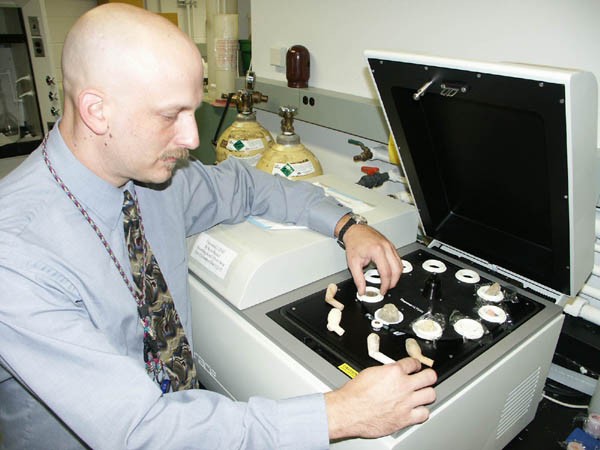
The specific equipment used to determine the composition of the clay pipes is an x-ray fluorescence spectrometer. This device, which shoots a x-ray beam into the material, will be used to examine about 125 clay pipe samples over the next year. Each sample will be examined from three to five times and these results will be among the data reported back to the MAC lab for their interpretation.
Flexibility is one of the hallmarks of the Becker Lab. The Becker’s analytical laboratory, where this work is housed, boasts advanced capabilities such as qualitative identification of unknown organic materials; hydraulic fluid analysis; elemental composition analysis of alloys and other materials; identification of carbon and sulfur in alloys and composites; analysis of total halides; special research development test and evaluation projects; and aircraft incident investigation support.
NAVAIR provides advanced warfare technology through the efforts of a seamless, integrated, worldwide network of aviation technology experts. From professional training to carrier launch; from sensor data to precision targeting; from aircraft and weapons development to successful deployment; from real-time communication to aircraft recovery NAVAIR provides dominant combat effects and matchless capabilities to the American warfighter.
(For more information about this release, call Joan Phillips at 301-757-1789.)
Photo Cutline: Kyle Russell, analytical chemist at NAVAIR’s Patuxent River Becker Lab, examines samples of 17th century pipes. The pipes are displayed on the x-ray fluorescence spectrometer Russell will use to analyze the clay the pipes are made from.
Photo by Joan Phillips