It’s a bird thing on the Bloodsworth Island Range
PATUXENT RIVER NAVAL AIR STATION, MD—Adequate housing for raising a family at Navy facilities has often been a challenge - particularly if you happen to be a family of great blue herons. Thanks to a recent building boom by NAS Patuxent River employees, the herons of remote Bloodsworth Island now have a 440 percent increase in base housing.
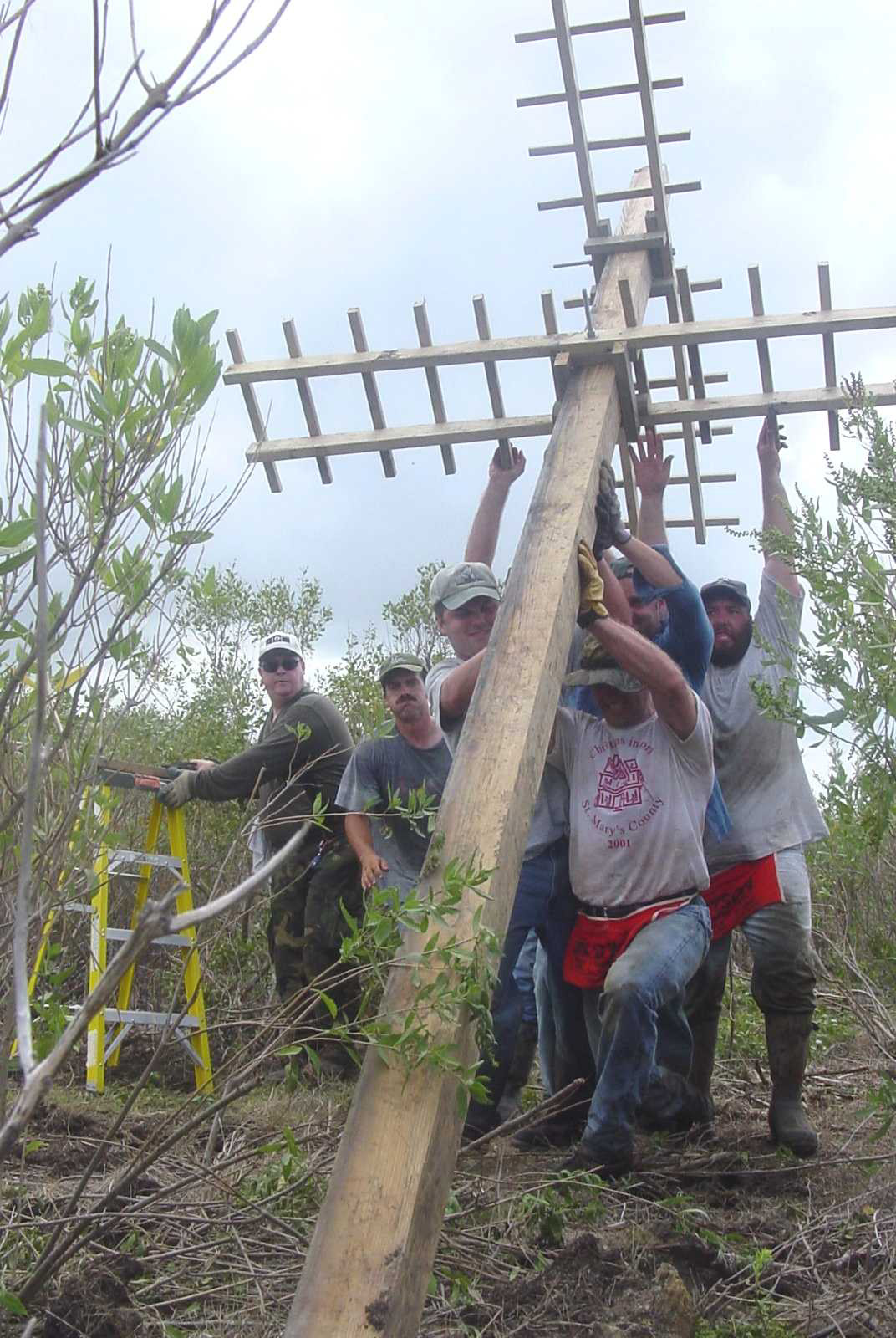
A task force from various departments at Pax River and other military and environmental agencies recently spent four days building and erecting nesting platforms for the great blue herons, which gather on the island each year to nest. The new housing can accommodate up to about 300 heron “families.”
The project location, called the Bloodsworth Island Range, is located in the Chesapeake Bay in Dorchester County, Md. It comprises about 6,000 acres and is surrounded by the isles of Adam, Pone, Northeast and Great Cove. As far back as 1946, the range was used by the Navy as a target for air-to-ground bombing and aircraft strafing by various military installations. However, shore bombardment exercises ceased in the late 1980s and ordnance drops, live and inert, ceased in 1995. Since 1996, the only use of the island has been aircraft radar testing by research, development, test and evaluation flight operations at NAS Patuxent River, which acquired the island in March 2001.
Over the years, the rise in sea level, combined with an increase in soil salinity, has dramatically changed the landscape of the island. Due to the encroaching salt waters, the number of loblolly pines and other trees on the island have been decreasing. For example, Great Cove Island is submerged. This caused a decrease in the number of suitable nesting sites available for the herons. Great blue herons, like many birds, require high nesting sites to protect themselves from opportunistic predators. Herons nest in large colonies called rookeries for protection.
The Navy wanted to ensure these herons would still have a home to flock to. In 1983, with the help of the U.S. Fish and Wildlife Service, Maryland Department of Natural Resources and other environmental organizations, 26 nesting platforms were designed and erected. The platforms were an immediate success.
“Even though they had never been tried before, we expected that great blue herons would use the nesting platforms since there was already an existing rookery on the island and trees were becoming so scarce,” said Kyle Rambo, who manages the conservation division team at NAS Patuxent River. “What surprised us, however, was how fast the birds occupied the structures, and how soon the potential nest sites were fully utilized.”
The Navy took further steps to protect the birds. The northern portion of the Bloodsworth Island Range was designated as a “no fire area” to protect the heron rookery. Historically, the range has also been closed to any type of firing during migratory bird seasons to protect migrating birds and over-wintering waterfowl.
NAS Patuxent River conservation division employees have since returned to the island numerous times to repair platforms and to confirm that the herons were still using nesting sites. Before the recent project to restore the heron rookery, only 17 poles remained on the island. The plan was to erect 49 new platforms, with four nesting sites each, to allow growing room for the rookery. The catch came in transporting the roughly 11,000 pounds of materials from here to the island.
Carl Dyson, a member of NAS Patuxent River’s conservation division, was tasked with this duty. He turned to the Helicopter Mine Countermeasures Squadron 14 at Naval Air Station Norfolk, Va. for help. Using a MH-53E Sea Dragon, the helicopter crew delivered the lumber and a skid steer with hydraulic auger to the island. It took three trips to deliver the supplies.
With the materials and equipment in place, Dyson assembled a team of workers who came from Pax River. The team dug six-foot deep holes to plant each of the 300 pound, 20 foot pre-treated lumber platforms in. The holes were lined with PVC collars to present any collapsing in the wet soil. The Explosive Ordnance Disposal Detachment from Naval Surface Warfare Center Dahlgren, Va., assured the safety of the volunteers when digging the holes and the team stayed the remaining of the week to help finish the project.
The heron project team lifts one of the 300-pound nesting platforms and into its hole on the Bloodsworth Island Range.
Photo by Laura Walko