
NAWCAD vice commander retires
By BRIAN SERAILE
NAS Patuxent River Public Affairs
PATUXENT RIVER NAVAL AIR STATION, MD—Capt. John “JB” Hollyer, the first Navy officer to command a U.S. Air Force flying squadron, retired here Jan. 31 as the Naval Air Warfare Center Aircraft Division vice commander.
Hollyer has accepted an engineering position with Veridian that will allow him to continue flight tests and flight test engineering.
He said he decided in August to retire.
“It is time to transition to a new phase of my life,” he said. “I wanted to take my expertise out where I can utilize it to the fullest.”
Hollyer, 46, became the first Navy officer to command an Air Force flying squadron when he commanded the 35th Flying Training Squadron, 64th Wing, 19th Air Force at Reese Air Force Base and the 8th Flying Training Squadron, 71st Wing, 19th Air Force at Vance Air Force Base, Okla. Both squadrons flew the T-37B twin-engine trainer aircraft built by Cessna. That experience, Hollyer said, was one of the highlights of his career.
“As much as we do things differently in the Navy and the Air Force, the people and the junior officers are as awesome in the Air Force as they are in the Navy,” he said. “It doesn’t matter whether it’s Navy blue, Air Force blue or Marines, it was one of the most interesting experiences I’ve ever had.”
Hollyer said the people he worked with were dedicated and committed.
“That tour taught me that a junior officer is a junior officer,” he said. “They’re full of life, they’re dying to do great things and to do the right things. They work extremely hard and for all the right reasons. I would have been proud to take any one of them anyplace, anywhere in the world at any time.”
Hollyer said being commander of VX-20 was also a career highlight.
“I got to work with incredible people,” he said. “They do it better than anybody else down here.”
Hollyer said his entire experience at Pax River has been enhanced by the people he’s worked with.
“You can’t ask for a more awesome group of people whose job it is to ‘can,’ not to ‘can’t.’ I think they have a tremendous reputation with the fleet.
“I think there are pockets where we can probably do better with our reputation to the fleet and I think they’re trying real hard to do that ... certainly on the flight test side in the environment that I’ve been most familiar with.”
Getting the word out about what goes on at Pax is the first step toward polishing that reputation, he said.
“If you want people to have a reputation for doing awesome things then we go out and tell people what awesome things we did,” he said. “I could brag on people around this base until hell freezes over.”
Hollyer does not mince words when describing his feelings about NAS Pax: “I love this place.”
Others do not mince words when talking about Hollyer.
“He is the epitome of leadership in a military uniform,” said Ken Sola who was a human factors systems engineer at Crew Systems, which supports many of Hollyer’s programs at Force Warfare. “Those who have worked for and with him would have followed him into the jaws of hell.”
When Hollyer was head of air patrol squadrons, he initiated a policy of holding his monthly team meetings in the Flight Deck Lounge, Sola recalls.
“As with everything else this people-oriented leader did during his career, Hollyer hung it out for his folks,” Sola said. “End result? Extraordinarily high morale in his group, largest percentage of attendance ever at the monthly meetings, and a great esprit de corps for his personnel.”
Sola recalled reaction to Hollyer’s remarks at a change-of-command ceremony, when Hollyer became the first Navy commander of the joint Navy-Air Force training command.
“There wasn’t a dry eye in the house when he finished giving all the credit for his position to his wife and every one of his former subordinates, many of whom were at the change-of-command.”
Just prior to Desert Storm, Hollyer led a dedicated team of military and civilian crew in an intense and unbelievably fast “inerting” of P-3 fuel tanks, knowing the P-3s would soon be going into harm’s way in that engagement, Sola said.
“Hollyer has always been a can-do guy with the leadership skills and personal credibility to get everyone under his command and even near him to volunteer to work with him,” Sola said. “We loved him. We will always love him.”
Hollyer was designated a Naval aviator in the spring of 1980. He qualified as a P-3 plane commander, mission commander, instructor pilot, and post-maintenance functional check pilot with VP-10.
In 1985, he was selected for the United States Naval Test Pilot School and graduated with Class 90. Afterward, he reported to the Force Warfare Aircraft Test Directorate as the P-3 survivability projects officer.
After graduation from the United States Naval Postgraduate School in 1990, he reported to the Golden Eagles of VP-9, at NAS Moffett Field, Calif., as the maintenance officer. He deployed to NAS Adak, Alaska, and was the officer-in-charge of several counter-drug detachments to the Republic of Panama and Mexico.
Hollyer returned to Force in 1992, where he participated in the first operational deployment of the AGM-65 Maverick missiles on the P-3. In 1994, he began commanding the Air Force flying squadron.
Hollyer was then assigned to NAVAIR as the P-3 assistant program manager for Systems Engineering (Class Desk) responsible for all engineering for the P-3 aircraft from October 1996 through March 1998. In April of 1998, he reported to the Naval Force Aircraft Test Squadron as the chief test pilot, commanding the squadron from December 1998 through November 2000.
After a brief tour as director of operations for Program Executive Office, Air ASW, Assault, and Special Mission Programs (PEO(A)), Hollyer became the vice commander, NAWCAD March 1, 2001.
He has more than 4,500 hours in nearly 50 fixed wing and rotary wing aircraft. Awards include the Legion of Merit, Meritorious Service Medal (three awards), the Navy Commendation Medal, the Navy Achievement Medal, the Armed Forces Expeditionary Medal, the Navy Meritorious Unit Commendation, the Air Force Outstanding Unit Commendation, and various other personal and unit service awards.
-USN-
Photo by Brian Seraile
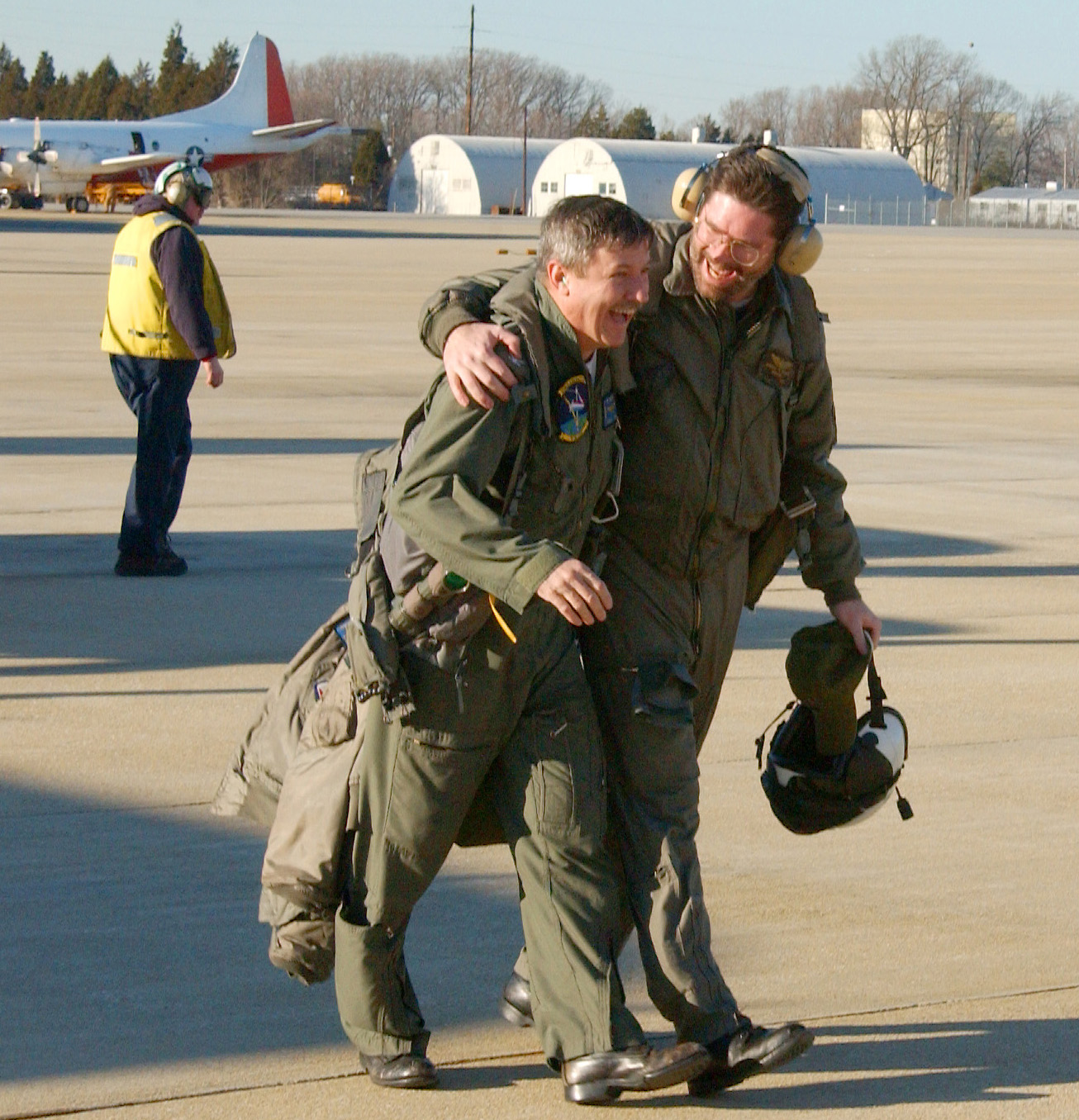
Capt. John Hollyer returns from his final flight as a Sailor on a P-3 Monday. The traditional ‘wetting down’ did not occur as wind chills dipped into the 20s.