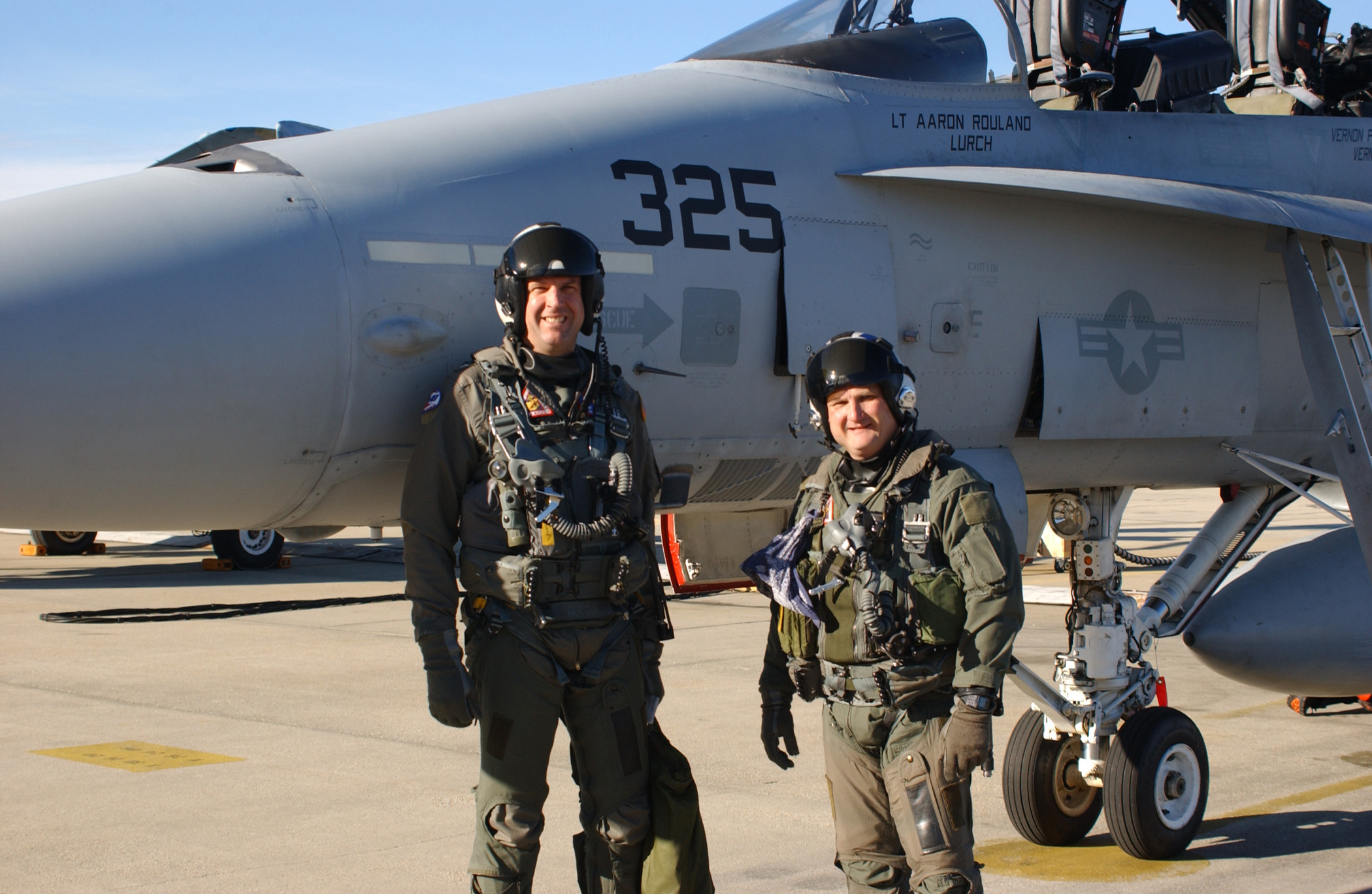
Randy Hepp (pictured right) and Capt. Jim Galanie, NAVAIR Patuxent River, complete Hepp’s 1000 flight hour in an F/A-18. (U.S. Navy photo)
Photographer Reaches 1000 F/A-18 Flight Hours
Naval Air Systems Command, Patuxent River, MD -- It took 22 years, two months, and two days, but it was well worth it for Navy photographer Randy Hepp who reached 1000 flight hours, January 13, in an F/A-18 aircraft. Hepp reached the milestone as he was photo chasing another F/A-18 at NAVAIR Patuxent River, MD.
“It was a great moment,” said Hepp; “I got my patch in the back seat of an F/A-18B with Capt. Jim Galanie in the driver’s seat. I have a total of 4,359 flights in 32 different aircraft, and have come close to 1,000 hours in several of them, so I never thought I would reach 1000 in the Hornet.”
Hepp started flying in the army, and in 1979, after leaving the army; he flew as a photographer for McDonnell Douglas. He started working on the F/A-18 program in 1980 after being transferred to Pax River.
“I got my first flight in an F/A-18 in November 11, 1981 with Mike Tkach, a McDonnell Douglas Pilot. It was a “B” model Hornet, which in those days was called a “T” model."
Hepp is proud of the years he has spent with the F/A-18 program both with McDonnell Douglas and as a navy civilian. “I have quite a few ‘firsts’ with the F/A-18,” he said. “I saw the first F/A-18 fly, back in November of 1978 in St. Louis. I took a photograph from the ground. I was also the first person to land on a carrier in a two-seat F/A-18. They needed a qualified flight crew person to ride in the back seat. It was a safety issue. I was qualified so they put me back there”
These days I like to call my job engineering documentation,” said Hepp, who averages about ten F/A-18 flights per month. “With the newer electronic and digital world we’re working in these days, I actually do data collection. Years ago when we worked with just film, data was too hard to convert and analyze because of all the special equipment you had to have. But in the last five years, I have more power in the laptop computer than I’ve ever had. What makes my job different is that I have to capture and collect data at, and in, a certain amount of time. It’s like a sports event with a touchdown, except that I need to collect data before, during, and after the event.”
Hepp uses digital video cameras for some particular jobs, such as weapons captive carriage shot flights, but admits to doing most of his chase shots with an old style action master camera, which takes 200 frames per second with high speed film. Trying to meet the Public Affairs (PAO) need and the documentation requirements, Hepp shoots with three cameras at the same time. He uses high-speed film for documentation, digital video for the PAO and a quick view of how the test went, and a 120 format still camera for the “hang on the wall” photos.
“The camera is portable enough to do the job, he said. “I usually take about five rolls of film. I use all footage I shoot, sometimes taking out frames for individual PAO use.”
During a photo chase Hepp usually records dynamic maneuvering, weapons jettisons, and tests that only a camera can record. His 1000-hour mission was prompted by a request from the Boeing Company. “The shots from the flight were primary to photograph this load out, which was a pretty healthy load,” he said.
When it comes to getting into position for the right shot, Hepp’s years of photo shooting Hornets pays dividends. “You can’t waste time and gas positioning for light when you’re up there, so there’s only a couple of moments when you can get the right shot. You anticipate how the pilot will maneuver the airplane and work with him to get into position. As long as the sun isn’t directly in front, you pretty much take what you can get.”
Flying is just a small part of Hepp’s job. For every flight hour it usually takes four hours of preparation time. He attends pre-briefs the same as the pilots and has to de-brief the film, get it processed, transfer any digital data, and take care of the video analysis. When that’s done he cleans and prepares the equipment for the next shoot.
Hepp expects to continue flying in an F/A-18 for many years to come. “It’s a fun job. I get paid to go on a multi million-dollar roller coaster ride. It’s just unbelievable to finally get that 1,000 flight hour patch,” he said.
NAVAIR provides advanced warfare technology through the efforts of a seamless, integrated, worldwide network of aviation technology experts. From professional training to carrier launch; from sensor data to precision targeting; from aircraft and weapons development to successful deployment; from real-time communication to aircraft recovery NAVAIR provides dominant combat effects and matchless capabilities to the American warfighter.