
Employee's federal career spans six decades
By Gary Rice
Not many people worked for the government as long as he did. When he started, FDR was president, and the world was at war. With almost 55 years of federal service, Frank Romano enjoyed a career that covered a lot of history.
Until he retired recently, Romano worked in the Rotary Blade Shop at the Naval Air Systems Command (NAVAIR) Depot Cherry Point. In his job as an Aircraft Mechanical Parts Repairer, he was involved in all aspects of the H-53 and H-3 rotor blade overhaul process. He was last assigned to the Bonding Room but was qualified to work in all areas of the shop.
“I obviously enjoyed my job,” Romano said, “because I was there a long time. I liked the work and the people I worked with.”
NAVAIR Depot Cherry Point provides maintenance, engineering, and logistics support on a variety of aircraft, engines, and components for all branches of the U.S. armed forces. Employing almost 4,000 people, the depot is the only source of repair within the continental United States for many jet and rotary wing engines. It is the Navy’s center of excellence for rotary wing aircraft, providing engineering and logistics support for all Navy helicopters.
Romano first went to work for Uncle Sam in December 1942, when he joined the Marine Corps shortly after high school. He says joining the Corps was the fulfillment of a childhood dream.
“I always had my heart set on becoming a Marine,” he said. “I loved reading about the history of the Marines, and I knew that’s what I wanted to be.”
A native of Jersey City, N.J., Romano enlisted when he was only 17 and had a hard time getting his parents to sign the consent papers.
“There was a war on, and they weren’t thrilled with the idea,” Romano said. “But I convinced them it was the right thing to do, and off I went.”
After completing boot camp at Paris Island, Romano was assigned to the 4th Marine Division. In the Pacific, he served as a member of a machine gun squad during the island hopping campaign against Japan. He fought in a number of battles in the Pacific, including Iwo Jima.
“Iwo is the one I remember best,” he said. “It was a frightening experience, and like everybody else, I stayed scared most of the time. But we had a job to do, and we went and did it.”
Romano hit the beach and fought his way across Iwo Jima with his division. As a machine gunner operating with a rifle platoon, he was in the thick of the fighting. Near the end of the battle, he was wounded by a blast of shrapnel from an exploding artillery shell.
“It blew my helmet right off,” he said, “and I took some shrapnel in the head.”
As a result of his injury, Romano was evacuated to a field hospital behind the lines and was later flown to the Naval Hospital in Hawaii for treatment. He was awarded the Purple Heart and soon returned to his unit.
After the war, Romano stayed in the Corps and served as a machine gunner with the 1st Marine Division in the Korean and Vietnam wars. He says there was a big difference in the way those wars were fought compared to what he had experienced in World War II.
“In the Pacific, the campaigns were well defined,” he explained. “Every action had a clear beginning and end. We advanced, pushed the enemy back, and occupied territory. In Korea and Vietnam, you just kept fighting without really going anywhere and never knew if it was going to end.”
Although he got through the latter two wars unscathed, Romano had one close call in a minefield that caused him to reflect on the frailty of human life.
“My platoon leader stepped on a Bouncin’ Betty,” he said. “I was walking right behind him when he tripped the wire. I saw the mine pop up and hit him, but it was a dud, it didn’t explode. If it had exploded, I wouldn’t be here today.”
Romano retired from the Marines as a sergeant major in May 1973. He was in Kansas at the time, but after a few years in the Midwest, he came to live in Havelock.
“I had done a tour of duty with the air wing aboard Cherry Point,” he said, “so I owned a home here, and this is where my family was when I was in Vietnam. Cherry Point was my only tour with Marine aviation, but I always had a lot of admiration for the guys who provided close air support to the infantry.”
Romano started working at the depot in August 1976. He had to leave a few months later due to a hearing problem, but in January 1979, he came back to stay. He says that when his retirement date drew near, he was a bit apprehensive about leaving federal service.
“I always try to do the best job I can,” he said, “and I enjoyed every bit of my military and civil service. I derived a tremendous amount of joy out of being a Marine, and if I had it all to do over again, I wouldn’t change a thing.”
NAVAIR provides advanced warfare technology through the efforts of a seamless, integrated, worldwide network of aviation technology experts. From professional training to carrier launch, sensor data to precision targeting, aircraft and weapons development to successful deployment, and real-time communication to aircraft recovery, NAVAIR provides dominant combat effects and matchless capabilities to the American warfighter.
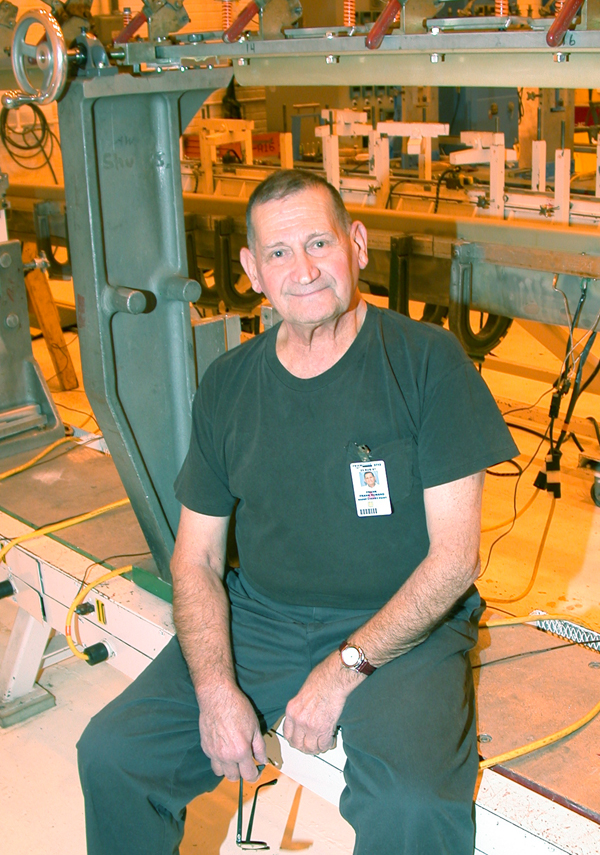
Photo: In the Rotary Blade Shop Bonding Room at the NAVAIR Depot Cherry Point, Aircraft Mechanical Parts Repairer Frank Romano sits at an H-53D Pocket Bonding Fixture. (Photo by Gary Rice)