
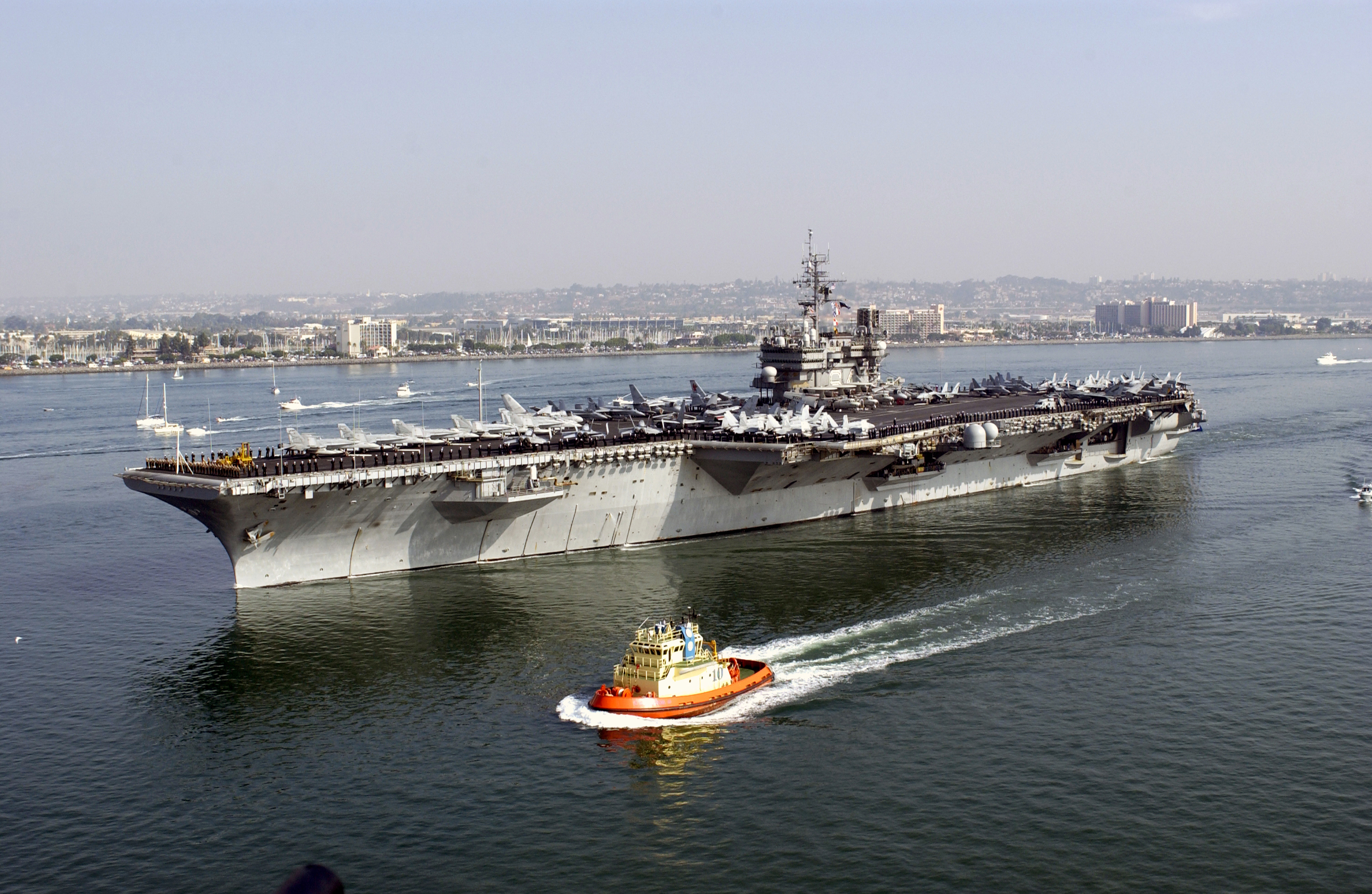
San Diego, Calif., (Nov. 2, 2002) -- USS Constellation (CV 64) departs Naval Air Station North Island at the start of a regularly scheduled six-month deployment in support of Operation Enduring Freedom. Constellation carries aircraft assigned to Carrier Air Wing Two (CVW-2). (U.S. Navy photo)
NAVAIR provides quality training for Navy Sailors and Marines
Getting 5000 sailors and Marines ready for a carrier deployment is a huge undertaking – one just recently completed by the crew and ship’s company of the USS Constellation (CV-64).
As the Constellation pulled away from its moorings last month for a two-week Composite Unit Training Exercise (COMPTUEX) prior to its final deployment, the ship was missing a group of approximately 20 individuals who normally were present on training exercises.
Those 20 people are technical representatives within the Naval Air Technical Data and Engineering Services Command (NATEC). They, and 485 other “tech reps” within NATEC, are responsible for the aircraft and Support Equipment (SE) training and emergency repair requirements on all Navy and Marine aircraft, including F/A-18s, F-14s, EA-6s, E-2s and C-2s. They are also responsible for the SE training of all Aircraft Intermediate Maintenance Department (AIMD) personnel.
Much of that training previously occurred during the two-week COMPTUEX.
“We took a proactive approach this time,” explained Don Genesse, the Tactical Air division head at NATEC and originator of the new Carrier Readiness Training program. “Instead of sending our guys out with the ship to train sailors at sea, we offered the training during the 90 days prior to COMPTUEX.”
NATEC is part of the Naval Air Systems Command (NAVAIR), a leader in providing advanced warfare technology to the American warfighter. Genesse sees the Carrier Readiness Training program as an efficient and effective way to re-enforce NAVAIR’s commitment to provide the best guidance, advice and support sailors need regarding Naval aviation technology.
“Not only are we able to save money by cutting the amount of overtime and travel these trainings take,” said Genesse, “but we’re also improving the quality of work-life for our tech reps and allowing them to be available for emergency situations.”
Sailors within the AIMD provide intermediate level maintenance support for embarked aircraft, including maintenance beyond the normal level of routine maintenance performed by the flight squadrons themselves. Many AIMD personnel are new to the Navy and need specific training to make them combat ready. The new training program ensures each individual is equipped with the knowledge and ability to successfully perform his or her job.
According to Genesse, the Constellation was the test ship for the Carrier Readiness Training prototype. Was it successful?
“Ninety-five percent of scheduled training was completed prior to COMPTUEX,” said Genesse. “Normally we take 20 tech reps out to sea for the exercise to train sailors. There were none aboard this time when the Constellation left.”
The training program’s success is dependent on finding an accurate assessment of each sailor’s training level. This assessment is made as a joint decision between the shop supervisor or chief, the division officer and the individual sailor. Department strengths and weaknesses are used to adjust the training programs to meet crew needs.
“We’re not going to waste anyone’s time or funds with unnecessary training,” said Genesse. “We’re committed to giving those sailors the training they need to provide absolute combat power.”
“Our priority (of training sailors) hasn’t changed,” Genesse explained. Members of his team are frequently called to ships at sea to assist in emergency situations. “But we’re continuing to change our methods to be as effective and cost-efficient as possible.”
A lot of data has been collected from this first test of the Carrier Readiness Training program. According to Genesse, “lessons learned” will be analyzed and necessary adjustments made prior to instructing sailors on the USS Nimitz (CVN-68) – the next group to be trained.
“I’m a firm believer that if you have adequate training, you won’t need assistance,” he said. “If we do a good job before the ship leaves, then we won’t need to go later.”
NAVAIR provides advanced warfare technology through the efforts of a seamless, integrated, worldwide network of aviation technology experts. From professional training to carrier launch and recovery; from sensor data to precision targeting and real-time communications; from aircraft and weapons development to successful deployment and sustainment; NAVAIR provides dominant combat effects and matchless capabilities to the American warfighter.
For more information about the Naval Air Systems Command, go to www.navair.navy.mil.