
Naval aviation benefits through lessons learned from NAVRIIP process
By NAVAIR Public Affairs
Maintenance and supply officers at Naval Base Norfolk recently shared lessons learned from the latest Naval Aviation Readiness Integrated Improvement Program (NAVRIIP) five-week mapping and barrier removal process for the E-2 aircraft.
“It’s a common sense approach to doing business,” said Lt. Cmdr Dave Spencer, assistant maintenance officer, Airborne Early Warning Wing, U.S. Atlantic Fleet (CAEWWL). “Our day job is to always support the fleet and solve issues with maintenance, supplies and readiness, and NAVRIIP helps to formalize our process for solving non-deployed readiness issues,” Spencer continued.
“It’s a very easy process that just is a matter of getting a variety of personnel in one room to walk through the process to identify where problems arise,” said Lt. Josh Height, Aviation Support Detachment Officer, Regional Supply Office Norfolk. “Before, we had a method to improve our processes, but not one that got everyone together in the same room to discuss issues experienced by different departments.”
During the recent out-brief in Norfolk, attended by flag officers making up the Naval Aviation Readiness Improvement Team (NAVRIT), in mid-October 2002, Capt. Brian Roby, commodore of Airborne Early Warning Wing, U.S. Atlantic Fleet, detailed the top degraders to aircraft readiness and highlighted three specific systems for the E-2c currently being worked by the Norfolk NAVRIIP team. The systems identified were the enhanced main display unit (EMDU), elevator load feel bungee and multi-function control and display unit (MFCDU).
After system identification, barrier removal teams (BRT) address and resolve readiness barriers within a limited time frame as identified for specific aircraft systems. Members of the BRT, along with each team leader, identified many positive outcomes from the formalized process of system identification and the barrier mapping and removal process.
“Before the NAVRIIP team and the Thomas Group begin barrier identification and the mapping process, it was beneficial to us to look at our current readiness issues,” said Spencer, BRT leader for the multi-function control and display unit. “By knowing what our non-deployed readiness issues are before the team begins the mapping and barrier identification process, you are already prepared to begin using the tools and the processes they provide. You can run with it to improve and resolve the readiness issues more efficiently. “
In the case of the elevator load feel bungee system, aviation structural mechanic Chief (AW) Eddie Sanders, AIMD Production Control Division chief petty officer, resolved the barrier locally by mapping the barrier removal process before the NAVRIIP team reached his division. Sanders realized the problem with the bungee system stemmed from a retaining washer being installed backward and the spring length being too short. By identifying the issues before the BRT arrived, Sanders was able to resolve the issue more quickly, which will enable an increased non-deployed readiness rate for the E-2C.
Spencer also expressed how the NAVRIIP process works to eliminate temporary work around solutions. “We must be willing to accept that a process or remedy we put in place previously to fix a barrier was only a temporary work around solution. When the BOG team begins to map the process to find the barriers to readiness, you work to completely fix the work around and resolve the problem entirely to keep it from resurfacing later on.”
Team leaders addressed how effectively the process works and how each will sustain the process locally.
“We will continue on with the process as barriers arise,” said Lt. Don Heffentrager, avionics division officer, AIMD Norfolk, and BRT leader for the enhanced main display unit (EMDU). “We will take and apply the mapping process for each barrier found in the future, and BRTs will be formed. We will go from there and utilize the formal mapping process.”
“We are going to continue the process,” said Spencer. “When the Boots on the Ground (BOG) team and the triad, consisting of the wing commodore, wing maintenance officer and station supply officer, identify the barriers we should look at, then we’ll start to go after it. It would be very foolish not to use the process and foolish not to re-look issues locally in the future using the process as barriers are identified. Characteristically, issues come back around every three or four years. Now, we have the process we’ve been working toward all along.”
“The NAVRIIP approach emphasizes proactive actions in finding barriers in advance and looking for process improvements at every level,” said Heffentrager. “It gives you the tools needed for success to improve non-deployed readiness.”
NAVRIIP was created to improve naval aviation readiness in the inter-deployment training cycle (IDTC). NAVRIIP is a uniquely designed process that addresses the root causes of barriers to meeting non-deployed readiness with a goal to sustain long-term aviation goals in support of the fleet and warfighter. Readiness issues such as training, maintenance and supply are addressed in a coordinated systematic manner that makes best use of available resources. One of the most critical parts of NAVRIIP is the five-to-six week visit by the BOG team. The BOG team visits bases to facilitate interaction with the fleet maintaining and supporting the aircraft, weapons and equipment. During this period, the top detriments to readiness are identified, processes that support readiness are mapped out and barriers are identified. To conclude the visit, the senior NAVRIT officers are briefed on the results of the BOG.
“By including the walk-around management approach in the process, leaders at every level affected by non-deployed readiness, can visually understand where the specific barriers arise and how to effectively approach the solution,” said Spencer.
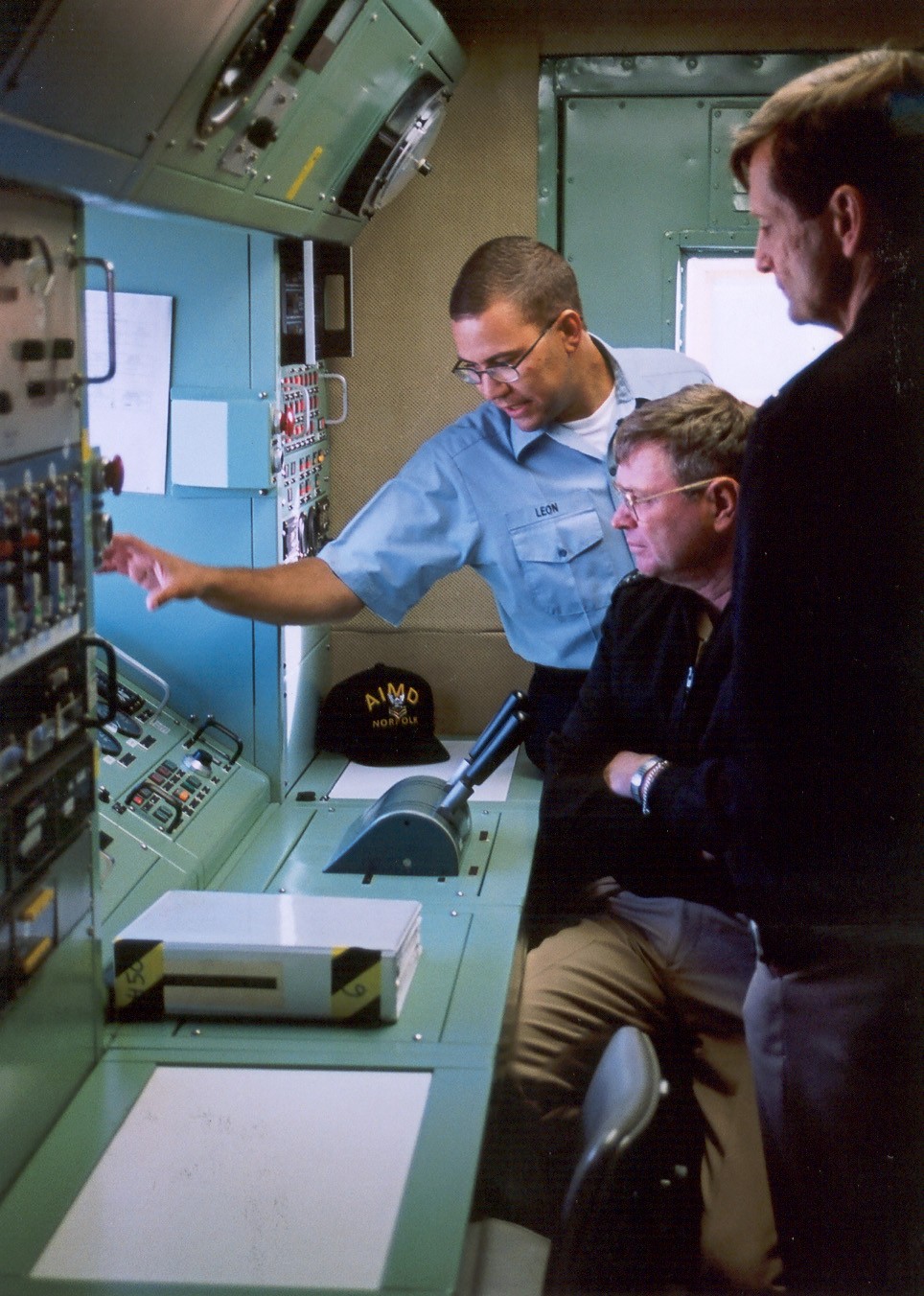
Photo By: Eddie Riley
AD1 Carlos Leon explains how the test cell cap is used in testing aviation equipment and parts to Rear Adm. Wally Massenburg, NAVRIIP chief operating officer and assistant commander for Logistics at Naval Air Systems Command (NAVAIR), and Read Adm. Mark Harnitchek, Naval Inventory Control Point commander.