
Safety gear saves employee's life
By Gary Rice
We have all heard about how important it is to wear the proper safety gear. Whether at home or on the job, articles of protective clothing and equipment are designed to keep us safe from injury or death. For those who ride motorcycles, helmets and protective clothing are particularly important. And Earl West is living proof that they really work!
West, a sandblaster in the Small Parts Blasting Shop at the Naval Air Systems Command (NAVAIR) Depot Cherry Point, was on his way home from a trip to the Gettysburg battlefield. He was riding on Interstate 95 when the first sign of trouble appeared.
“Two SUVs came racing up behind me,” West said. “They were having some sort of problem between them, and I didn’t want any part of it, so I pulled off the highway onto the shoulder to get out of their way. With people driving like that, I decided to get off 95 and travel on roads I thought would be safer. Little did I know!”
West exited the interstate and turned onto Route 117. He had gone only a short distance, traveling at about 50 mph, when disaster struck. A pickup truck pulling a large trailer suddenly pulled out of a field right in front of him. West hit the brakes, but with no place to go and no time to react, he crashed into the pickup.
“My head came down on the back of the truck and hit right at the front of my helmet,” West said. “The bike went down, and I went skidding about 80 feet on my back across the gravel and asphalt.”
The impact of the crash broke West’s femur and caused other internal injuries, but he didn’t suffer a head injury or any cuts or scratches on his body because he was wearing protective clothing. Even his hands were not injured due to his gloves. Fortunately, the driver in a car behind him witnessed the accident and used a cell phone to call 911. An ambulance arrived in about 10 minutes.
West was taken to a hospital in Clinton, where doctors x-rayed his leg and gave him morphine to dull the pain. He was then taken in an ambulance to Duke Medical Center. In the ambulance, he lost consciousness and remained in a coma for three weeks.
“I was hurt pretty bad,” West said, “but I’m lucky to be alive. If I hadn’t been wearing my helmet and protective clothing, I’d be dead. That’s what saved me.”
West now has a plate in his leg and says his recovery was a real ordeal. He was out of work for almost three months.
“People just don’t see motorcycles,” he said. “They’re looking for cars, not bikes. The guy who pulled in front of me swore he never saw me. When I hit him, he said he thought he had a blowout!”
West says he is concerned because he sees so many people dressed in T-shirts and shorts riding motorcycles. Protective clothing may be expensive, but the cost is nothing compared to the possible consequences of not wearing it. West thinks most people just don’t understand the danger.
“Anyone who rides without a full-face helmet and the proper clothing is a fool!” he said. “Some people think safety gear is confining or uncomfortable. That’s fine until something happens, and then they get skinned alive.”
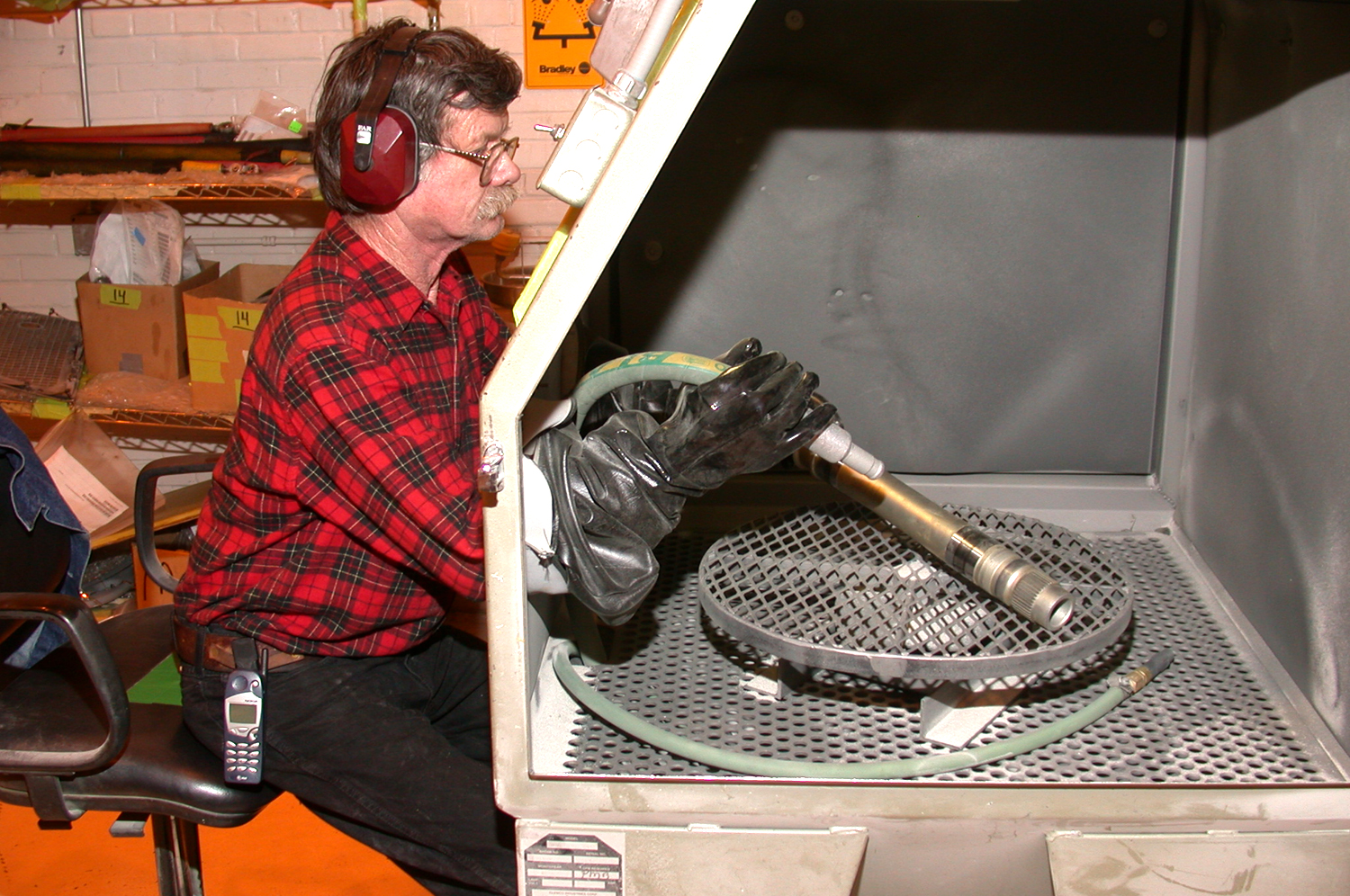
West has been working at the depot as a sandblaster for 22 years and enjoys his job. On second shift, he strips paint and corrosion off of small aircraft parts using environmental friendly processes.
NAVAIR Depot Cherry Point provides maintenance, engineering, and logistics support on a variety of aircraft, engines, and components for all branches of the U.S. armed forces. Employing almost 4,000 people, the depot is the only source of repair within the continental United States for many jet and rotary wing engines. It is the Navy’s center of excellence for rotary wing aircraft, providing engineering and logistics support for all Navy helicopters.
Originally from Wilmington, West’s career prior to the depot presents quite a contrast. He joined the Navy in 1960 and served as a Hospital Corpsman for six years, including two years in Italy. After that, he attended the University of North Carolina at Wilmington and graduated in 1972 with a Bachelor of Arts degree in Biology. He worked as a biologist on the Hudson River in New York for four years and tried a few other things before returning to North Carolina in 1981. He says he hopes to retire later this year and move to Florida.
“I plan to do some fishing and some more touring on the bike,” West said. “I’ve been riding motorcycles on and off all my life, ever since college, and I’ve always been an advocate of safety equipment. The crash has not stopped me from riding, but now I’m more safety conscious than ever!”
Photo: With the door of his blasting cabinet open to show the interior, Sandblaster Earl West demonstrates the procedure he uses to sandblast small aircraft parts in the Small Parts Blasting Shop at the NAVAIR Depot Cherry Point. (Photo by Gary Rice)