ISO audit helps depot improve and excel
By Gary Rice
Audit. It is a word everyone dreads to hear, a word that conjures up frightening images of prying inspectors digging into our personal files and records, uncovering hidden secrets, looking for ways to make us pay. It’s the kind of situation people usually want to avoid.
But the Naval Air Systems Command (NAVAIR) Depot Cherry Point’s recent International Organization for Standards (ISO) audit was no such thing. Its purpose was to determine if the depot should be certified to an upgraded ISO standard. It was designed to help the command improve where improvement is needed, and it recognized the organization’s many business process strong points and successes.
“We don’t want to surprise anyone,” David Dudley, Team Lead Auditor, said. “This is not about finding fault or placing blame. It’s all about making the organization better.”
Dudley and his team of five auditors from ABS Quality Evaluations of Houston, Texas, were on board for their semiannual assessment of the depot’s business practices and procedures. Over the course of five days, they examined documents and records, interviewed workers and supervisors, and evaluated the work performed in shops throughout the depot.
“I always begin with an opening meeting,” Dudley said. “This is a courtesy to the department heads and senior supervisors to let them know what my plans are. The next step is to familiarize myself with the operations in whatever area I’m going to look at. I start with a documentation review to find out what procedures are in place to control the operations, and then I do a walk-around. In an organization as big and complex as the depot, a walk-around is a good orientation to what is actually happening. It gives me an overview of what the business processes in the shops are like.”
NAVAIR Depot Cherry Point provides maintenance, engineering, and logistics support on a variety of aircraft, engines, and components for all branches of the U.S. armed forces. Employing almost 4,000 people, the depot is the only source of repair within the continental United States for many jet and rotary wing engines. It is the Navy’s center of excellence for rotary wing aircraft, providing engineering and logistics support for all Navy helicopters.
The audit was an intensive undertaking, and the five auditors worked long hours to cover a lot of ground in the time allotted.
“Our schedule is usually very flexible,” Dudley said. “I like to audit where the action is, wherever people are working. The primary question I ask is, ‘What do you do?’ What I’m looking for from people is an explanation of how they perform their jobs. I’m also trying to determine how well the command’s quality policy has been disseminated, whether people are aware of what the goals and objectives are. It’s a requirement of the ISO standard that those goals and objectives are communicated all the way through the organization. People need to know how they contribute, so that’s something I look for.”
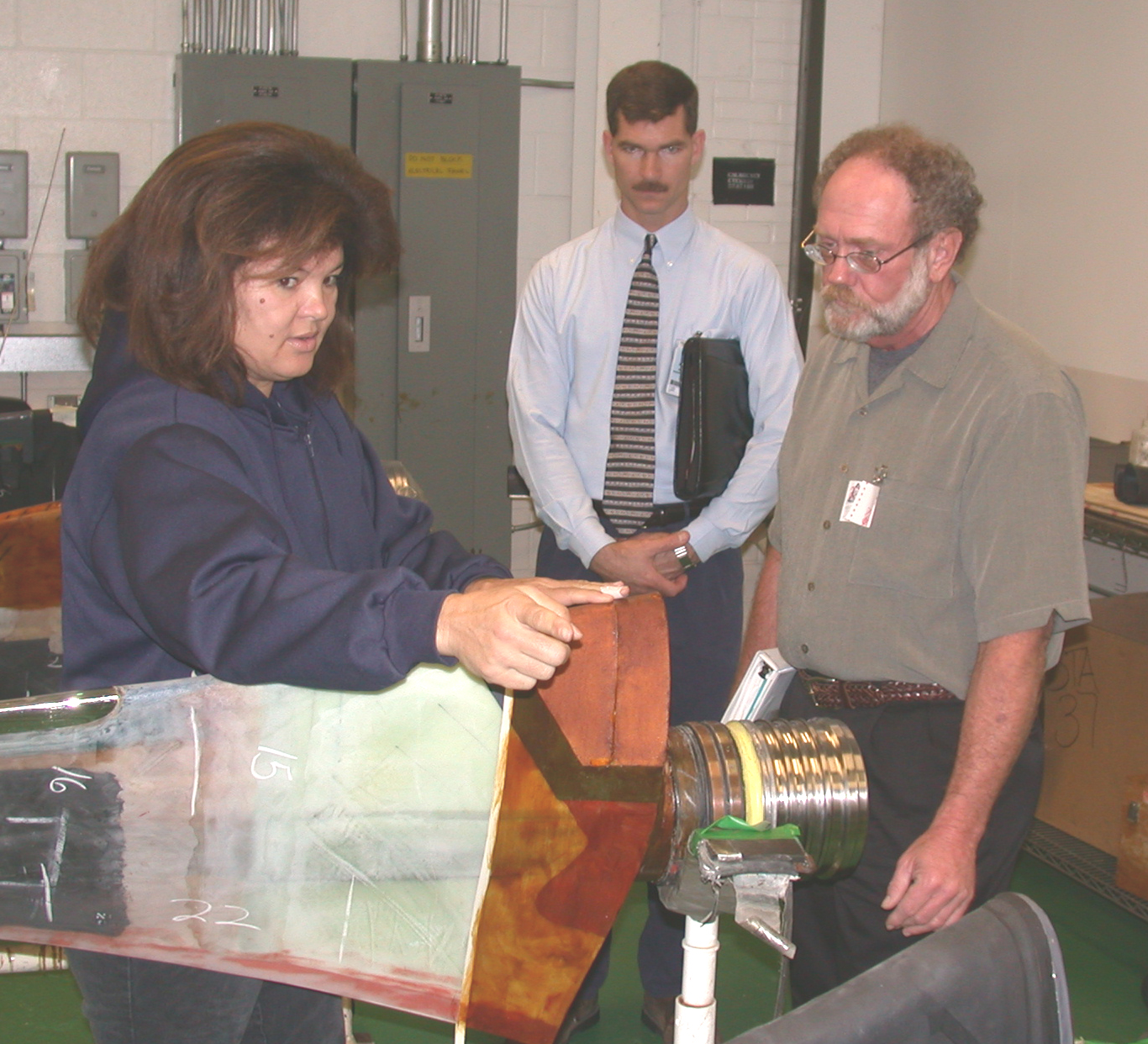
One of the many shops Dudley audited during the week was the Industrial Components Repair and Modification Division’s Propeller Shop in Building 137. He spoke to the shop supervisor, Willis “OJ” Jarman, and evaluated the work of two shop employees, Propeller Worker Becky Oxendine and Propeller Mechanic Al Malone.
“It kind of tenses you up a bit when you know you’re going to be inspected,” Jarman said. “But we knew it was coming, and we were prepared for it.”
“It made me a little nervous at first,” Oxendine added. “I was thinking he might ask a question I wouldn’t be able to answer, but everything went fine. He asked me to explain step-by-step how I do my job. I was confident in my answers and explanations, and he seemed satisfied.”
“When I ask people how they do their jobs, I check to see if there are procedures and work instructions they follow,” Dudley explained, “and I expect them to know where those materials are. I observe them performing their daily tasks and compare what they do to their written directives.”
“He had a few questions about the way we annotate changes in our manuals,” Jarman said, “but we showed him documentation to prove we are authorized to use the books that way, and he was pleased.”
“I’ve been through a whole lot of audits,” Malone said, “and I think they serve a good purpose. They’re intended to help everybody stay on the right page, and they keep everything right. The auditors were not here to hurt us, they were here to help.”
As a result of the assessment, the depot’s certification will be upgraded from the ISO 9001 1994 standard to the ISO 9001 2000 standard. In addition, the scope of the command’s quality system was expanded to include areas that were not included before.
“We will recommend that the depot be ISO 9000 2000 certified,” Dudley said, “and you should get your certificate soon after we resolve a few minor issues. This audit was one heck of a job, and I was really impressed with the things we learned. The people at the depot have positive attitudes, they are progressive thinkers, and they know how to implement successful programs and processes. For the most part, we found that the goals and objectives of this organization are deeply planted at all levels.”
“Everyone was very open and cooperative,” Auditor Susan Van Wingerden said. “There is a great amount of dedication from management on down, and the command’s goals are well defined. We found a few minor discrepancies in a few shops, but everyone worked together to come up with solutions and solve the problems. There is always some room for improvement, and it is clear that everyone here wants their systems to get better. People know what they’re doing and why they’re doing it. I was impressed with the level of commitment I found.”
At the wrap-up meeting, Commanding Officer Col Eugene Conti expressed special appreciation to Dr. Bruce Laviolette, Director of Corporate ISO Programs, for his hard work in coordinating and facilitating the assessment. He also thanked Dudley and his team of auditors for their continued assistance and support. But he offered his deepest gratitude to all the employees of the depot for their superb efforts in making the audit a success.
“This was a tall order and a big challenge,” he said. “You make me proud everyday, because no one in private industry or anywhere else can do what you do everyday. We are leaders in this business, and we will continue to lead. We still have challenges ahead of us, and I am confident we will take the findings of the audit team and continue to move forward.”
NAVAIR provides advanced warfare technology through the efforts of a seamless, integrated, worldwide network of aviation technology experts. From professional training to carrier launch, sensor data to precision targeting, aircraft and weapons development to successful deployment, and real-time communication to aircraft recovery, NAVAIR provides dominant combat effects and matchless capabilities to the American warfighter.
Photo: As ISO 9000 Management Rep Sean Doss (center) observes, Propeller Worker Becky Oxendine explains the steps she follows in performing her job in the depot’s Propeller Shop to ISO Team Lead Auditor David Dudley. Dudley evaluated Oxendine’s work procedures as part of the command assessment his team conducted at the depot recently. (Photo by Gary Rice)