NAVRIIP improves aviation readiness one platform at a time
By NAVAIR Public Affairs
Note to Editors: Please see two sidebars below referencing a description of the NAVRIIP process and the history of the Norfolk triad alignment.
The Naval Aviation Readiness Integrated Improvement Program (NAVRIIP) continues to provide a process for identifying barriers to non-deployed readiness, but the focus has shifted from aviation bases to aircraft type/model/series (T/M/S) to realize results more efficiently and more systematically across naval aviation communities.
“We are solving readiness issues using a formal process,” said Lt. Cmdr. Dave Spencer, assistant maintenance officer, Airborne Early Warning Wing, U.S. Atlantic Fleet (CAEWWL). “We are also sharing the information throughout the aircraft intermediate maintenance department (AIMD) and discussing the items hurting our heads to give the fleet a chance to solve their requirements issues.”
Initially, NAVRIIP was designed to address non-deployed readiness issues site by site, not by T/M/S. Due to restructuring the approach, maintainers are now able to address readiness more efficiently across a specific T/M/S of aircraft by communicating and reporting the findings on barriers to other sites that support the same aircraft. The other sites can then move forward with the barrier removal process before the NAVRIIP team reaches their base. Adjusting the NAVRIIP system-wide process and schedule to locate barriers by T/M/S sequentially, lessons learned are more readily be passed from base to base as the NAVRIIP team visits continue. By facilitating open communication between bases with the same aircraft, maintainers are more enabled to move forward with analyzing other systems with readiness issues when the NAVRIIP team reaches their base. By systematically improving the NAVRIIP process, non-deployed readiness rates can quickly be increased.
“We concentrate on chipping away the barriers locally and realize that the big issues can be escalated when the resources are not locally available,” said Lt. Don Heffentrager, avionics division officer, AIMD Norfolk.
The NAVRIIP BOG leaders visited Naval Base Norfolk for a look at barriers to and quick fixes for E-2C readiness. The Capt. Brian Roby, CAEWWL commodore, presented the leaders a brief that covered developments and implemented logistic solutions for aircraft systems that are responsible for degrading non-deployed aircraft readiness at the wing. This meeting concluded five-week barrier identification and mapping effort by the Norfolk NAVRIIP team and the Thomas Group. Specifically, the BOG team learned about and toured three system wide readiness barriers with the E-2C, the Navy’s airborne early warning aircraft. The flag officers received direct accounts of the problems identified by the fleet within the specific aircraft systems.
The NAVRIIP team decided to concentrate on three degraders at the onset, and sequentially move through the remaining top degraders as a barrier is resolved. The three top degrading systems identified were the enhanced main display unit (EMDU), elevator load feel bungee and multi-function control and display unit (MFCDU), which are each integral for E-2C aircraft readiness.
“You’ll notice we are centric on the E-2 side of the house,” said Roby. “We chose to concentrate on the E-2; we’ll be back next year to discuss other top degraders for other type/model/series.”
Local fleet members resolved many of the initial problems identified. Aviation Structural Mechanic Chief (AW) Eddie Sanders, AIMD Production Control Division chief petty officer, resolved the elevator load feel bungee barrier locally by mapping the barrier removal process before the NAVRIIP program was introduced to his division. Sanders realized the problem with the bungee stemmed from a retaining washer being installed backwards and the spring length being too short. There are 104 bungees with this problem. Sanders developed a solution by breaking down the bungee, fixing the installation and then reassembling.
“One of the great points of the BOG process is that at the local level if the resources are available, the barrier is easily leveraged and resolved,” said Rear Adm. Wally Massenburg, NAVRIIP chief operating officer and assistant commander for Logistics at Naval Air Systems Command (NAVAIR). “It’s when the resources are not available that NAVRIIP really becomes essential. NAVRIIP provides the formal process for identifying the problems.”
The EMDU and MFCDU systems become barriers to readiness due to problems with availability. Both systems have a high turn-around time in regards to availability which impacts the amount of time the E-2C is down between deployments.
“We ranked the degraders based on our work load,” said Cmdr. Stu Jones, regional supply officer, Norfolk. “There were some barriers we could knock out locally and immediately. The BOG team identified some of our dirty laundry and made us aware of the local quick kills.”
After top barriers were chosen for removal, barrier removal teams (BRT) were established to begin the break down process. Removal of local barriers is ongoing at the local triad level. Barriers that are not locally resolved in a timely manner will be escalated to the aircraft program office. At this time, no barriers have been escalated.
As of October 14, 17 local barriers were removed. In the next few months, the local triad anticipates five to six barriers removed, three BRTs formed to work solutions and that five barriers will be escalated to the aircraft program office. Future barriers for removal include 34 that are currently being investigated.
“We have realistic expectations with barrier removal. With three BRTs in work at all times, we know we will have some barriers escalated but we will continue to work the process,” Cmdr. Mike Kelly, Norfolk AIMD officer. “The Thomas Group emphasizes and is honest enough to say that you will have a backlog but that keeping the rhythm going is important. We understand this process takes some time.”
SIDE BARS
The NAVRIIP Process
Naval Aviation Readiness Integrated Improvement Program (NAVRIIP) was created to improve naval aviation readiness in the inter-deployment training cycle (IDTC). NAVRIIP is a uniquely designed process that addresses the root causes of barriers to meeting non-deployed readiness with a goal to sustain long-term aviation goals in support of the fleet and warfighter. Readiness issues such as training, maintenance and supply are addressed in a coordinated systematic manner that makes best use of available resources. One of the most critical parts of NAVRIIP is the five-to-six week visit by the “Boots on the Ground” (BOG) team. The BOG team visits bases to facilitate interaction with the fleet maintaining and supporting the aircraft, weapons and equipment. During this period, the top detriments to readiness are identified, processes that support readiness are mapped out and barriers are identified. To conclude the visit, senior officers from the naval aviation readiness improvement team (NAVRIT) tour facilities, meet the maintainers, and then are briefed on the results of the BOG.
For more information, please contact NAVAIR Public Affairs by calling 301-757-1487, or by visiting the website - www.airpac.navy.mil/navriip.
The Triad Realignment
The Norfolk Naval Aviation Readiness Integrated Improvement Program (NAVRIIP) began in July 2001 when the Norfolk AIMD was directed to realign under CAEWWL by September 2001. The aviation support detachment (ASD) was also directed to realign under CAEWWL by October 2001. The realignment of the two departments under the wing established the Norfolk triad and created alignment between the fleet, which determines the requirements, the program managers that provide the requirements, and the planning and programming organizations, which provides funding if necessary to improve aviation readiness. The triad began to meet three times per week and conducted briefings with the wing commodore each Wednesday. After the September 11 terrorist attack, Operation Noble Eagle provided the triad an opportunity to operationalize weekly efforts in support of extensive shore-based E-2C operations. In October 2001, the triad’s structure and scope was formalized, and in April 2001 expanded to include fleet forecast information for aviation readiness requirements. At this time, the commodore’s first brief focused on a comprehensive list of top degraders that were increasing aircraft IDTC time. In mid -October 2001, the top degraders to readiness for the E-2C, which included supply and availability barriers, were identified. The triad then began system selection in August 2002 and the Thomas Group facilitation for the five-week process mapping and barrier identification session followed in early September 2002.
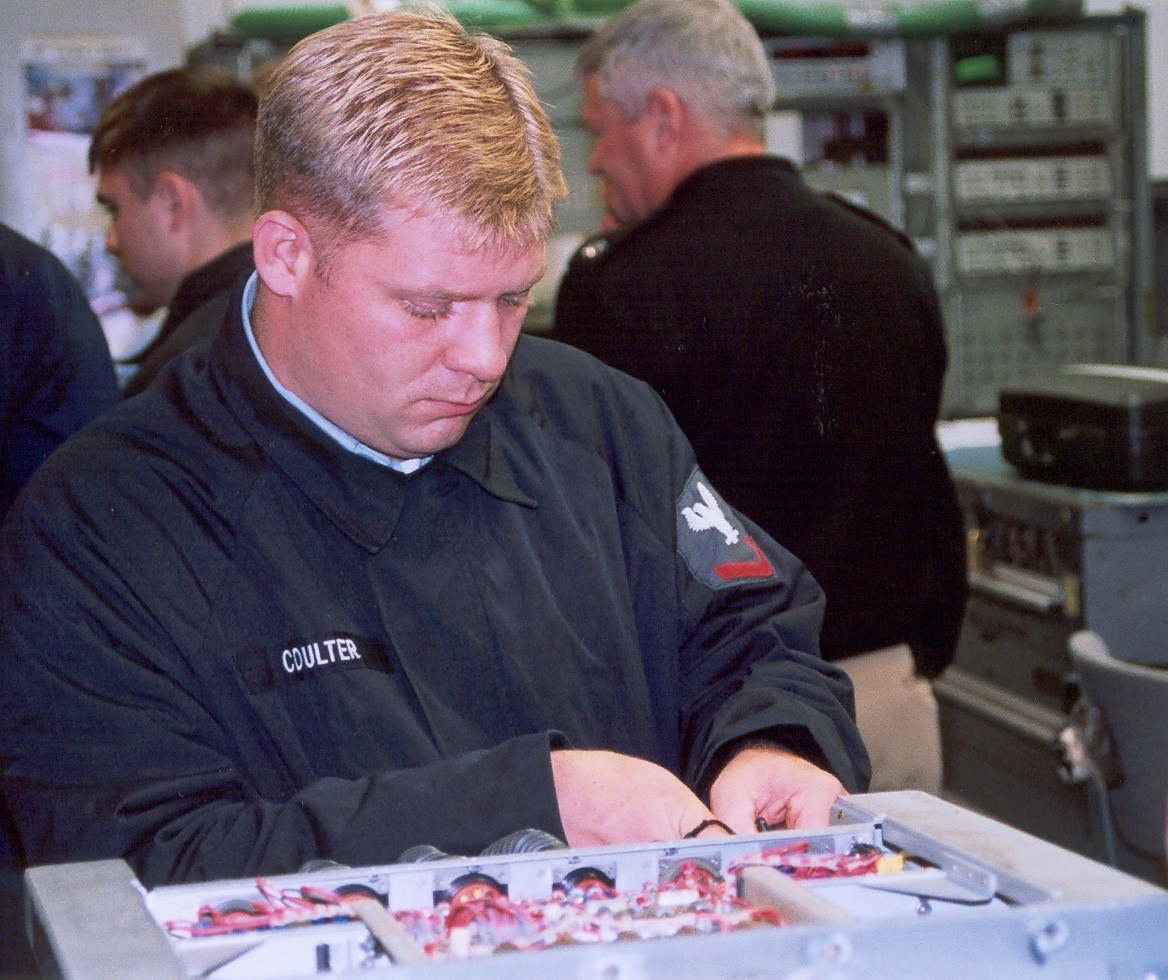
Photo by: Eddie Riley, NAVAIR PAO
AT3 John Coulter, avionics technician, works on the enhanced main display unit for the E-2C during the recent Norfolk NAVRIIP boots on the ground visit.