
After midnight they are still going strong
By Vicky Falcón
NAVAIR Public Affairs
It is almost midnight and Dale Hafer checks the batteries in his flashlight one last time before climbing up to the deck of USS Theodore Roosevelt (CVN-71). The last flights of the night have been recovered, and with all the planes back, Hafer and his team can pull off the deck covers and begin their work in earnest.
Hafer works out of Naval Station Norfolk, Va., as a Carrier and Field Service Unit (CAFSU) representative for the Naval Air Systems Command’s (NAVAIR’s) Fleet Technical Services Division. His mission is to provide on-site technical services for the Aircraft Launch and Recovery Equipment (ALRE) program aboard Theodore Roosevelt and any other aircraft carriers on the east coast. He is a direct link between the ship’s personnel and the engineers who designed the equipment at NAVAIR Lakehurst, N.J.
According to Hafer it is common for CAFSU representatives to work long hours – some by flashlight.
“You work until the job’s done,” said Hafer, who has put in 20-22 hour workdays on a carrier. “We don’t want to obstruct the pilot’s night vision, so we work on deck by flashlight.”
Hafer, who joined CAFSU in 1997, loves his job. He is responsible for anything mechanical on the catapults and arresting gear. Sometimes he troubleshoots a minor problem; sometimes he has to perform a full certification.
Kyle Caldwell, V2 Boatswains Mate on the Theodore Roosevelt routinely seeks Hafer’s assistance to resolve issues involving the ship’s catapults and arresting gear systems.
“While deployed in support of Operation Enduring Freedom, he responded to two casualty report (CASREP) technical assist visits including a launch valve piping steam leak and two major arresting gear restacks, repairs that are normally accomplished pier-side,” said Caldwell. “His aggressive and tireless efforts as a technical expert have set the standards.”
Caldwell describes Hafer as an inspirational team builder and an outstanding role model for peers and subordinates. “He is a true asset to the ALRE community,” Caldwell added.
“When I’m working a job on the ship, whether it be on the catapults or the arresting gear,” Hafer said, “I work on that job with the thought in mind that I might be the next person to be shot off that cat or the one to take the next trap on that wire.”
Because of the nature of his job, Hafer is on-call 24-hours a day.
“To me, there is no better feeling than being called out to the ship on a CASREP,” he said. “When the ship sends out a CASREP for help it means the equipment is down. That makes it my responsibility to fix it and get the ship back to full operating status.”
That dedication and work ethic earned him the respect of Marvin Harris, V2 ALREMO on the USS George Washington (CVN-73), and his crew.
“Prior to our deployment in June we discovered three potential problems with the catapult launching systems,” said Harris. “Dale immediately took charge and assisted in the repairs. Without his help, my crew would not have had the opportunity to spend much-deserved time with their families.”
Being on call can make it difficult for his family, though Hafer’s wife fully supports him in his work.
“I traveled twice to Bahrain for CASREPs on Theodore Roosevelt – once during Christmas of last year and then again a month later,” he said. “That was really hard.”
Hafer’s sacrifices have been rewarded, though, as he recently received the Navy Meritorious Civilian Service award – one of 25 such awards presented to members of his division in the past five years. “Although I take a lot of pride in my work there is no way I could ever do all that I do without the support from my fellow CAFSU reps and the members of the VRT (Voyage Repair Team) . . . everyone is always willing to help,” he said.
There are 100 representatives located at 22 Fleet Technical Services Division offices throughout the continental United States and overseas. Their work ethic and quality of service represents NAVAIR’s commitment to provide the world’s best guidance, counsel, advice and support regarding Naval Aviation technology.
“The men and women we serve have a right to expect us to come to their aid,” said Hafer. “My job is to be the 911 of the warfighter.”
And if that means working all night by flashlight on the dark, cold deck of a carrier, Hafer is more than happy to oblige.
NAVAIR provides advanced warfare technology through the efforts of a seamless, integrated, worldwide network of aviation technology experts. From professional training to carrier launch; from sensor data to precision targeting; from weapons development to successful deployment; from real-time communication to aircraft recovery NAVAIR ensures the American warfighter will . . . Reign Supreme – Return in Glory.
For more information about the Naval Air Systems Command, go to www.navair.navy.mil.
U.S. Navy photo by Dave Womack
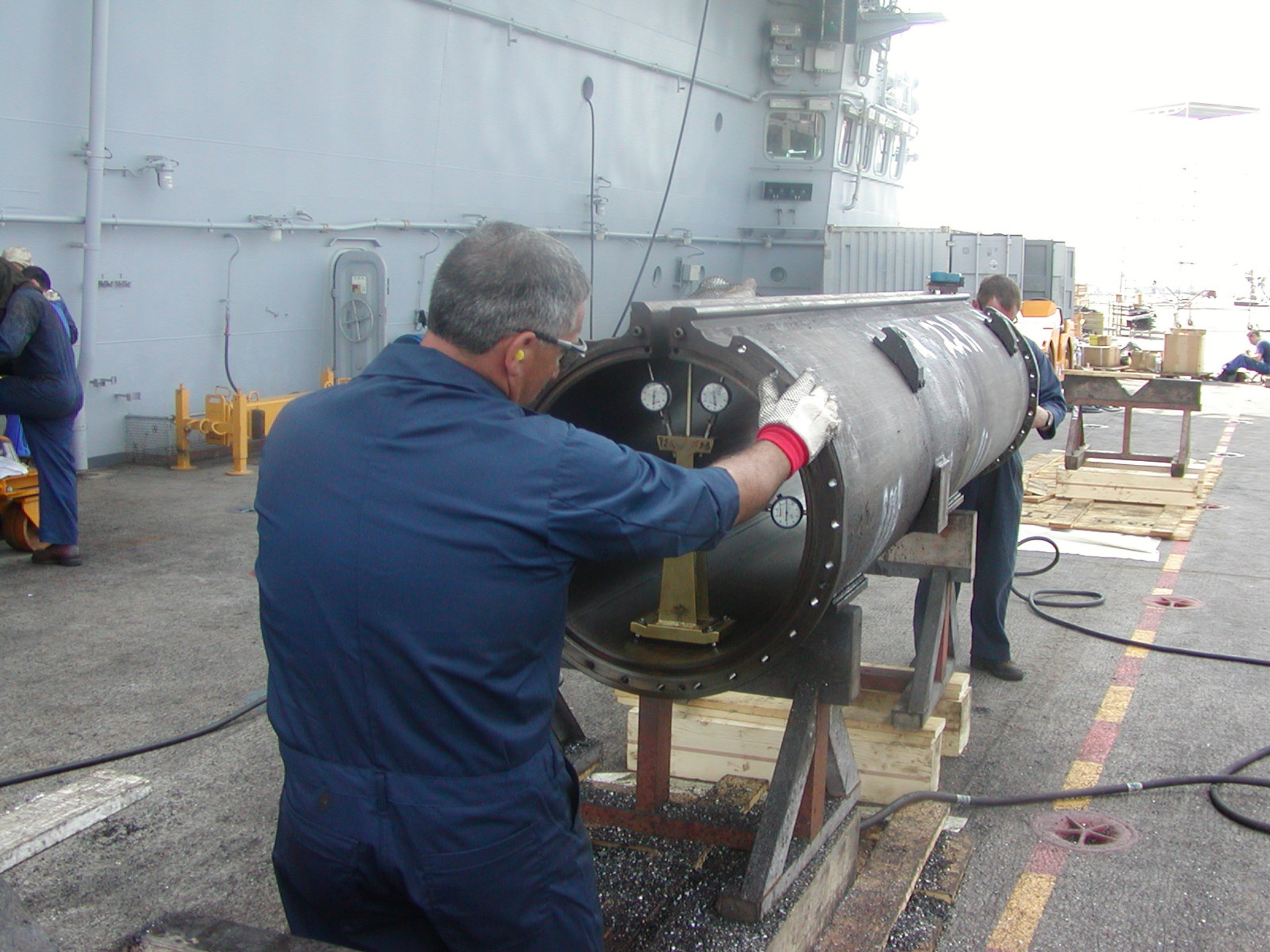
Caption: NAVAIR Carrier and Field Service Unit (CAFSU) representative Dale Hafer (foreground) takes measurements of a catapult power cylinder following resizing of the cylinder on board the French carrier Charles De Gaulle in Toulon, France. Kevin Vanderberry, another NAVAIR CAFSU, records the measurements.