
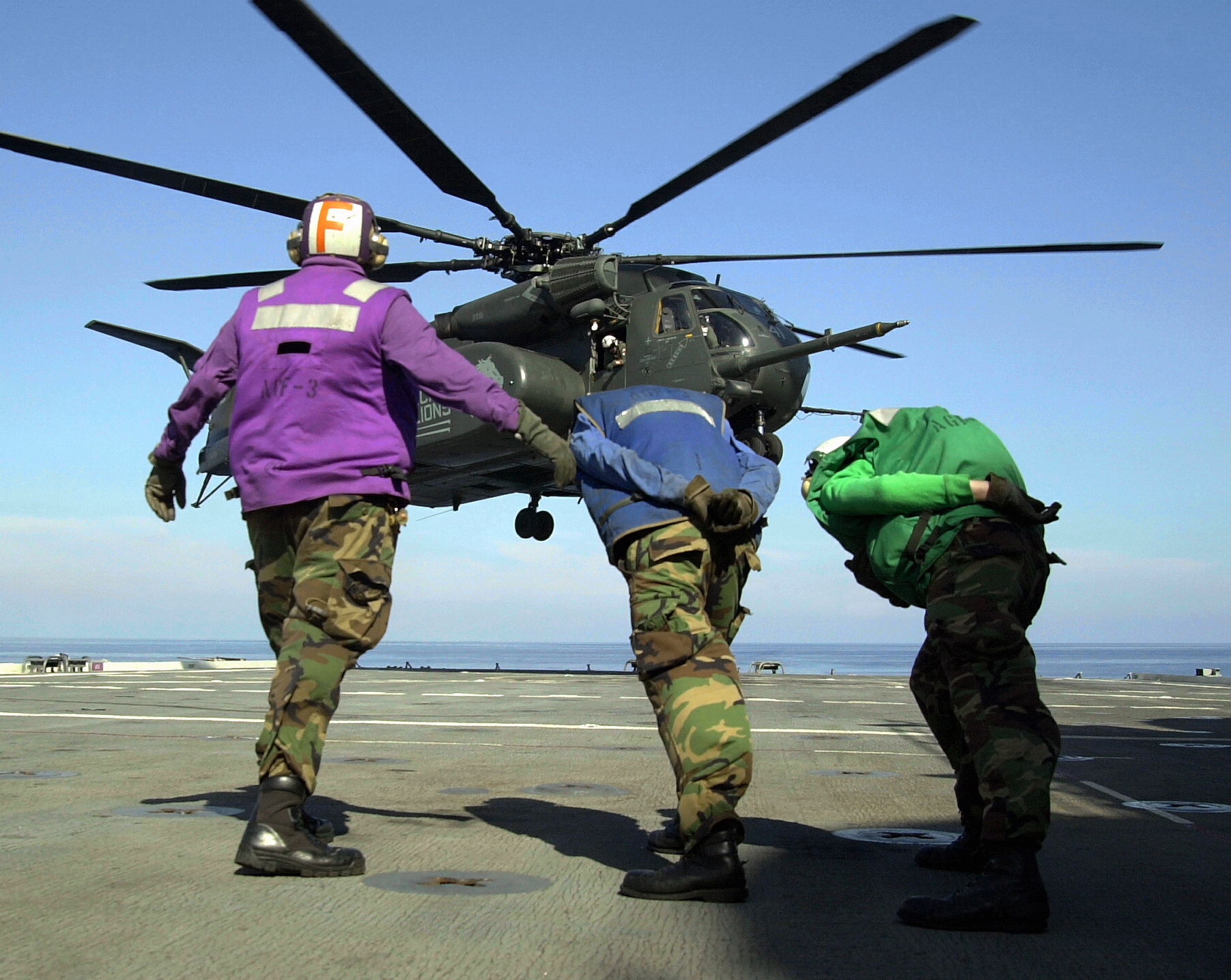
At sea aboard the command ship USS La Salle (AGF 3) Sep. 9, 2002 -- Three flight deck crew members brace against the rotor wash of a MH-53E “Sea Dragon” assigned to Helicopter Combat Support Squadron Four (HC-4) stationed at Naval Air Station Sigonella, Italy, while operating from the flight deck of Commander Sixth Fleet flag ship. La Salle is on a regularly scheduled deployment. (U.S. Navy photo)
NAVAIR Response Center . . . support for the aviation community
The deck of an aircraft carrier is a colorful place.
Blue helmets and blue vests are worn by aircraft-handling crewmembers. Arresting gear crews wear green helmets and green vests. White helmets and blue vests indicate elevator operators, while helicopter plane captains wear red helmets and brown vests.
Every color combination signals a specific billet and responsibility – and plays a crucial role in safety on deck.
For Corporal Frankie Williams, of Marine Wing Support Squadron 373 stationed at Marine Corps Air Station Miramar, Calif., the Navy’s “colors table” was complex and unfamiliar.
“We needed to get a group of Marines properly outfitted prior to deploying (on a Navy vessel),” said Williams. “We needed to get the correct supplies ordered, but we had no access to NAVAIR (Naval Air Systems Command) instructions and manuals.”
Williams went through his chain of command, only to discover that the manual in question was not included in his unit’s Technical Publications Library inventory.
“I then did what we Marines do best,” said Williams. “We adapt and overcome.”
Using his computer’s search engine, Williams eventually came across the NAVAIR Response Center (NRC). Once making contact with them, Williams explained his problem to one of the customer service representatives and was pleased to receive the publications he was looking for that same day.
“The NAVAIR Response Center’s mission is to coordinate and facilitate the resolution of Naval Aviation-related questions and issues,” said Fillip Behrman, program manager for the NAVAIR Response Center. “We assist customers who have been unable to find answers via their appropriate chains of command by putting them in touch with the experts across the Naval Aviation team. Our goal is to ensure the customer is provided (via the NRC or directly by the subject matter expert) the most current, comprehensive and accurate responses possible in a timely manner.”
“Our warfighters have the right to expect timely, accurate answers to their questions – and that’s what we provide,” he added.
As part of the Navy’s Distance Support program the NRC can support fleet, government and contract customers from afar. The NRC works around-the-clock across traditional organizational boundaries to provide coordinated solutions to naval aviation-related questions.
The NRC has been in operation for one year, and acts as a conduit between the aviation technology experts and providers at NAVAIR, and the customer – facilitating the resolution of thousands of aviation questions and issues.
“When we stood-up the NRC last year we received about a dozen calls during our first month of operation,” said Behrman. “Now we receive approximately 150 per month and those numbers are growing.”
According to Behrman, the customer calls the Navy Integrated Call Center (NICC) at 877-41TOUCH (press option 2) and describes his or her question to a customer service representative. The representative enters the request and assigns a tracking number, which follows the action to completion.
All aviation-related questions are then forwarded to the NRC for action. The NRC obtains any necessary clarification from the customer and routes the question to the appropriate subject matter expert. The expert then researches the issue and responds directly to the customer – usually within two to 48 hours. Finally, the NRC follows up with all parties to ensure a satisfactory resolution.
And Williams is one of those satisfied customers.
“Not only did I have the paperwork within a couple of hours, but they also instructed me in how to find and download NAVAIR manuals on line,” said Williams.
And the Marines being deployed will be properly outfitted in the purple helmets and floatation vests worn by the aviation fuel crew.
NAVAIR provides advanced warfare technology through the efforts of a seamless, integrated, worldwide network of aviation technology experts. From professional training to carrier launch and recovery; from sensor data to precision targeting and real-time communications; from aircraft and weapons development to successful deployment and sustainment; NAVAIR provides dominant combat effects and matchless capabilities to the American warfighter.
For more information about the NAVAIR Response Center, go to http://nrc.navair.navy.mil. For more information about the Naval Air Systems Command, go to www.navair.navy.mil.
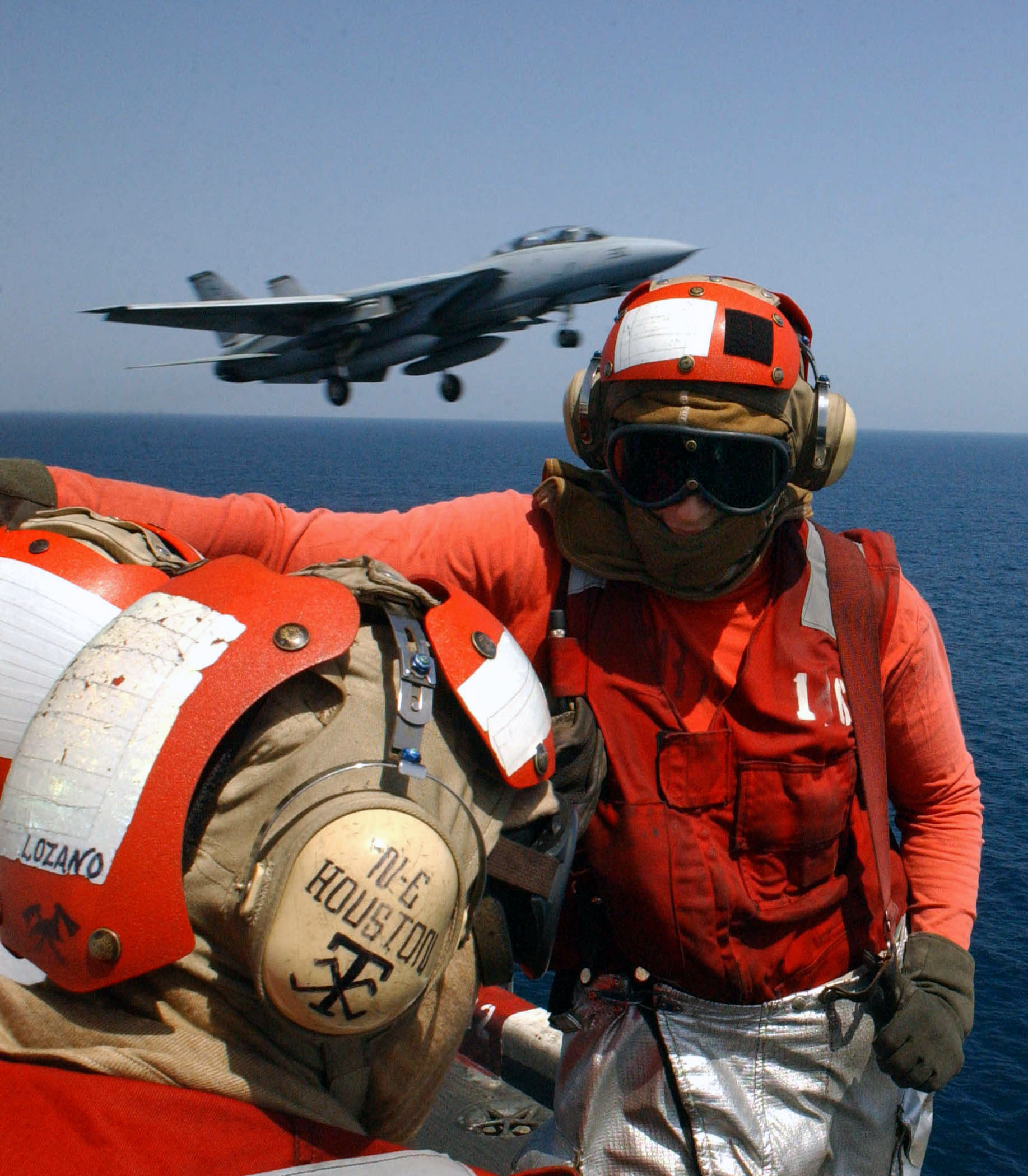
At sea aboard USS John F. Kennedy (CV 67) May 17, 2002 -- Sailors from the crash and salvage crew stand by in case of an emergency as an F-14 “Tomcat” from the “Red Rippers” of Fighter Squadron One One (VF-11) launches from the flightdeck of the USS John F. Kennedy. The Kennedy is on a regularly scheduled deployment in support of Operation Enduring Freedom. (U.S. Navy photo)