
NAVAIR Employee Strong Advocate and Example for Disabled
By Ward Carroll
NAVAIR Public Affairs
Harsha Desai has been disabled since birth, but she’s never used that reality as a crutch. Whether solving a systems problem for NAVAIR or prepping her son for college, she approaches life with an infectious verve. She even used her engineering skills to help design her own prosthetic devices.
“I’m a below-the-knee amputee,” Desai said, “and I worked with Dr. Buddy Greyson of MHC Orthotics and Prosthetics, Inc. in Leonardtown to provide requirements and design an energy storage mechanism that transfers weight from heel to toe while walking, much like a normal human foot does.” The electromechanical device has opened a new world of physical possibilities. “I can hike for miles now,” she said.
Desai was born and raised in Bombay, India and came to America to attend college. She had intended to return to India, but while earning her Masters in Electronics Engineering from Widner University she met her future husband and following graduation settled down in Howard County, Maryland. She started her professional career working as a Principle Design Engineer with Singer-Link Simulation Systems before joining the Naval Surface Warfare Center in 1987. She came to NAVAIR five years ago, just after the organization relocated from Crystal City to Patuxent River. She recently started working at the PMA-272 Class Desk, focusing on the AN/ALR-67 (V) 2, Radar Warning Receiver system.
“I’ve always worked research and development,” Desai said. “I wanted to deal with the production side for once.”
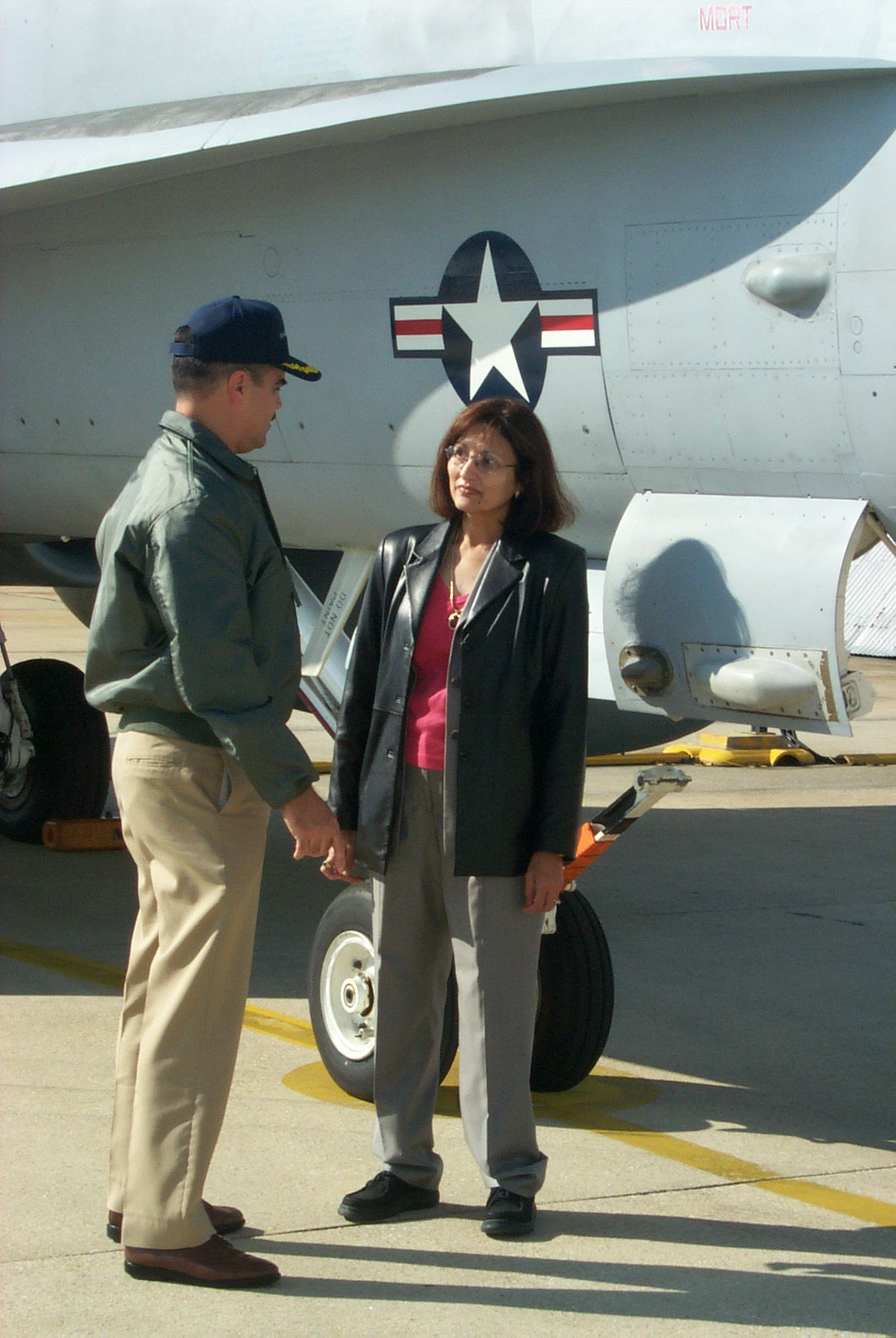
Desai has also been a leader in dealing with issues facing the disabled. She was appointed to the Governor of Maryland’s Committee on Employment of People With Disabilities in 1987 and served as an active member for ten years. She remains in close contact with the commission in an informal capacity, and the commission recently recognized her efforts by selecting her as a subject for an upcoming photo exhibit featuring individuals with disabilities who are working important and exciting jobs in the state of Maryland. Desai accepted the invitation with an important stipulation: “I wanted the photo to show me standing next to a naval officer in front of a Hornet,” she said. “The message should be clear: Disabled people may not be eligible to fly the jets into combat, but they can do great work to assist those who will.”
The photo exhibit will open in January 2003, coincident with the opening of the legislative session, and then go on the road at prominent public places all across Maryland (e.g. malls and county government centers). Desai, who lives with her husband and son in Charles County, was one of 24 people selected from each of the 23 counties in Maryland, plus the city of Baltimore.
Photo caption: Harsha Desai, a NAVAIR engineer (PMA-272) who is being recognized by the Governor of Maryland’s Committee on Employment of People With Disabilities, discusses her role in supporting the F/A-18 Hornet with Cmdr. Miguel Ortiz (PMA-272). Photo by Vicky Falcón.