NAVRIIP discovers success stories
By Betsy Haley
NAVAIR Public Affairs
Leaders of the Naval Aviation Readiness Integrated Improvement Program (NAVRIIP) recently returned to Naval Air Station (NAS) Oceana, Va to discover many success stories since their first visit one year ago and to review the barrier removal process for the F/A-18 type-model-series (T/M/S).
In particular, by resolving 163 barriers to readiness, the NAS Oceana Aircraft Intermediate Maintenance Detachment (AIMD) was able to average a 50 percent across-the-board increase in meeting aviation supply demand, while reducing flight-line cannibalization and improving shore-based readiness for the F/A-18 and F-14. The barriers identified during NAVRIIP’s first visit were successfully resolved at the local level except one that was escalated to the NAVRIIP planning and programming organization, Cross Functional Team-3 (CFT-3).
“These numbers are a testament to the support that we received from senior leadership such as the Naval Aviation Integrated Improvement Team (NAVRIT), Naval Aviation Inventory Control Point (NAVICP), Defense Logistics Agency (DLA) and the close working relationship of the local leadership team,” said CDR Jerry Zumbro, Oceana AIMD OIC.
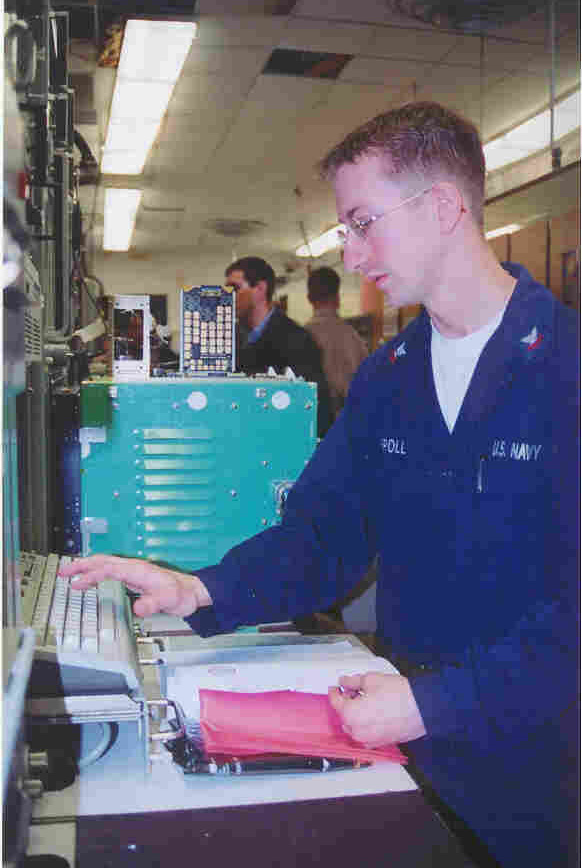
“NAVRIIP has helped us to get all of the supplies we need, streamlined our processes and made it easier to get the parts we need when we need them,” said AT2 Jeffery Carroll, AIMD technician. “The NAVRIIP process helps us to understand the complete cycle of repairs and parts within the AIMD.”
The NAVRIT toured the NAS Oceana AIMD, and during the tour actually assisted in resolving a local barrier with a targeted forward-looking infrared looking radar (T-FLIR) shipping plate. CDR Joyce Robinson, from the Naval Inventory Control Point (NAVICP), joined the walk-around tour, and was able to collect data on how the design of the T-FLIR shipping plate causes damage to the system in transit. She also found out how the current design of the plate does not allow for part number visibility. Robinson is assisting the maintenance technicians in gaining approval to change the design of the plates, and the container design engineer and the NAVICP F/A-18 lead technician are currently working the issue. The facilitation to solve this local barrier came to fruition because Fleet members, flag officers and other NAVRIIP team members were able to meet face-to-face to discuss what is causing problems within the detachment, and then agree on quick fixes for resolutions.
“Being on site to see and hold the shipping plate and component was invaluable,” said Robinson. “The Fleet technicians demonstrated removing the optical stabilizer's shipping plate, and drove home the consequence of not being able to read the stabilizer's part number through a view port. The shipping plate is heavy and requires some effort to twist it from the optical stabilizer; multiple removals of the plate induce excessive handling to the fragile component,” Robinson said.
During the same timeframe last year when NAVRIIP was first introduced to Oceana, the lean manufacturing process was also introduced to the AIMD. The lean process is the production of materials to meet maximum daily demand with a balanced flow process by identifying and eliminating non-value added activities.
“A primary reason for becoming lean is to take unnecessary work off the backs of Sailors and Marines who have always gone the extra mile to sustain our forces,” said Rear Adm. Wally Massenburg, assistant commander for Aviation Depots, Naval Air Systems Command (NAVAIR). “This is in addition to the obvious benefit of increased productivity.”
For example, the bomb release unit-32 (BRU) test bench maintenance technicians began using the lean process in February 2002. Since the process was initiated, production has increased.
“Our backlog was over 250 BRU-32’s needing break down, now since we began the lean process, we have cut it to eight, ” said aviation ordnance officer Gary Mueller, AIMD Oceana. “We are producing 10 a day, compared to five-to-six before we began this process. We have also cut our total-cycle time from eight hours to six hours. Our Fleet customers are telling us that this is the best product to come out of AIMD in years,” Mueller said.
“With this situation, you have metrics which measure your progress,” said Massenburg. “The lean process combines maintenance and supply logistics that better support vertical alignment which drives readiness. “
The lean process was also introduced to the engine maintenance technicians for F/A-18 and F-14 aircraft in an attempt to reduce the number of bare firewalls. The repair backlog was reduced from 208 engines needing repairs to 30, while also reducing the number of aircraft with engines out for repairs from 68 down to 37. The total turnaround time for F-404 engines went from 78 days to 20 days.
“The lean process helps us to continue our work flow and eliminate waste with engine kits,” said ADC (AW) David Benton, chief petty officer, AIMD Oceana. “We also have improved quality of work, including our working conditions. Our airmen up to our first class petty officers now understand their jobs and what they are supposed to repair every day.”
“Boots on the ground helped us a lot,” said ADC Jerry Robinson, night- check production chief, AIMD Oceana. “It solved a lot of issues. NAVRIIP goes hand-in-hand with the lean process.”
Benton reiterated that the lean process helps to determine mistakes in the break down process, and move forward with resolving issues to increase the total time an engine is working while on an aircraft.
“NAVRIIP offers standardization and cycles of learning. When we go to this type of T/M/S construct, it is time for officers to transport best of breed, best of practices onto to others,” said Massenburg.
Eventually, the lean process, along with other manufacturing theories that will be introduced by NAVRIIP, will be institutionalized across other AIMDs.
During the recent F/A-18 T/M/S evaluation last month, the local Oceana NAVRIIP leadership team (including the Strike Fighter Wing Commodore, Fighter Wing Commodore, Supply officer, AIMD officer, Strike Fighter Wing maintenance officer and the Fighter Wing maintenance officer), identified barriers for the following systems: the APG-65/73 radar (including the radar transmitter, radar set, receiver and antenna), T-FLIR and F-404 engine.
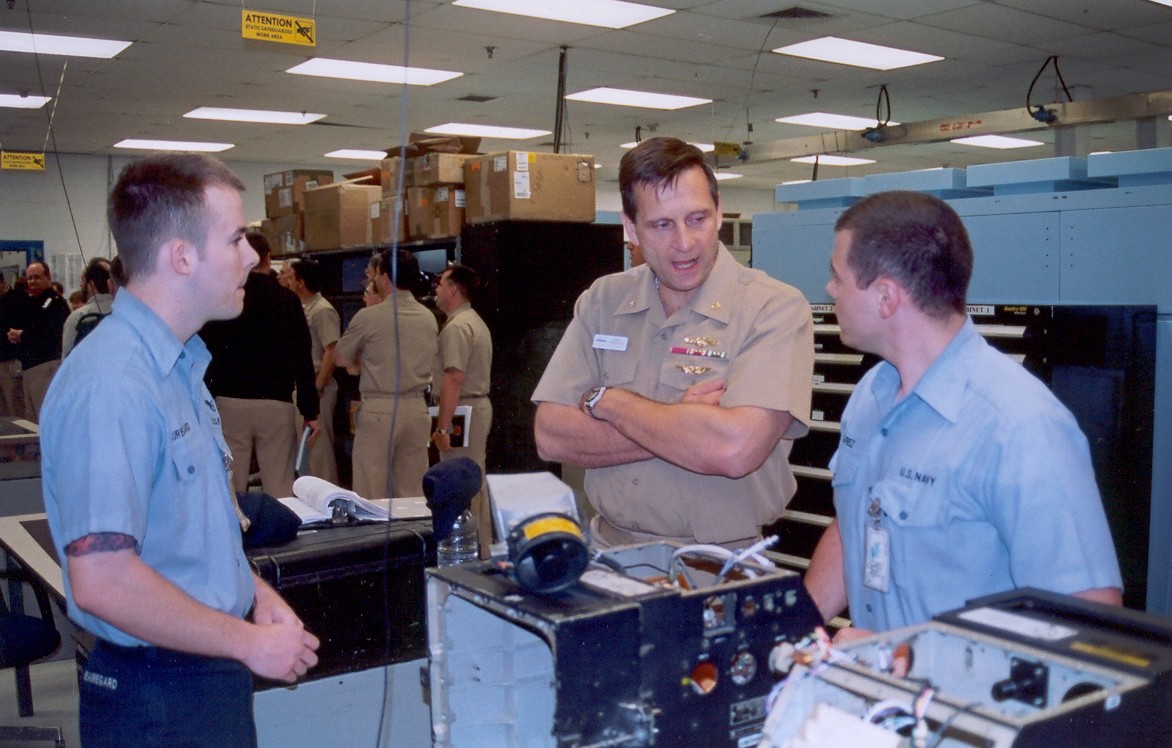
“With NAVRIIP you have to use your trouble-shooting skills to determine what barriers are preventing system readiness,” said ATAN Jesus Suarez, AIMD Oceana. “NAVRIIP helped us analyze many systems for the F/A-18.”
Due to NAVRIIP’s recent shift in focus from site specific to TMS specific barrier identification, all sites that support the F/A-18 will form a barrier removal team (BRT) and will work together on removing each barrier. NAS Lemoore, Marine Corp Air Station Miramar, Calif., and NAS Oceana will establish BRTs to focus on the top three barriers. After each barrier is resolved, others BRTs will be established.
After evaluating the F-404 engine, barriers include establishing pre-removal screening of engines, common performance metrics and building specifications across all sites, while also tasking a single asset manager for workload balancing.
The APG-65/73 radar system requires a method to identify best practices and then exporting the practices across Naval Aviation.
The T-FLIR system requires improvements to work center manning (FLIR training), availability of supply equipment and Wing benefits.
Recently, the Support Equipment Division (SED) identified a new barrier concerning manpower within the A/S32A-42 tow tractor work center. The local Oceana leadership team was not able to resolve the barrier locally, and it has since been escalated to the resources organization to address skilled manpower shortages and poor reliability issues to better expedite logistical support and reliability.
In June, the NAVRIIP will next address barriers with the SH-60 B, F and H helicopters at NAS North Island, Calif.
For more information on NAVRIIP, link to http://www.airpac.navy.mil/navriip/.
Photo 1 Cutline:
Rear Adm. Mark Harnitchek, Commanding Officer, Naval Aviation Inventory Control Point, discusses the NAVRIIP process with F-14 test bench technicians, ATAN Jesus Suarez and AT3 Sean Beauregard, AIMD Oceana.
Photo by Eddie Riley, NAVAIR PAO
Photo 2 Cutline:
While trouble-shooting a data storage unit processor memory card, AT2 Jeffery Carroll, AIMD technician, enters data into the hybrid test station, during the NAVRIT AIMD tour.
Photo by Eddie Riley, NAVAIR PAO.