Working on helo tails is a booming business
Tail boom 1
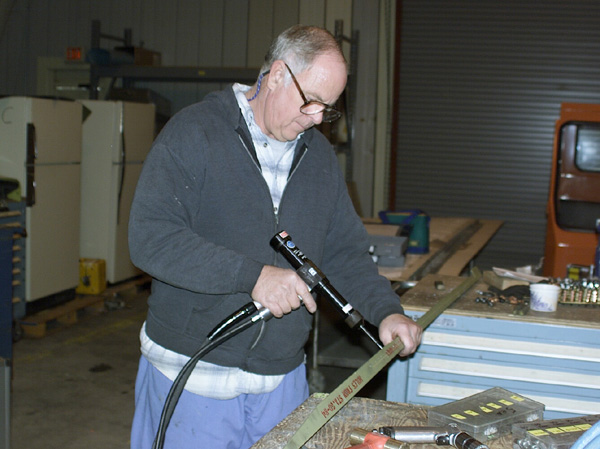
Dennis Locke, Code 6.2.1, works on a spar cap to a UH-1 Huey at Camp Pendleton. Photo by Joe Feliciano
Tail boom 2
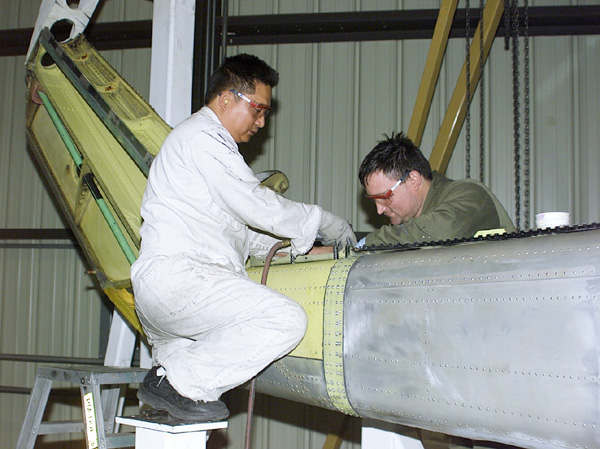
Sheet metal mechanics William “Tibby” Thibedeau (right), with NAVAIR Depot North Island’s Multi-Line Product Line, and Roger Martin, a Raytheon contractor, work on an AH-1W Cobra tail boom at the Depot at North Island. Photo by Scott Janes
Working on “tails” is a “booming” business
By Bill Bartkus
NAVAIR Depot North Island
NAVAIR Depot North Island artisans at Naval Air Station North Island and at Marine Corps Base Camp Pendleton have stepped up to the plate and have joined forces to work on what has been called a “first ever” project. Their work further cements together the Navy and Marine Corps fighting team.
Artisans at both sites are replacing major structural components on Marine helicopters, specifically the tail boom. Workers are replacing components in the aft section on AH-1W Cobra tail boom at North Island, while their teammates at Camp Pendleton are working on the aft section of UH-1N Huey.
Over time, North Island will work on all the Cobras on the West Coast; artisans at NAVAIR Depot Cherry Point, N.C., are working on Cobras and Hueys on the East Coast. North Island Depot sheet metal mechanics at Camp Pendleton expect to work on all the Hueys assigned in the Pacific theater.
Both sites began working on the prototypes in January. Michael Collins, the CH-53E Sea Stallion production supervisor at North Island, Code 6.2.1.7, and Russell Moore, with Field Services at Camp Pendleton, Code 6.2.1, both agree that each prototype will take about four to six weeks to complete. After the artisans work out any facility issues, Collins and Moore said that each Cobra and each Huey should take about a month to complete.
“Because of the age and torque of the aircraft, the tails on the helicopters become twisted,” said Collins, “and they don’t align. The metal is fatigued.”
Artisans at both sites are realigning the tail booms to their original configuration.
Both sites are helping each other. Artisans at Camp Pendleton are disassembling the 300-pound tail on the Cobra, and then shipping them by truck to North Island where artisans are working on them in a “can” near Building 306. Marines who own the Hueys are disassembling the tails at Camp Pendleton and delivering them to Field Service there where they are worked on in a hangar at the base.
The Cobra tails will be sent back to Camp Pendleton where Depot artisans will reassemble them back onto the aircraft. The Huey tail booms will be delivered back to the squadrons and Marines will put them back on the aircraft.
It’s a win-win situation.
Two sheet metal mechanics work on each tail boom at both sites. Robert Reynolds is the crew leader at North Island, and Dennis Locke oversees the crew at Camp Pendleton.
Moore said that Cognizant Field Activity engineers decided to perform a complete retrofit on the Hueys in the form of a Local Engineering Specification directive and developed a retrofit kit to replace the worn parts.
The work on the tail booms will be incorporated into the Integrated Maintenance Concept program, Collins said.