Twin TPS visitations recall the past, foretell the future
By Bill Swanson
NAS Patuxent River Public Affairs
PATUXENT RIVER NAVAL AIR STATION, MD—The U.S. Naval Test Pilot School this past holiday season received two gifts reminiscent of Charles Dickens’ classic story A Christmas Carol: one from the distant past, one a vision of the not-too-distant future.
The future arrived first, when Lockheed Martin representatives presented TPS with a 1/10th scale model of the Joint Strike Fighter X-35C on Dec. 19. Leading the delegation in a brief ceremony at the school was Charles T. “Tom” Burbage, Lockheed executive vice president and general manager of the JSF program, and a 1975 graduate of TPS Class 68. With Burbage was retired Vice Adm. Jack Ready, former commander of the Naval Air Test Center and now with Lockheed, and Peter Shaw, JSF program manager for Northrop Grumman, a partner with Lockheed in building the JSF. Accepting the model on behalf of TPS was its executive officer, Cmdr. Paul Sohl.
Lockheed’s X-35 was selected in October 2001 as the winning JSF prototype after a seven-year competition with Boeing Aircraft’s X-32. As part of that competition both aircraft were flight-tested here as well as at Edwards Air Force Base, Calif. In his remarks accepting the aircraft and thanking the Lockheed officials, Sohl noted that Lockheed has begun construction of the first 14 F-35 aircraft based on the X-35C, and that nine of those 14 will be sent here for testing and evaluation beginning in 2006.
The competition between Lockheed and Boeing is the subject of a two-hour documentary, Battle of the X-Planes, to be aired on the Public Broadcast System’s “Nova” series on Feb. 4.
The award of the contract to Lockheed, variously estimated to be worth more than $200 billion, is the largest single government contract in history. The F-35 will become the Navy’s first “stealth” aircraft and was designed to replace F-14 Tomcats as well as earlier versions of the F/A-18 Hornet. Variants will also serve the Air Force and Marine Corps, replacing A-10 Thunderbolts, F-16 Fighting Falcons, F/A-18s, and AV-8B Harriers. The latter Marine Corp version will have “STOVL” capability – short-take-off and vertical-landing – and for this capability it has been chosen by the British Navy and the Royal Air Force to replace its Harrier fleet. Seven other foreign nations have joined in development of the JSF as well.
It was doubly fitting that Burbage should be the person to make the presentation of the model: a 1969 graduate of the U.S. Naval Academy, he served 11 years in the Navy, and is a 1975 graduate of TPS. In February 2002 he was presented with Flight International Magazine’s annual Aerospace Industry Personality of the Year Award.
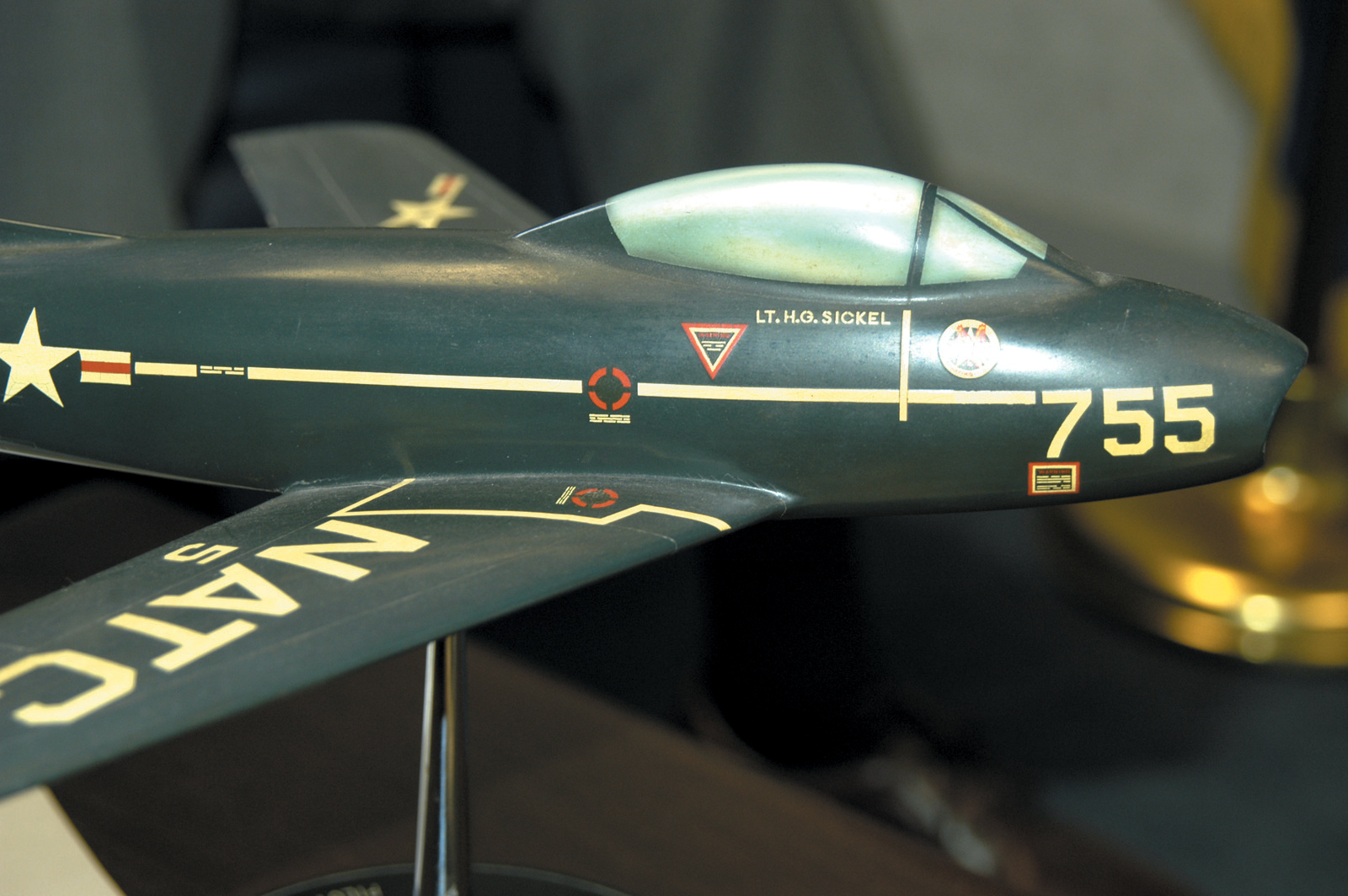
A few days after Burbage’s visit and presentation, the past returned to TPS, also in the form of a model airplane given to the school, though this one was hardly state-of-the-art. It was a small model of an XF-J-2 Fury, the Navy’s version of the Korean War-era F-86 Sabre built by North American Aviation of Columbus, Ohio. The model is a replica of the Fury stationed here in the mid-1950s, and has the same markings, down to and including serial numbers and TPS emblem. The letters on the wings read “NATC” for Naval Air Test Center, and on the nose is the plane’s number, 755. Just under the canopy is the name of the pilot who flew it, Lt. H.G. Sickel, Horatio Gates “Bud” Sickel, who was named after a distant relative, Revolutionary War Gen. Horatio Gates, the man who received British Gen. John Burgoyne’s surrender at the historic Battle of Saratoga.
Lt. Bud Sickel was a 1951 graduate of TPS, Class 6, and won the school’s Outstanding Student Award that year. In 1956 Cmdr. L.M. “Butch” Satterfield became director of TPS, and Bud Sickel became assistant director – and was killed that year when his FJ-2, number 755, crashed during a routine flight from Pax River to North American’s plant in Columbus. He left a widow and two very young sons.
That’s not the end of the story; it’s the beginning. In 1957 TPS graduated a civilian engineer from Mississippi State University, Thomas S. Moore, of Class 19. Moore had joined the Marine Corps at the start of World War II and graduated from flight school in Corpus Christi, Texas, in 1943, at the age of 19; he spent the remainder of the war there as a flight instructor. Moore left the Marines in 1946 but was recalled for the Korean War, flying F7F Tigercats and F3D Skyknights in the Marines’ only all-weather night interceptor squadron. He earned a silver star there for strafing and bombing an enemy train during an escort mission north of Wonson Harbor, North Korea.
In 1958, the year after Moore graduated from TPS, the school underwent a major upgrade of its program and curriculum, and as part of that upgrade Satterfield persuaded Moore to come back to TPS as head of the academic program. Moore began teaching Class 21 in 1958, and retired in 1975, but then came back as a contract employee for two more years. He taught every class from Class 21 through Class 69, specializing in jet engines, math, and stability and control systems. His lecture notes on stability and control are still used at the school to this day as the core of that course.
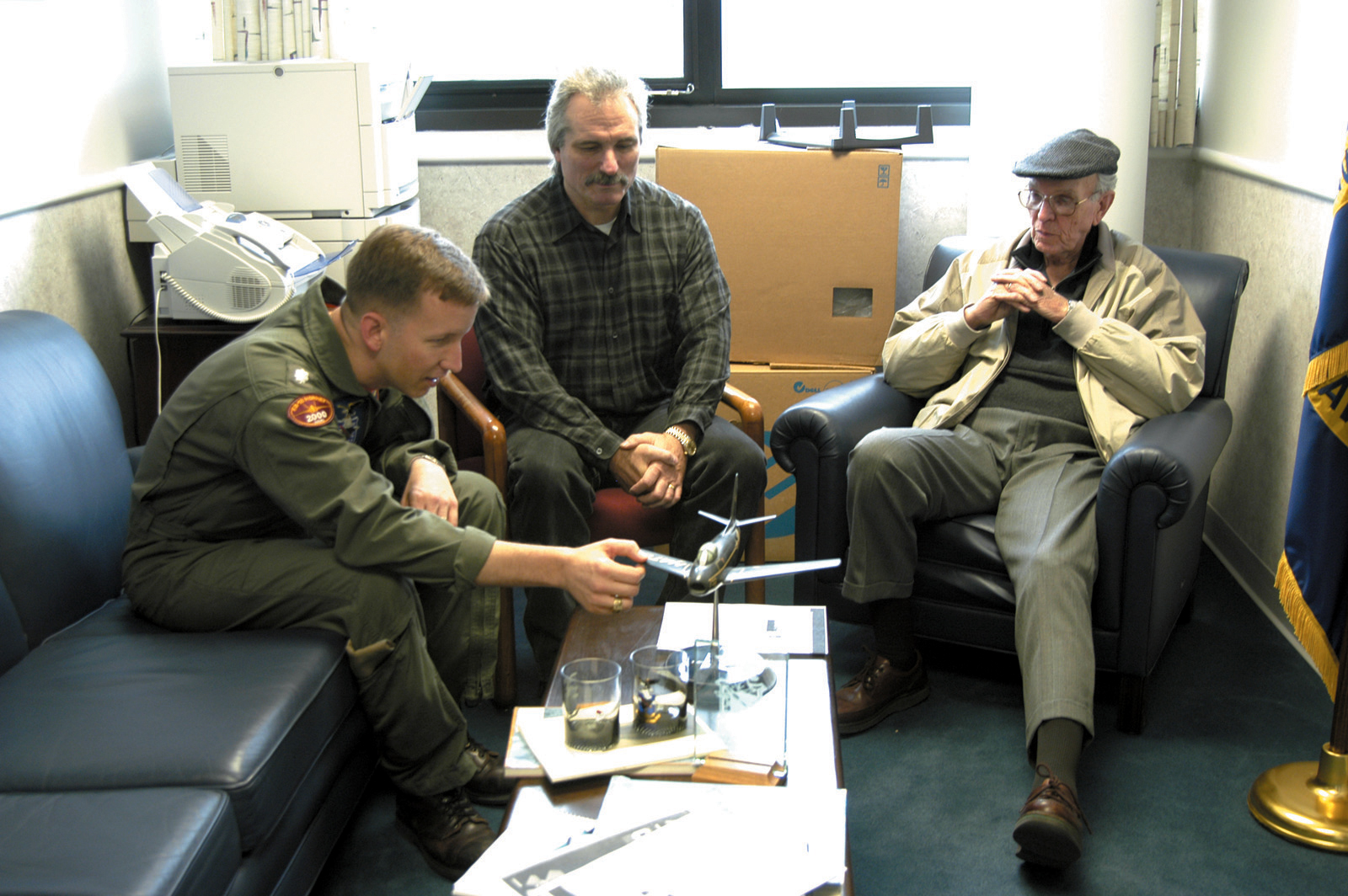
In 1960, Moore married Sickel’s widow and adopted Sickel’s two sons. One of the boys, Gates, chose his adoptive stepfather’s name, becoming Gates Sickel Moore. It was Gates Moore who owned the model of XFJ-2 number 755 with his father’s name on it. It was Gates Moore who donated to TPS the model of the plane his father was killed flying.
Gates Moore grew up in St. Mary’s County, attended St. Mary’s Ryken and graduated from Great Mills High School in 1970. He now lives in Austin, Texas, where he drives singer Willie Nelson’s tour bus. His stepfather, Thomas Moore, still lives in Dameron.
Both men came to TPS last week to deliver the model to TPS. Sohl received the model on behalf of the school in an informal ceremony a few days before Christmas.
“I used to have that model on my dresser,” Gates Moore said. “I’ve looked at it every day of my life. I’ve had it, well, I’m 50 years old, ever since I was born, I guess.”
-USN-
Photo 1 -
Photo by Bill Swanson
Cmdr. Paul Sohl, executive officer of U.S Naval Test Pilot School, examines the model of an XFJ-2 Fury being donated to TPS by Gates Sickel Moore, center, whose father, Lt. H.G. Sickel, was killed flying the XFJ-2 in 1956. With them is Moore’s stepfather, Thomas S. Moore, who was head of the TPS academics department from 1958 to 1975.
Photo 2 -
Photo by Bill Swanson
A close-up photo of the model of an XFJ-2 Fury—the Navy version of the F-86 Sabre—shows the same markings as the real aircraft stationed at the U.S. Naval Test Pilot School here in 1956, when it was flown by Lt. H.G. Sickel, deputy director of TPS. The model has number 755 painted on the nose, as well as Sickel’s name; between the two is the emblem of the TPS as it was in 1956. The model was donated to TPS by Sickel’s son Gates Moore.