
Hovering objects ‘defy’ gravity
By NORINE ROWE
NAS Patuxent River Public Affairs Department
PATUXENT RIVER NAVAL AIR STATION, MD—Lured by an emerging technology that seems to defy gravity, two Great Mills High School seniors set out on a quest this school year to uncover the mystery behind electrokinetic propulsion.
After conducting more than 200 hours of research into their independent physics project, students Matt Martz and Jeff Dronenburg demonstrated an electrokinetic propulsion device (EPD) to a group of NAVAIR and NAWCAD employees. The presentation took place recently in the Electro-Optics and Special Mission Sensors Division.
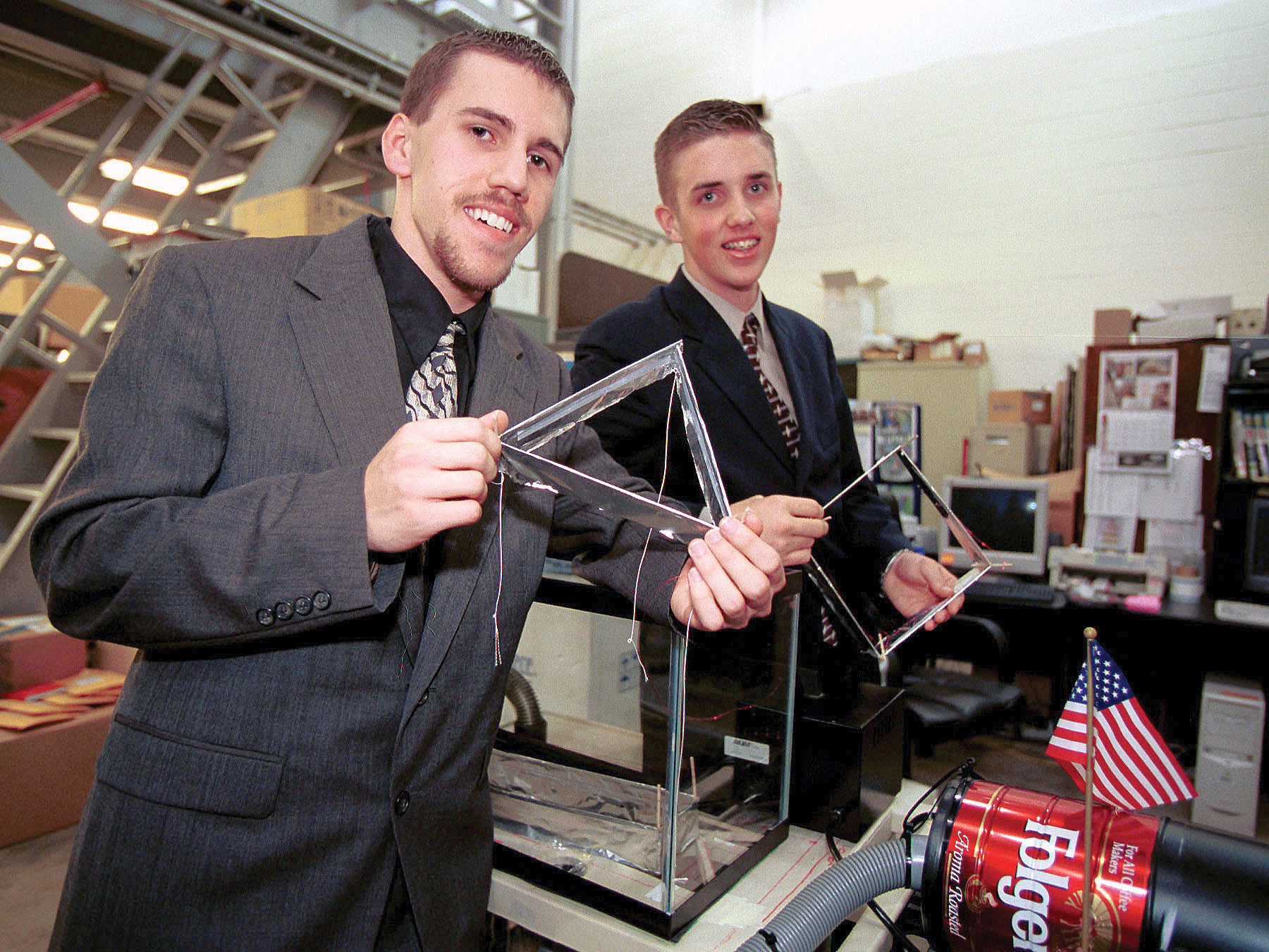
With station employees gathered around, the students switched on a vacuum attached to a glass tank by a long hose. They then sent 20,000 volts of electricity into a foil-covered triangle of balsa wood tethered to the bottom of the glass enclosure. As the jolt of electricity coursed along copper wires attached to the triangle, it rose in the air, appearing to defy gravity as it hovered in mid-air.
“It’s been an amazing project,” said Martz, an intern with the Electro-Optics and Special Mission Sensors Division during the last two summers, who explained that the students’ success in creating an EPD was unhampered by the fact that they’ve been unable to explain exactly how or why it works.
“Many theories have been put forth to explain electrokinetic propulsion technology, but none of them have been proven,” Martz said.
In conducting their research, Martz and Dronenburg looked at the Biefeld-Brown Effect, the tendency of an asymmetrical capacitor to move towards its positive electrode as high voltage electricity flows through it. To understand how an EPD works, Martz and Dronenburg explored three main theories used to explain the Biefeld-Brown Effect. Martz and Dronenburg were unable to prove the theory as applied to electrokinetic propulsion.
Undaunted, Martz and Dronenburg plan to continue their research into different EPD designs, force measurement and lifter simulation. They remain convinced that electrokinetic propulsion technology has valuable uses in the future if it can be properly harnessed. And although they didn’t manage to solve the riddle of electrokinetic propulsion, they did learn a lot in the process.
“We did a lot of research into electricity, how capacitors work and Einstein’s theory of relativity,” Martz said. “We also learned about safety precautions that are needed when dealing with electrokinetic propulsion, such as building a containment chamber to filter ozone and block radiation.”
Supervising the students in their research was Allen Skinner, a physics teacher at Great Mills High School, who provided guidance while ensuring that the students conducted their research in a safe manner.
“This project gave the students a chance to do real science and real-world problem-
solving,” Skinner said. “In the regular science curriculum, you already have the answers. But with this kind of science project, the students generate a problem and come up with their own research. It’s a very open-ended kind of investigation.”
As part of their independent study project, Martz and Dronenburg had to develop a project outline and plan for assessment to be approved by their school and the public school system. They also had to keep a weekly video journal of their work, participate in science competitions and prepare a detailed report on their research. They both received an “A” grade for the project, Martz said, and next month they’ll be entering their project in the St. Mary’s County Science Fair.
“I was very impressed by the demo,” said Gary Hyatt, a NAWCAD technician with Project Beartrap, who attended the students’ presentation. “I’ve never seen an EPD before, and I think the students did a great job of setting up and presenting the model.”
Another observer of the student demo was Matt’s father, AWCM Tom Martz with NAVAIR’s Anti-Submarine Warfare Systems, who described himself as a “science nut.”
“I think an EPD is really fascinating, especially when I saw it fly the first time,” the elder Martz said. “The hardest part for me throughout this project was keeping my hands off and letting these guys do this all on their own.”
Following graduation from high school this year, the younger Martz plans to study engineering in college. He has already received letters of acceptance from Virginia Tech and Florida Tech.
Dronenburg hopes to attend the U.S. Naval Academy or the U.S. Air Force Academy with the goal of becoming a pilot.
-USN-
Photo by Norine Rowe
Great Mills High School seniors Jeff Dronenburg, left, and Matt Martz display the electrokinetic propulsion devices they designed as part of an independent study project in physics. The students demonstrated their EPDs to a group of station personnel in the Electro-Optics and Special Mission Sensors Division here.