
Light duty helps in healing while reducing lost time for NAVAIR
By Vicky Falcón
NAVAIR Public Affairs
Accidents happen.
When Wendell Walsten hurt his left arm and hand in May 2000 working as an air conditioning mechanic at NAVAIR China Lake, Calif., his career came to a screeching halt.
“After three surgeries and partial mobility loss, my doctor informed me that I needed to change jobs,” said Walsten.
Today Walsten is being trained as an aircraft technician, performing radio frequency sweeps and troubleshooting electronic warfare systems.
Walsten says his successful career shift is the result of many prayers and his willingness to learn. “I did not go in with a negative attitude,” he said. “I went into the job ready and willing to learn any and everything – and the people I’ve come in contact with during this period of transition have been ready and willing to help me succeed.”
Walsten is just one example of how NAVAIR is working to help injured employees stay with the organization, according to Brad Allen, acting Occupational Safety and Health manager for NAVAIR. Allen is also team lead for the newly developed Lost Time Reduction team, comprised of NAVAIR-wide Injury Compensation Program administrators, Safety and Occupational Health personnel, Office of Counsel and civilian personnel.
“We are looking at ways to try to reduce lost productive days,” said Allen, “days people spend away from work due to injuries.”
According to Allen, helping employees come back to work in a light duty capacity is one area often overlooked by managers within the organization.
“Bringing an employee back early is good for the employee and good for NAVAIR,” Allen said. “It is a win-win situation for everyone involved.”
NAVAIR ends up gaining some productivity from an employee who wasn’t able to work at all, he explained, but more importantly, the employee regains self-esteem knowing he or she is needed and recognized as a valuable asset to the organization.
“Studies have shown that bringing a person back to work aids in the healing process – both the mental and physical,” said Allen. “It’s good for the employee to be productive sooner.”
Jerry Brown would agree.
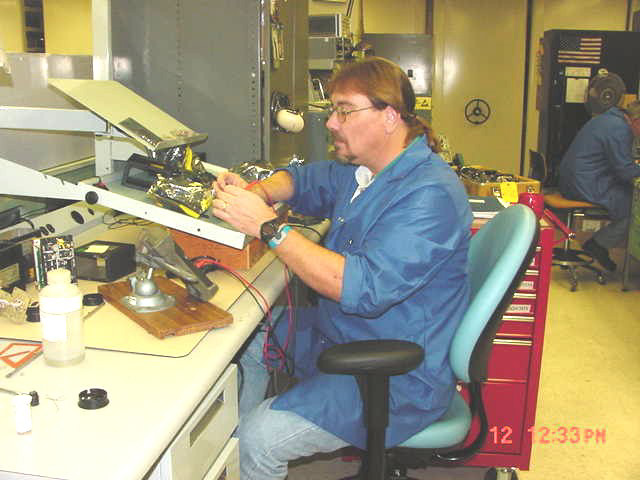
Brown, who works at NAVAIR Depot Jacksonville, Fl., as an electronics technician, has been in and out of surgery and rehabilitation for two years following a back injury that occurred while he was repairing a power supply on a Sidewinder missile. His injury was complicated by an automobile incident shortly after he tried to come back to work.
“I was on full-time workman’s compensation for nearly a year,” said Brown. “It was very hard at home. I felt helpless, worthless and useless and was constantly fighting depression.”
Though it took some effort to get ergonomically correct equipment, Brown, who spends a lot of his work hours performing microscopic soldering, has been able to return to his position.
“I still have some problems,” he said, “and sometimes I hurt real bad.” But he is happy to be back to work in the career he’s had for more than 20 years.
Getting injured employees back to work earlier – even if it is light duty – is not a new initiative, said Allen. “It is an ongoing program for NAVAIR, but one we’re trying to draw attention to in light of the recent DoD and SECNAV initiative.”
The Department of Defense and Secretary of the Navy initiative focuses on reducing lost time due to injuries across the Navy and throughout DOD.
“Our employees have the knowledge, expertise and experience that keep NAVAIR the leading provider of naval aviation technologies,” said Allen. “We are also dedicated to maximizing taxpayer value through an efficient organization. Fortunately, both commitments have the same results – a healthier workforce and a cost reduction for the Navy.”
NAVAIR provides advanced warfare technology through the efforts of a seamless, integrated, worldwide network of aviation technology experts. From professional training to carrier launch and recovery; from sensor data to precision targeting and real-time communications; from aircraft and weapons development to successful deployment and sustainment; NAVAIR provides dominant combat effects and matchless capabilities to the American warfighter.
For more information about the Naval Air Systems Command, go to www.navair.navy.mil.
Photo by Tom Rowe.
Caption: Jerry Brown, an electronics technician at NAVAIR Jacksonville sits at an ergonomically correct desk following extensive surgery and rehabilitation from a back injury at work.