NAVAIR “out front” on the road to Sea Power 21
By Amy Behrman
NAVAIR NCW Public Affairs
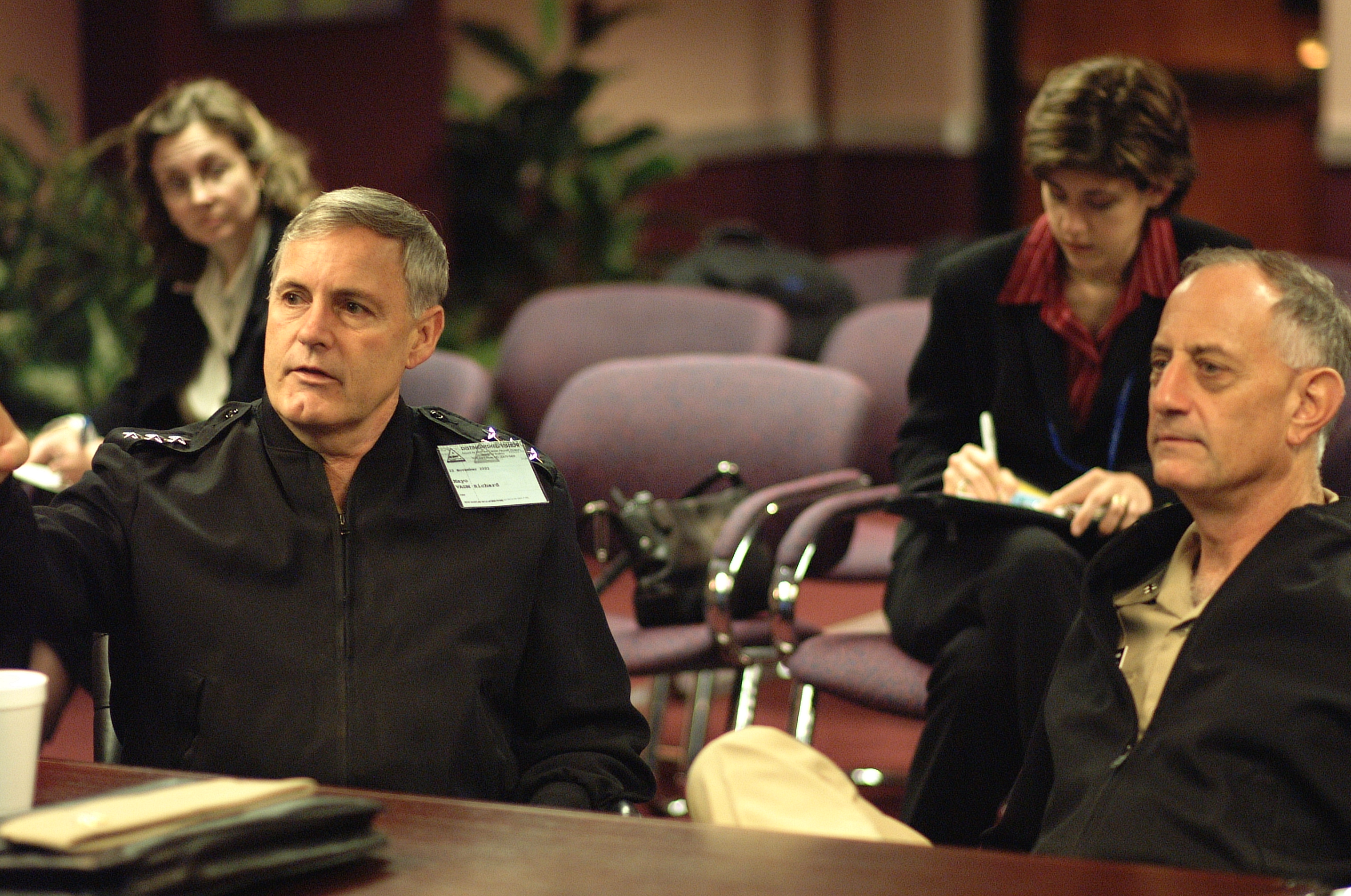
“NAVAIR is clearly out front in supporting the CNO’s Sea Power 21 vision,” said Vice Adm. Mayo during a visit to NAVAIR Patuxent River, MD November 22. Admiral Mayo, commander of the recently established Network Warfare Command (NETWARCOM), talked with NAVAIR leaders about the potential for collaboration on the development of Network Centric Warfare and the Navy’s Information Operations mission. NAVAIR Vice Commander, Rear Adm. Bert Johnston hosted Admiral Mayo on a tour of NAVAIR’s state-of-the-art research, development, test and evaluation (RDT&E) facilities.
Admiral Mayo is responsible for developing an entirely new warfare area – Information Operations. NETWARCOM’s mission is “to act as the Navy’s central operational authority for space, network management and information operations in support of naval and joint forces afloat and ashore; to operate a secure and interoperable naval network that will enable effects-based operations and innovation and to coordinate and assess the Navy’s operational requirements for space, information technology and information operations.” NETWARCOM also serves as the Naval Component Commander to U.S. Space Command (USCINCSPACE) as Commander, Naval Space Command.
“We see tremendous potential in working with NAVAIR on developing IO”, said Capt. James McGovern, director, Information Operations Division (N9), who accompanied Admiral Mayo on the tour.
Admiral Mayo also expressed interest in working with NAVAIR on “Sea Trial” – the CNO’s process for fleet-driven innovation. NETWARCOM, in partnership the Navy Warfare Development Command (NWDC), will facilitate Sea Trial on behalf of the Commander, Fleet Forces Command. As described in Sea Power 21, these commanders will “reach throughout the military and beyond to coordinate concept and technology development in support of future warfighting effectiveness. The Systems Commands and Program Executive Offices will be integral partners in this effort, bringing concepts to reality through technology innovation and the application of sound business principles.”
Poised and Ready for Sea Power 21
NAVAIR has already invested a great deal of resources and human talent toward understanding the technical, warfare and business challenges of transforming to Network Centric Warfare.
From flight to the ground test environment, Admiral Mayo witnessed NAVAIR’s ability to engineer the battlespace and accelerate innovation. With the capability to conduct distributed live, virtual and simulated test events, linking aircraft and weapons ranges to labs on both coasts, NAVAIR is able to simulate future combat scenarios and then extract data to conduct performance trades in a Network Centric context.
“At NAVAIR, we engineer with the Warfighter in mind,” said John Robusto, Director of Network Centric Warfare. Robusto described NAVAIR’s RDT&E community as “clearly aligned and forward leaning” in meeting the Warfighter’s future challenges, both efficiently and affordably. “Our goal is to integrate new technologies, capabilities and doctrinal changes within the 24-month inter-deployment training cycle – a major improvement over today’s lengthy acquisition cycles.
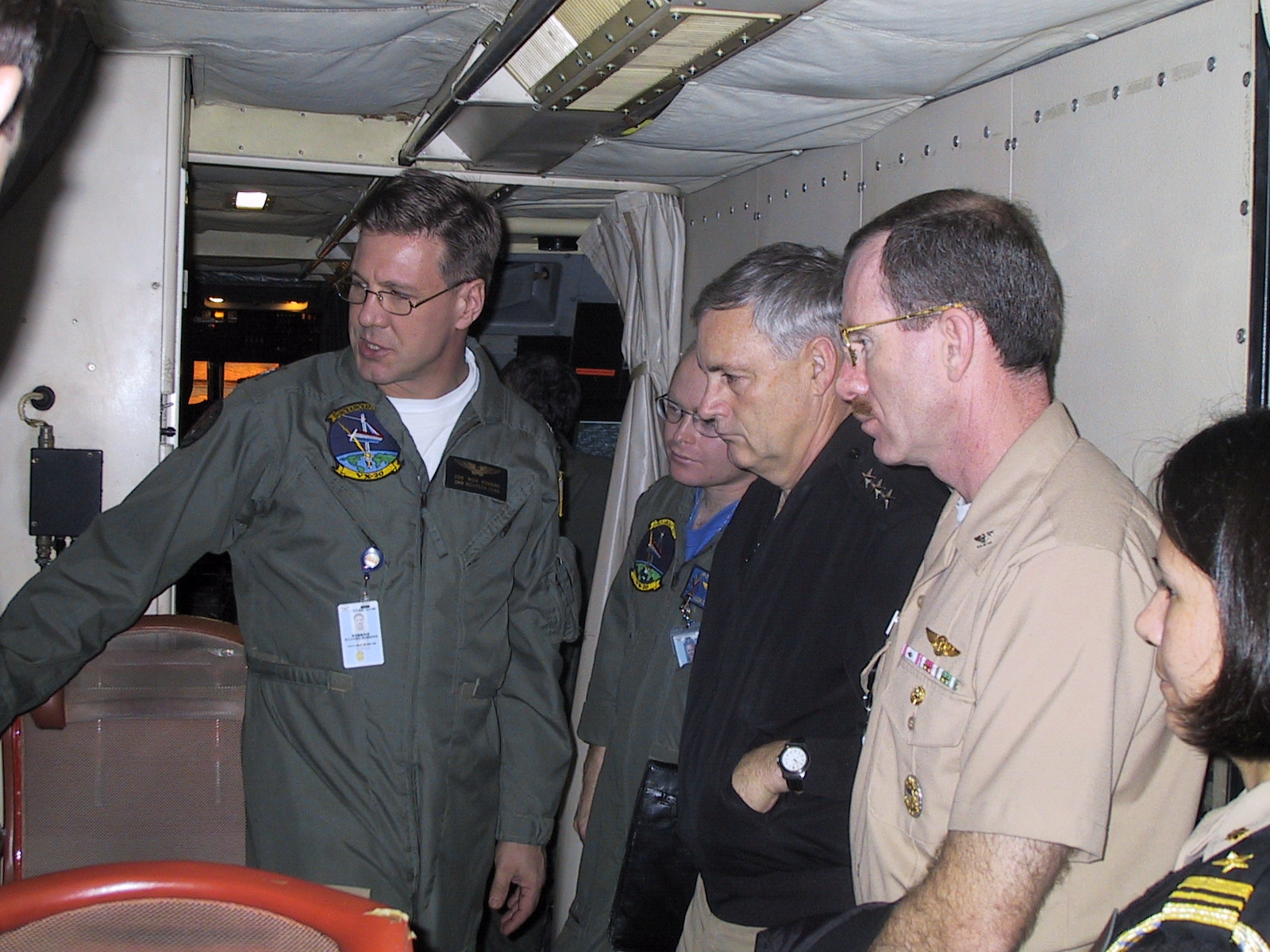
Climbing aboard NAVAIR’s time sensitive targeting and NCW test bed -- the “Hairy Buffalo” aircraft -- Mayo talked with engineers from Northrop Grumman and NAVAIR’s VX-20 test squadron (FORCE) about the Buffalo’s capabilities. The aircraft was modified during FY-02 to provide RDT&E support for the Nation’s Homeland Defense Mission.
According to project manager Cmdr. Ron Carvalho, the modified P-3C was designed, built, tested and operated by NAVAIR personnel in less than six months. As the Navy’s first smart plane, “the Buffalo provides an avenue for experimentation and risk reduction in evaluating new technologies and advanced operational capabilities,” said Carvalho. “It is a risk mitigator, designed to evaluate the influence of new technologies on existing doctrine and tactics.”
Admiral Mayo went on to visit NAVAIR’s Atlantic Ranges and Facilities, starting with a briefing and tour of the Air Combat Environment Test and Evaluation Facility or ACETEF. ACETEF is a fully integrated ground test facility allowing full-spectrum test and evaluation of aircraft and aircraft systems in a secure and controlled engineering environment. Serving international customers, ACETEF uses state-of-the-art simulation and stimulation techniques to provide test scenarios that will reproduce actual combat conditions.
At ACETEF, aircraft systems are deceived through a combination of simulation by digital computers and stimulation by computer-controlled environment generators that provide ratio frequency, electro-optical, and laser stimuli closely duplicating real signals.
“ACETEF is the only facility in the world that can link together aircraft and weapons flying on the range to aircraft suspended in a shielded hanger or anechoic chamber, to warfighters flying high-fidelity simulations in the Manned Flight Simulator,” said John Robusto, Director of Network Centric Warfare at NAVAIR. Admiral Mayo witnessed this unique capability up close while flying in the V-22 simulator over the “virtual landscape” of Patuxent River, MD.
“NAVAIR’s ACETEF is a unique national asset,” said Rear Adm. Bert Johnston, NAVAIR Vice Commander. “We have a ten-year head start in simulation and stimulation, due to the demands of naval aviation and our heritage of flight safety,” continued Johnston. “We need the ability to measure, at a sub-box level, the effects of environmental factors or software failures…because when planes go down, people die.”
Admiral Mayo wants to support the information networks afloat with the same analytical rigor NAVAIR demands for aircraft safety and performance. “We need an off-line network or simulations to safely model end-to-end effects,” said Mayo, recognizing that in today’s information age, a downed network also presents great risk to human lives.
After completing the tour, Admiral Mayo commented that NAVAIR already possesses many of the attributes of NCW capability. He encouraged NAVAIR to foster increased collaboration with the other Navy Systems Commands in support of the Fleet – bringing the Navy’s best collective assets and experience to bear on the problems of NCW.
“NAVAIR is poised and engaged,” said Robusto. “We’ve formed a ‘high speed, low drag’ Network Centric Warfare Team to help put the CNO’s Vision for Sea Power 21 into action. NAVAIR will help refine NCW capabilities through a process of experimentation, modeling and simulation, prototyping, and rigorous analysis that will enable the Navy to prove NCW capabilities before they are delivered to the Fleet.”
Located in eight principal sites around the country, NAVAIR provides the US Navy, other Department of Defense services, and allied militaries around the world with precision naval aviation technologies – specializing in sensors, aircraft, weapons, training, launch & recovery systems, and communications systems.
###
Photo Captions:
(Mayo_Johnston.jpg)
Admiral Mayo, commander, NETWARCOM, talks with NAVAIR Vice Commander, Rear Adm. Bert Johnston, about the challenges of Network Centric Warfare. Admiral Mayo recently toured NAVAIR’s Air Combat Environment Test and Evaluation Facility at Patuxent River, MD.
(Mayo_Hairy Buffalo.jpg)
Inside the Hairy Buffalo, NAVAIR’s NCW test bed, Admiral Mayo talks with VX-20 engineers about recent upgrades to the system’s time sensitive targeting capabilities.