
NAVAIR lab customizes tool for Warfighter
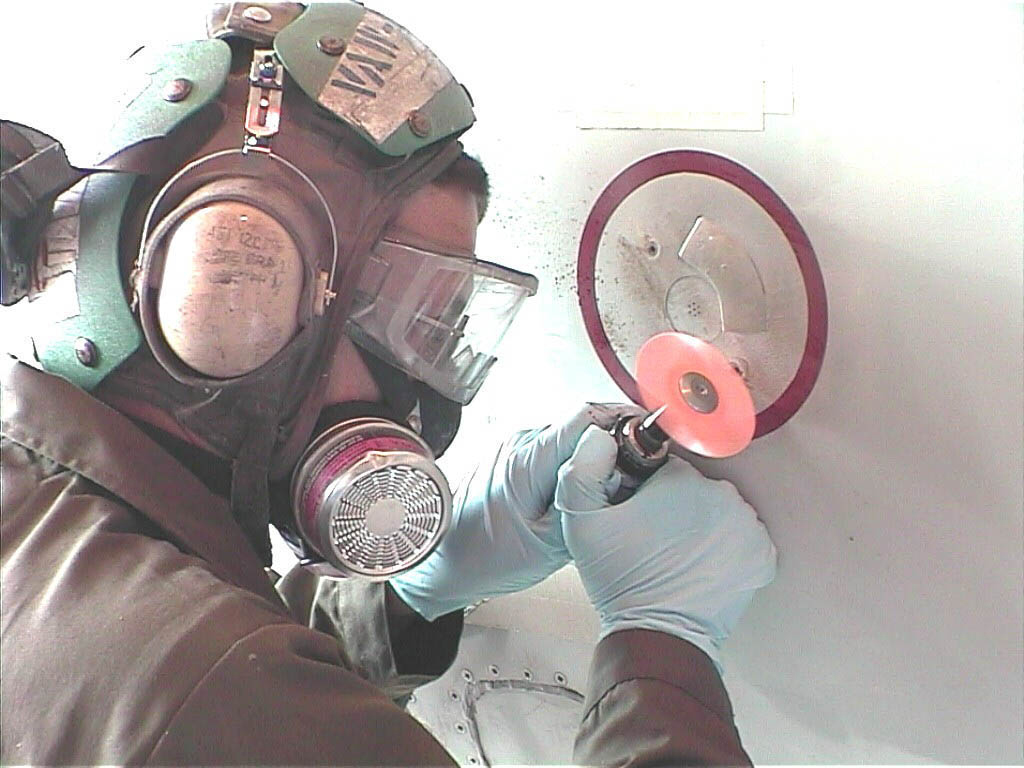
PATUXENT RIVER NAVAL AIR STATION, MD—Engineers and scientists from the Naval Air Systems Command Organic Coatings Lab in the Aerospace Materials Division here are encouraging the use of a new radial bristle disc for corrosion control on naval aircraft. The tool provides a kinder gentler alternative to the traditional abrasive tool aircraft maintenance people commonly used. The new system, designated for use on aluminum surfaces only, includes a high-speed pneumatic grinder outfitted with a 3-inch radial bristle disc impregnated with an abrasive material, is available for procurement.
“We took an existing product (a 3M Corporation developed radial bristle disk) and refined it to meet the fleet’s needs,” explained Thomas Doughty, engineering technician and fleet support representative for the Aerospace Material Divison’s Organic Coatings Lab. “Fleet feedback was instrumental in the development of this product. One of the suggestions we got was to change the color of the discs. We had the discs manufactured in bright colors so maintainers could see the discs against dark floors.”
Doughty further explained that the current technology for repairing corrosion has been around for at least four decades. Corrosion is a constant challenge for naval aircraft maintainers. The old system used a low speed grinder and either an abrasive wheel or flap brush attachment. Both attachments were more destructive to the metal surrounding the corrosion and required far more time and muscle to use than the new radial bristle discs. The radial bristle discs can result in a 50 percent reduction in labor for small corrosion and paint removal applications on aluminum. The abrasive material impregnated in the new discs removes coatings and corrosion without damaging the substrate.
The discs are precise, as well. Since bristle discs will not abrade or gouge bare metal like flap brushes, damage to the area surrounding the corroded area is minimized and requires a minimum of repair. A built in safety feature causes the bristles to fold and render the tool inoperable if pressure in excess of two pounds is applied. This feature also prevents much of the surface damage caused by the old tool.
Another key selling point for the bristle discs is that they reduce the work area temperature. The bristle disc generates less than 100 degree Fahrenheit surface temperatures while the abrasive wheels may yield temperatures in excess of 200 degrees F.
Additionally, the bristle discs are easier to handle. Bristle discs require only one and a half pounds of hand pressure to be applied to the grinder to remove corrosion while abrasive wheels require up to 12 pounds of hand pressure to do the same job.
The benefits of using the radial bristle discs go beyond the major military labor cost savings. There are environmental benefits as well. It is estimated that use of the discs will produce an 80 percent reduction in chromate dust particles NAVAIR-wide, and eliminates the need to use hazardous chemicals for stripping such as methylene chloride and phenol.
Aerospace Materials Division scientist Dr. Kevin Kovaleski and engineering technicians, Doughty and Greg Garrett began working with 3M to develop the two different radial bristle discs after Steve Spadafora, head of NAVAIR’s Materials Protection Branch, saw bristle disks while on a tour of 3M’s lab. He brought some back to Pax River and asked the scientists at the Becker Lab to investigate them as possible corrosion removal tools. The project to refine the tools for the corrosion removal application was sponsored by CNO (N45), Lead Maintenance Technology Center for the Environment, Aging Aircraft Integrated Products Team and the Office of Naval Research.
One disc is designed for medium to heavy corrosion removal and the second disc is designed for light corrosion removal and edge feathering. With the two discs, aircraft maintainers will be able to choose the right tool for the job.
Even though the bristle disc and high speed grinder are an improvement for corrosion removal, NAVAIR has taken the effort one step farther by developing a briefcase-sized tool kit for the repair of corroded areas. This kit, which is still in development, will supplement the discs and grinder with other tools needed to complete the post removal touch-up and repair of corroded areas. The spot corrosion touch-up kit will include touch-up primers and topcoats that maintainers will need. With their small-sized paints, the kits will reduce the amount of hazardous materials necessary in the work place.
Trainers from the Naval Air Technical Data and Engineering Service Command will include training on the proper use of bristle discs as part of their regular training to the fleet. The bristle disc technology will be included in the Naval Aviation Maintenance Training curriculum. Additionally, a training video is being developed by NAVAIR to help the end user with a description and demonstration of this new tool.
NAVAIR provides advanced warfare technology through the efforts of a seamless, integrated, worldwide network of aviation technology experts. From professional training to carrier launch; from sensor data to precision targeting; from aircraft and weapons development to successful deployment; from real-time communication to aircraft recovery NAVAIR provides dominant combat effects and matchless capabilities to the warfighter.
-USN-
A technician demonstrates the use of the radial bristle disc and high-speed tool on an E-2C engine nacelle at VAW-120 in Norfolk, Va.