
NAVAIR to provide improved management structure for aviation students
By Renee Hatcher
PEO(A) Public Affairs
The lives of naval aviation students as well as those who manage their training are about to get easier.
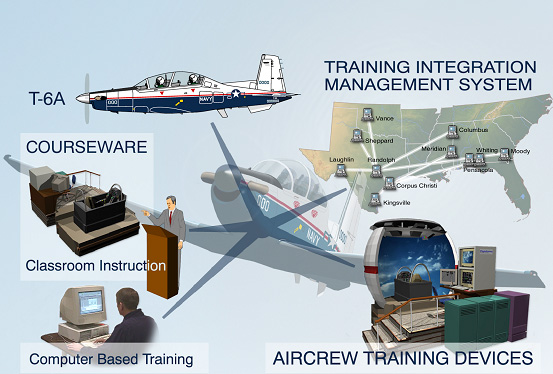
NAVAIR’s Naval Undergraduate Flight Training Systems Program (PMA-273) expects to have a new, single software application that manages all data associated with aviation training up and running at Naval Air Station Corpus Christi this spring, with the other naval aviation training commands to follow. The software, known as the Training Integration Management System (TIMS), will communicate with database servers on each base, and then communicate with servers at the Chief of Naval Air Training Command (CNATRA) and the Air Force’s Air Education and Training Command (AETC).
“For the first time, Navy and Air Force training will be digitally integrated,” said Capt. David Wooten, PMA-273. “TIMS is a centralized training system that will provide cradle-to-grave management of all training assets and student accomplishments.”
The Air Force is the lead service for the TIMS effort with the Navy in a Joint Program Office based at Wright Patterson Air Force Base. TIMS was jointly developed by the Air Force and Navy and was first implemented at Moody Air Force Base in May 2002. Since then, it has been deployed at three other Air Force sites. Several TIMS functions require modifications to meet Navy specific applications before TIMS can be launched for the Navy.
TIMS will provide a single entry point for common information like student biographical data. All of the training sites will be connected through TIMS so that students’ records and data can be transferred electronically as they move through the aviation training pipeline.
It will also help squadron and wing schedulers in building flight schedules by automatically tracking all syllabus events. When a student finishes a computer-based training lesson, TIMS will track completion of that event so a scheduler can tell from his workstation if a student is ready for the next event in the syllabus. After a flight or simulator event, an instructor will complete a student’s gradesheet in TIMS and those results will be automatically available to a squadron scheduler at another workstation. If a student is scheduled for an event before he or she is actually ready to proceed to that event, TIMS will alert the scheduler to the conflict.
TIMS will standardize CNATRA’s information management systems throughout the undergraduate aviation training community. It will replace three different legacy data management systems currently in use including the Training Management System used at NAS Corpus Christi and Pensacola, the Training Integration System used at NAS Kingsville and NAS Meridian, and the Standard Training and Support System Flight at NAS Whiting Field.
“This is becoming increasingly important as we transition to more frequent cross training of our aviators,” said Lt. Cmdr. Tom Cecil, a NAVAIR representative in the Joint Primary Aircraft Training Systems Program Office at Wright-Patterson Air Force Base. “This should make record keeping and record transfer simpler since students and instructors will use the same system regardless of what training base they are on.”
TIMS will give CNATRA more current information on the status of undergraduate aviation training. Data from each site will be transferred to NAS Corpus Christi every 24 hours. This will give CNATRA immediate access to the current status of students and resources at each base. Eventually, CNATRA and AETC will be connected through a virtual private network allowing each service to monitor their own students being trained by the other service. TIMS uses an open architecture and is designed to accommodate future expansion of its imbedded management functions as well as the number of installed sites.
“This is a unique training management system that will consolidate the many functions and interrelationships in the undergraduate flight training environment,” Wooten said. “TIMS will link the Air Force and Navy training sites in a way that we have never been connected before, making it easier to train the best aviators possible.”
GRAPHIC CUTLINE
A single software application that manages all data associated with undergraduate aviation training, known as the Training Integration Management System, is expected to begin deployment at Navy sites in spring 2004. It will digitally integrate all aspects of aviation training including classroom instruction, computer-based training, and simulator and flight events. The Air Force is the lead service on this joint effort and has been using TIMS since May 2002.