NAVAIR demonstrates control of UAV at highest level
By Renee Hatcher
PEO(A) Public Affairs
NAVAIR recorded another first in naval aviation history when a P-3C Orion launched, took control of, and recovered a Fire Scout Vertical Takeoff Unmanned Aerial Vehicle during a 45-minute technical demonstration Dec. 19 at NAVAIR Webster Field in St. Inigoes, Md.
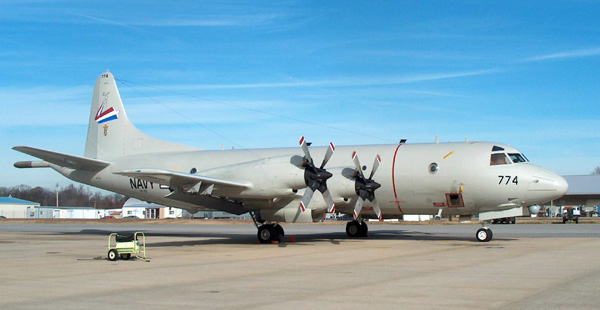
The Aircraft Improvement Program (AIP) P-3C demonstrated the highest level of control, level 5, by controlling the launch and recovery of Northrop Grumman’s Fire Scout, and controlling both the air vehicle and its sensor payload while airborne. The AIP aircraft took off from Patuxent River with an integrated Tactical Control System (TCS) installed that allowed the aircraft to control the airborne Fire Scout. This was a first for the Navy. The TCS developed by Raytheon Corporation and the Tactical Common Data Link (TCDL) developed by L-3 Communication Systems-West were integrated aboard the P-3C AIP aircraft by the prime systems integrator, Lockheed Martin Maritime Systems & Sensors-Tactical Systems Eagan.
The improvements to the P-3C give it the ability to execute its Over The Horizon-Targeting mission more effectively and increase its survivability in a hostile environment while retaining the ability to conduct other missions.
“Through its airborne control of the UAV platform and sensors, the P-3 AIP will be able to greatly expand its support to carrier strike groups and ground forces,” said Capt. Steve Eastburg, NAVAIR’s Maritime Surveillance Aircraft (PMA-290) Program Manager. “This capability will also improve platform survivability, decrease the targeting timeline, improve situational awareness and post-strike battle damage assessment, and provide a communication relay role for battle group assets.”
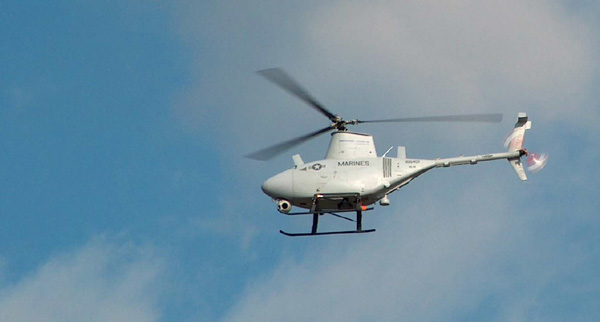
The demonstration began when the P-3C AIP aircraft took off from Patuxent River and launched Fire Scout from Webster Field using TCS. The AIP aircraft controlled the air vehicle and sensor payload via the TCS and vectored the Fire Scout to a simulated target, a U.S. Coast Guard vessel, on the St. Mary’s River. The Fire Scout fed streaming electro-optical video via TCDL to the P-3C during the demonstration. The P-3C then relayed the motion video from the Fire Scout, along with motion video gathered from the P-3C's onboard electro-optical sensor, to a ground station at Webster Field. This relay of Fire Scout sensor data to a ground station demonstrated the network centric concept of making Fire Scout sensor data available (by rebroadcast) to a ground station that is not in direct communications link with the Fire Scout.
The demonstration concluded when the AIP aircraft successfully recovered and landed the Fire Scout at Webster Field. It was a proof-of-concept and risk mitigation exercise for the adjunct UAV command and control requirement associated with the next generation maritime surveillance aircraft, the Multi-mission Maritime Aircraft. PMA-290 and NAVAIR’s Unmanned Aerial Vehicles Program Office (PMA-263) jointly sponsored the technical demonstration. The two program offices have been working as a single P-3C AIP-Fire Scout Demonstration Team since October 2002 to demonstrate the successful integration of TCS and TCDL aboard the P-3C AIP aircraft to enable the control of Fire Scout and its sensor capabilities.
“As the centerpiece of the Navy's UAV architecture, the Tactical Control System was demonstrated at its best today, successfully providing the highest level of UAV control, from an in-flight aircraft,” said Capt. Dennis Sorensen, program manager for NAVAIR’s Unmanned Aerial Vehicles (PMA-263). “Today's event paves the way for future system interfaces and connectivity that are vital to 21st century operational effectiveness.”
For more information, call Joan Holland at 301-342-0207 or via e-mail at [email protected].
Photo by Renee Hatcher
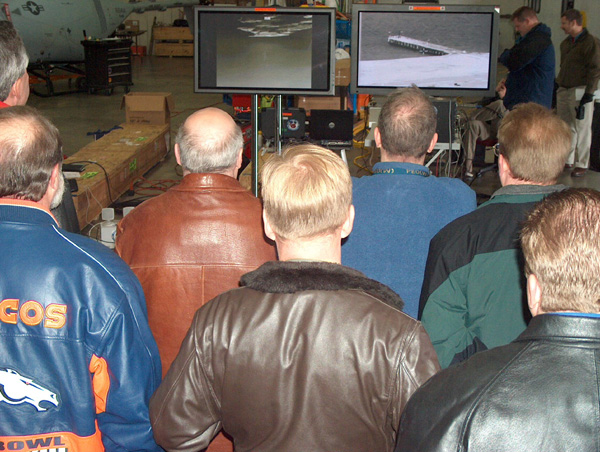
Members of the P-3C AIP-Fire Scout Demonstration Team gather in a hangar at NAVAIR Webster Field Dec. 19 for the P-3/UAV technical demonstration. During the demo, the Fire Scout unmanned aerial vehicle fed streaming electro-optical video to NAVAIR’s Aircraft Improvement Program P-3C Orion. The aircraft then relayed the motion video from the Fire Scout, along with motion video gathered from the P-3C's onboard electro-optical sensor, to a ground station that was displayed on two screens for observers to watch.
Photo by Renee Hatcher
This P-3C Orion parked at Naval Air Station Patuxent River is equipped with a Tactical Control System that allowed the aircraft to control the launch and recovery of a Fire Scout unmanned aerial vehicle during a technical demonstration Dec. 19 at NAVAIR Webster Field. This level of control was a first for the Navy,
Photo by Renee Hatcher
A Fire Scout Vertical Takeoff and Landing Tactical Unmanned Aerial Vehicle takes off from NAVAIR Webster Field Dec. 19 during a technical demonstration.