
23 minutes in the Oval Office
Editor’s Note: On May 1, 2003, President W. Bush became the first sitting President to be “trapped” aboard a ship using an arresting cable. This historic event happened on the USS Abraham Lincoln (CVN 72) while the carrier was steaming back from deployment in support of Operation Iraqi Freedom. For those dedicated people at NAVAIR Lakehurst who were responsible for the aircraft launch and recovery equipment (ALRE) that successfully brought the President’s S-3B to a safe stop, it was indeed a proud moment.
Introduction
Rear Admiral Michael H. Miller, deputy assistant to the president and director, White House Military Office, is a former commanding officer of the USS John F. Kennedy (CV 67) and, as such, had many dealings with George DiBiase, chief ALRE engineer at NAVAIR Lakehurst. Accordingly, when the schedulers planned a ceremony to commemorate the President’s “trap” on the Lincoln, RADM Miller knew he wanted DiBiase -- also known as “Mr. ALRE” to the Fleet -- to provide a technical overview of the equipment and systems used during the historical landing. With 52 years of ALRE experience as well as being the inventor of the Low Pressure Catapult, the admiral knew DiBiase was the ideal participant in the ceremony. DiBiase, in turn, invited Rich Headley, his ALRE manufacturing expert, to accompany him to the White House ceremony.
Arrival
Upon arriving at the East Wing of the White House, RADM Miller informed DiBiase that the ceremony would be in the Oval Office. “You mean we may meet the President?” DiBiase asked. “Yes,” Miller replied. “However, the president's schedule is very dynamic, and it may not happen. But we’re still on the schedule to meet him. I’m sure the Boss would like to meet you.” DiBiase turned to Headley: “Do you believe it, we may meet the President”!
After a briefing with the admiral in his East Wing office, the party moved down to the Roosevelt Room, which is adjacent to the Oval Office. As DiBiase and his ALRE experts were instructed on presidential protocol, tension started to mount. “Is this really going to happen?” wondered Headley. “Are we going to meet the most powerful man in the world?”
Team meets President
All doubts vanished as the door to the Oval Office opened and the three NAVAIR teammates were escorted inside. President George W. Bush extended his hand and greeted DiBiase personally. “George, I heard a lot about you. Welcome to my office.” He then greeted Headley and Gindele with the same cordiality.
“George, I understand your equipment enabled me to land on the Lincoln,” Bush said. “Yes sir, NAVAIR Lakehurst is responsible for the design, manufacture, quality and fleet support of ‘cats’ and gear,” DiBiase responded.
“Well, George,” the president said with a chuckle, “I can attest to the fact that your equipment works! And I thank you for that. Keep up the good work.”
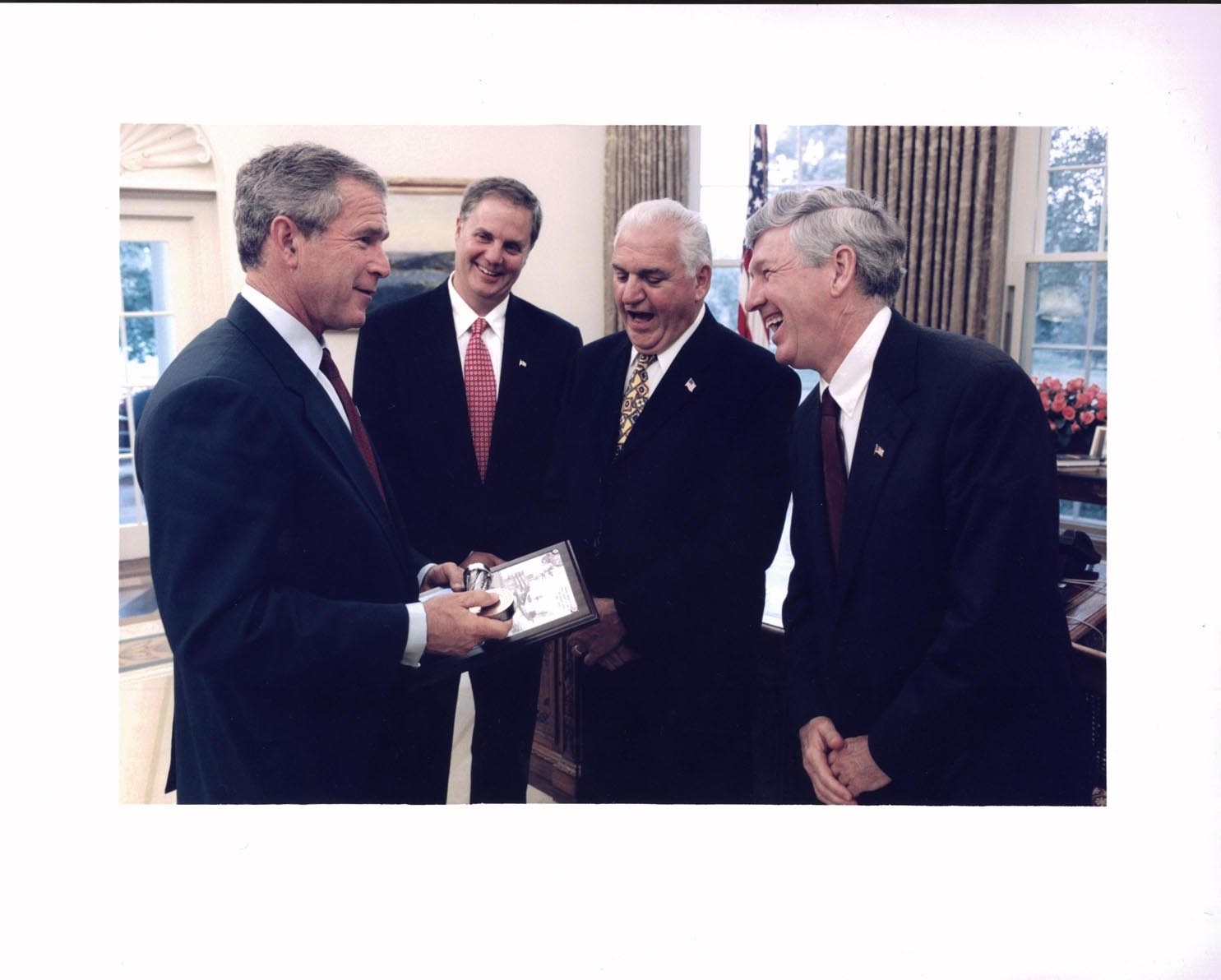
The President then listened intently as DiBiase explained the physics and dynamics of his arrested landing on the Lincoln. DiBiase concluded his technical overview by presenting Bush with a momento of his “trap”: a plaque upon which was mounted a piece of the actual cable that had stopped the president’s aircraft.
“That’s really the cable that I hit on the Lincoln?” he asked.
“Yes,” replied DiBiase. The President smiled and said, “George, come over to the front of my desk.” He then instructed his photographer to “Take a picture of my friends, George, Rich and Mark with me.”
“Take a few. I want these to look good.”
Headley also had a gift for the president: one of Lakehurst’s special “Hockey Puck” awards, which contained a sectioned piece of the terminal from the cable that the President hit on the Lincoln. During the presentation, Headley, mentioned that the artisans in Lakehurst industrial organization also manufactured the cable that his father hit as a naval aviator flying off the carrier San Jacinto (CVL 30) during World War II.
The President paused, smiled, reflected for a moment, and then proudly spoke of how his father was knocked out while bailing out of his damaged TBM Bomber in WWII.
“He was flying off the USS Jacinto when his plane was severely damaged while conducting a bombing run on a radio station on Chi Chi Jima, in the Bonin Islands” the president reported. “He was lucky he made it.” It was clear to the visitors that the President was very proud of his father’s actions during the war, especially once he asked, “George, do you think you can you make a plaque for my Dad?”
“It would be an honor, Mr. President,” diBiase replied. “After all, your father did have 126 traps as a naval aviator.”
The experience of a lifetime
Knowing that their one to two minutes of the President’s time were clearly up, DiBiase and company prepared to exit the room as previously directed by the White House staff. To their astonishment (and the White House scheduler’s surprise) President Bush announced he was, “going to give his friends a tour of the Oval Office!” Looking over to his schedulers with a chuckle, the president said, “and my friends don't have a choice.”
For the next twenty minutes, the most important and powerful man in the world took the time to escort three NAVAIR Lakehurst employees through the Oval Office.
At his first stop, he said, “Every President gets to design his own rug for the Oval Office. I let Laura design this. What do you think, George?”
“Very nice,” DiBiase responded. The president also proudly pointed out Laura’s garden.
He then turned to his desk and said, “George, this is a hand carved desk. It is called the Resolute desk since it was made from a British ship called the Resolute. Queen Victoria gave it to President Hayes as a token of friendship. Most Presidents since Hayes used this desk including Roosevelt, Eisenhower, and Kennedy. “If it was good enough for them, it’s good enough for me,” he humbly added.
Bush then spoke fondly of each painting on his Oval Office walls, identifying the artist and his thoughts on the meaning of each painting. Gindele noticed the president spent about three minutes on each painting and thought Bush exhibited a sensitivity and sincerity that “you never really see on the evening news.”
Getting to know him
As the group toured the Oval Office, Bush discussed the history of the White House, past Presidents, leadership, the war on terrorism and the pride he had in our armed services. To the Lakehurst visitors’ surprise, he asked their opinion in each area. “We were struck by the president’s sincerity, and the personal, down-to-earth conversation we were having,” said Gindele. “Our conversations included good natured kidding on a various topics.”
During one lighter moment while talking about leadership, Bush turned and surprised Headley when he asked him to comment on a painting that showed a cowboy on a horse leading other cowboys up a hill, littered with rocks and logs.
“Rich,” the President asked, “Look at the cowboy’s face. Is he going to make it up the hill?”
Headley, with hesitation, answered, “Yes.”
“Right answer!” Bush responded emphatically, “That is leadership!”
Later, Headley was overheard saying that he would have crawled under the Resolute desk if he had given the wrong answer.
Farewell
As the tour concluded, the President said, “George, I bid you farewell. I am due for a meeting with the Prince of Egypt.”
“It was truly an honor to meet with you,” DiBiase responded. “I will never forget it, Mr. President.”
After a round of hand-shaking, the Lakehurst trio left the Oval Office in a state of shock. Did it all really happen, they wondered?
“Did we do all right?” Dibiase asked Miller.
“I never witnessed the president take as much time out as he did for you guys,” the admiral replied. “You did great!”
30
Caption: President Bush kept his visit with (left to right) Mark Gindele, ALRE manufacturing quality expert, George DiBiase, chief ALRE engineer, and Rich Headley, ALRE manufacturing expert, friendly and informal. He spoke of family matters, current events, and even told a few jokes.