Reserve "Green Shirts" Help NAVAIR Meet Current and Future Challenges
By Lt. Mike Randazzo, Air Systems Program Public Affairs Officer
Aerospace Maintenance Duty Officers (AMDOs), who proudly don the green shirt, have been serving as the Navy’s professional aircraft maintenance management corps since President Lyndon Johnson formally established the community with the signing of Public Law 90-366 in July of 1968. The AMDO community recently celebrated its 35th anniversary at a professional symposium. The event’s theme, "Aerospace Maintenance Duty Officers Meeting the Challenges of the 21st Century,” featured three days of prominent guest speakers and informative discussions.
Officers from the Naval Air Systems Command's (NAVAIR) Air Systems Program (ASP), a vital part of the AMDO community, turned out for the event in force.
The ASP consists of approximately 600 Naval Reserve officer and enlisted personnel providing direct support to the NAVAIR team at its headquarters in Patuxent River, Md., and locations throughout the United States. The Program’s 32 units are located throughout 14 states, and provide NAVAIR with in-depth customer support for research and development, engineering, program management, logistics, and industrial capability. Of the ASP's 366 officers, 110 are designated AMDOs.
ASP AMDOs provide a variety of direct support primarily to NAVAIR's AIR-3.0, Logistics, and AIR-6.0, Naval Aviation Depots (NADEPs) throughout the U.S. ASP AMDOs are also attached to other NAVAIR competencies, including AIR-1.0, Program Management.
The original AMDO mission, "To provide full-time direction in the development, establishment, and implementation of maintenance and material management policies and procedures for the support of naval aircraft, airborne weapons, attendant systems and related support equipment," remains the same.
Today, however, in addition to working in squadrons and Aircraft Intermediate Maintenance Departments (AIMD) throughout the fleet, ASP AMDOs are very much involved as top-level Program Managers supporting numerous NAVAIR programs and operations.
“Air System Program AMDO officers epitomize the very best of industry skills,” said Rear Admiral Mike Bachmann, Assistant Commander, Logistics, Naval Air Systems Command. “Coupled with a deep understanding of operations acquired during their earlier fleet assignments, this cadre of professionals provides immeasurable value to the warfighter. I expect Reserve AMDOs will continue to serve as a meaningful component of the NAVAIR team well into the future.”
For more information about ASP please contact Lt. Mike Randazzo, ASP Public Affairs Officer, at 717-279-7068 or [email protected]. For more information about the AMDO program please log onto the AMDO Association's website at www.amdo.org.
NAVAIR (www.navair.navy.mil) provides advanced warfare technologies through the efforts of a seamless, integrated, worldwide network of aviation technology experts. From aircraft and weapons development to carrier launch and recovery; from sensors to real-time communications to precision targeting; from aircraft and weapons sustainment to state-of-the-art training; NAVAIR provides dominant combat effects and matchless capabilities to the American warfighter.
Sidebar:
A Brief History of the AMDO
The Navy's AMDO designators are 1520, 1524, 1525 and 1527. There are around 600, men and women, officers from Ensign to Rear Admiral on active duty filling critical roles in aviation maintenance throughout the fleet. AMDOs are attached to squadrons, aboard aircraft carriers, in fleet replacement and training squadrons, and at fleet and headquarters staffs.
Beginning in the late 1950s, and continuing through the early 1960s, various CNO-directed studies identified a need for an officer corps dedicated to providing full-time, professional aircraft maintenance in response to the challenges presented by the new generation of sophisticated and expensive weapon systems then being introduced into the fleet. Anticipated reliability and maintainability issues could not be permitted to compromise operational readiness or flight safety. There were simply too few professional maintenance officers available to meet these new challenges.
SECNAV officially established the Restricted Line community in March 1968. December 1968 saw the selection of the "Original 100" AMDOs from the ranks of Naval Aviators, general aviation officers, Aviation Limited Duty Officers and Aeronautical Engineering Duty Officers. This group became the nucleus of a professional aircraft maintenance management corps.
In 1981, a decision was made to join the AMDOs and AEDOs at the Captain level into a new, single competitive category with a 1500 designator (1505 for Selected Reserve officers). In 1983, the community instituted a formal selection board to select Commanders for assignment as Department Head of major shore and afloat Aircraft Intermediate Maintenance Departments.
In December 1988, the first AMDO was selected to Flag Rank. In 1990, the Chief of Naval Operations formed the AMDO Training and Administration of Reserve (TAR) program (designator 1527). These dedicated, full time reserve officers provide fleet experience and professionalism to the management of reserve Aircraft Intermediate Maintenance Department, staffs and squadrons.
Photo 1 Caption: Rear Admiral Mike Bachmann, Assistant Commander, Logistics, Naval Air Systems Command (center) with a contingent of Reserve AMDO’s representing the Air Systems Program at the recent Aviation Maintenance symposium, which celebrated 35 years of the AMDO community. The event’s theme, "Aerospace Maintenance Duty Officers Meeting the Challenges of the 21st Century,” featured three days of prominent guest speakers and informative discussions.
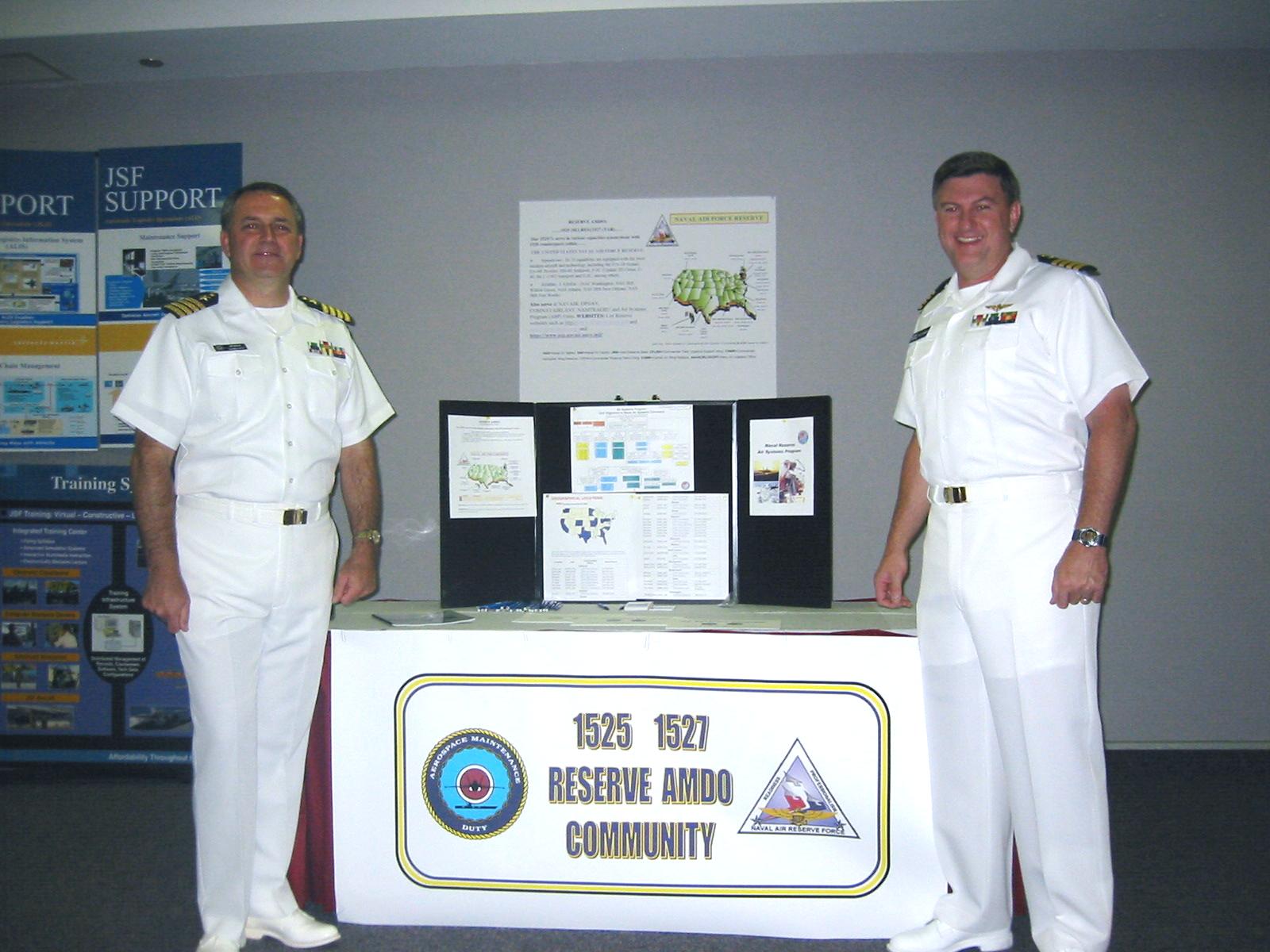
Photo 2 Caption: ASP Naval reservists CAPT Joe Badick (left) and CAPT Paul Danner (right) man the "recruiting" booth at the recent Aviation Maintenance symposium to raise awareness of the opportunities available to active duty junior officers in the Reserve AMDO program. The event’s theme, "Aerospace Maintenance Duty Officers Meeting the Challenges of the 21st Century,” featured three days of prominent guest speakers and informative discussions.