
Pax teams give fleet what it needs to help fight war on terrorism
By JIM JENKINS
Public Affairs
NAVAIR PATUXENT RIVER, MD—The Marine Corps’ heavy haulers now have more dropping from their cargo ramps than just cargo.
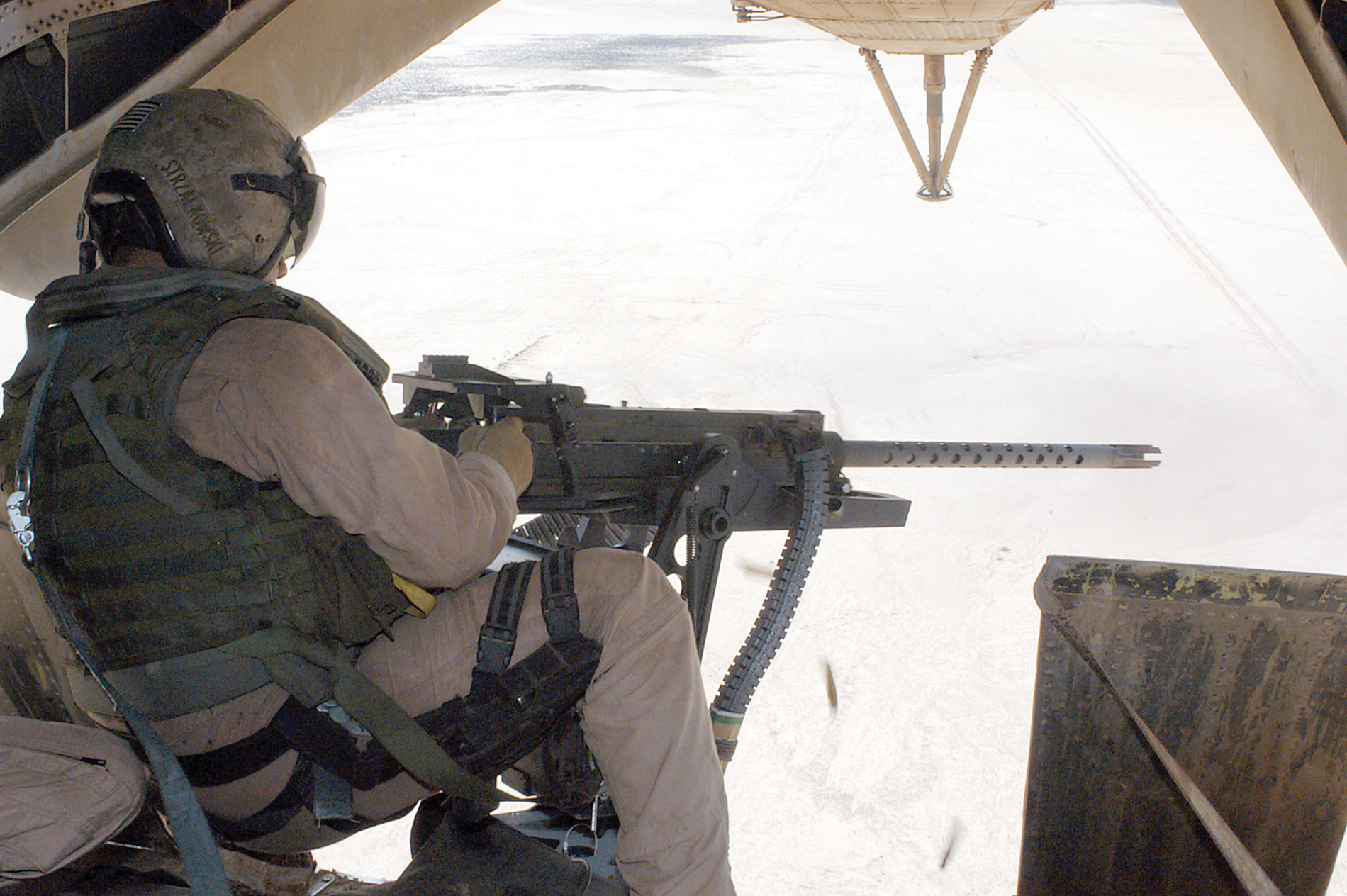
With the help of NAVAIR Pax River engineers, the CH-53E Super Stallions are slinging lead from the back end of the helicopter, adding more than 180 degrees of defensive fire to the rear of the aircraft. They are no longer vulnerable at their “six.”
Responding to a rapid-deployment-capability request made by Marine Heavy Helicopter Squadron 461 with the Combined Joint Task Force-Horn of Africa in support of Operation Enduring Freedom, teams from Pax, working with the Marine Corps Warfighting Laboratory, provided a flight clearance and prototype ramp-mounted weapons system to the squadron in just 40 days.
The system, referred to as M3M, consists of a Fabrique Nationale .50 caliber machine gun mounted to the ramp of the Super Stallion that can be installed and removed again in under two minutes, according to end users in the field. The M3M is also a soft-mount weapon that has the ability to absorb recoil due to an internal spring within the system. Reduced recoil means reduced load going back into the gunner’s arms and the aircraft each time the weapon is fired. There is less wear and tear on the Marine user, the system itself and the helicopter.
“With the collaborative efforts of AIR 4.3 Structures, AIR 4.6 Crew Systems and AIR 4.11 Stores Capability, we came up with an aggressive plan to do a limited flight test analysis of this ramp-mounted weapon system,” said Eric Schwartz, H-53 / Executive Transport Helicopters program office (PMA-261) class desk engineer here. “We shipped four units out to Djibouti right at the end of August and they are currently out there supporting Operation Enduring Freedom.”
The Super Stallions already had two .50 caliber machine guns mounted on both sides of the helicopter in the side windows covering the front and most of the sides of the aircraft with suppressive fire, but the rear was always exposed. Early on during OEF in Afghanistan, Marines were cargo-strapping gunners on the ramp of the aircraft armed with M16s and M60s to provide rear suppressive fire. CH-53E missions are such that when they land they either load or unload cargo or personnel from their rear ramps, exposing the interior of the aircraft to enemy fire. The CH-53E is not an offensive gun ship, but recent missions have put the Super Stallions in “hot” landing zones where fire could come from almost any direction.
“[The M3M] provides a new capability,” said Maj. Andrew Butler, MCWL M3M project coordinator. “The system works well.”
Butler, who spent time in Djibouti testing the system, said that they are still learning a lot about it as they continue to conduct the assessment, and that they were able to field four systems with help from PMA-261, the Defense Suppression Systems program office (PMA-242), NAVAIR engineers, Air Test and Evaluation Squadron 21 and other Pax River teams such as Test Article Preparation. Overall the response from the field has been good.
“Shot the RMWS yesterday. It kicks butt,” said one field operator in an e-mail sent to Schwartz. “[It’s] a real motivator for the Marines out here. We shot 6,100 rounds yesterday, 2,100 through the RMWS [and] not even a hiccup! Not a single misfire or jam. Great job getting the system out here.”
Despite the rapid deployment of the four systems, PMA-261 will begin a more thorough and detailed developmental test of the M3M ramp-mounted weapon system before it can be made readily available to other squadrons. Testing is scheduled to start this fall and involves using HX-21 aircraft.
“We have to do that in order to verify the M3M system for full fleet introduction,” Schwartz said. “With the incorporation of the ramp-mounted M3M system, the CH-53E Super Stallion will be an ominous force to reckon with today’s global war on terrorism.”
Photo by Sgt. Matthew B. Roberson
Sgt. Ron Strzalkowski, HMH 461 air crewman, engages multiple targets during the first live-fire exercise with the Ramp-mounted Weapon System at Camp Lemonier, Djibouti. The RMWS provides CH-53E Super Stallion helicopters with a much needed defensive system providing 180-degrees field of fire from the rear of the aircraft.
—USN—
NAVAIR provides advanced warfare technologies through the efforts of a seamless, integrated, worldwide network of aviation technology experts. From aircraft and weapons development to carrier launch and recovery, from sensors to real-time communications to precision targeting, from aircraft and weapons sustainment to state-of-the-art training, NAVAIR provides dominant combat effects and matchless capabilities to the American warfighter.