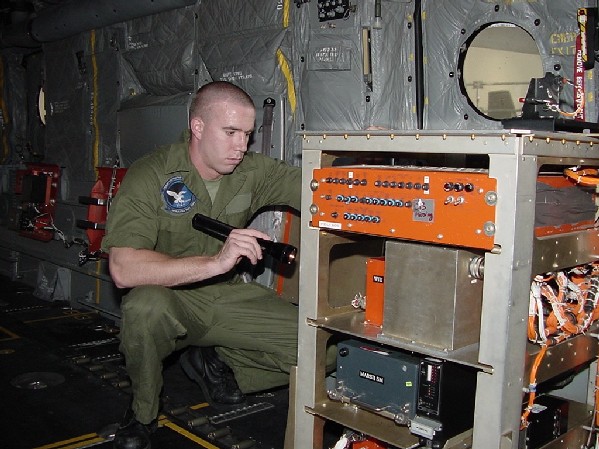
Marine Corps Sergeant Chris Hanzlik inspects an electronics rack in the cargo bay of a V-22. (Photo by Randy Teufel)
Marine Keeps Ospreys Airborne
When Sergeant Chris Hanzlik joined the Marine Corps in March of 1997 he did so with an eye on eventually getting into law enforcement. But more than six years and a handful of duty stations later, he’s come to realize that what he really loves is working on airplanes, and the airplane he’s learned to love more than any other is the V-22 Osprey.
“I’ve been associated with the V-22 since January of 1999,” the Minnesota native says, working under the expanse of the Integrated Test Team’s new tension fabric structure, the high-tech hangar that houses two of the seven Ospreys assigned to the test force at Patuxent River. “In fact, all of the Marine maintainers currently working on the ITT have been together since then, if not longer. We’ve been through a lot together. We’re the maintenance corporate knowledge for the Marine tiltrotor community.”
After boot camp and “A” school, Sergeant Hanzlik was assigned to HMM-262, an H-46 squadron that was based in Japan. Since that tour he’s focused his talents as an engine and drive shaft technician exclusively on the V-22. “The Osprey is different than the Sea Knight, but definitely not harder to work on,” Hanzlik says. “Because of the state-of-the-art design and health monitoring system, troubleshooting the V-22 is a lot easier.”
While the Marines who are currently supporting the V-22 ITT maintenance effort are only one part of the government/contractor team, as the focus of Osprey testing begins to shift from developmental testing to operational employment the corporate knowledge of Sgt. Hanzlik and others will be fully exploited. They’re joining VMX-22, the new tiltrotor operational test squadron and center of excellence in New River, North Carolina, in the near future. “Although I’m a northerner, I’m looking forward to going back down south,” Hanzlik says. “It’s great to take the V-22 one step closer to fleet operations.”