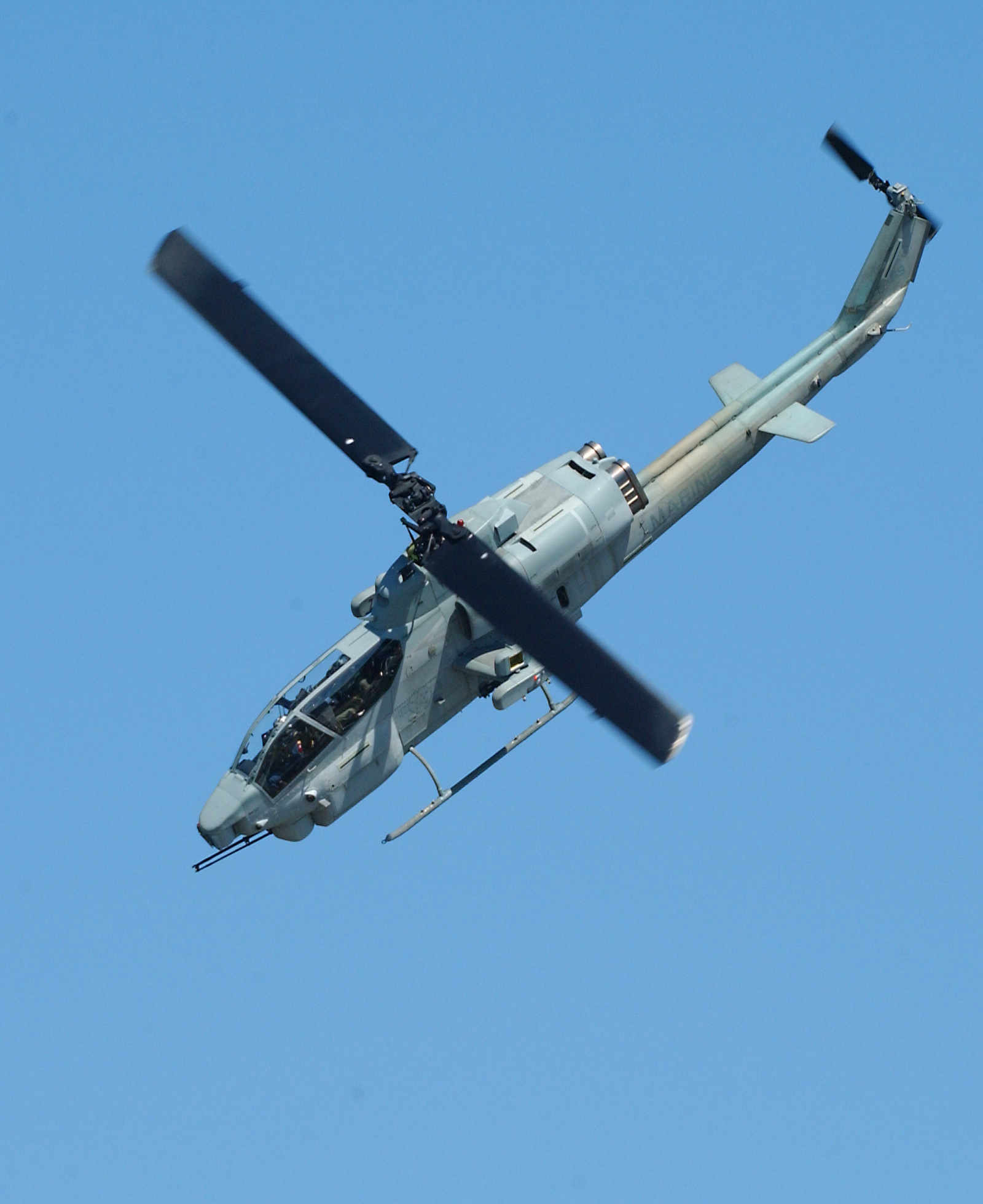
Marines' AH-1W Super Cobra turns 20
By John C. Milliman, Marine Corps Helicopter Programs PAO
NAVAIR Patuxent River -- Coming on the heels of the Marines’ 228th birthday, another anniversary important to Marines came over the weekend – the 20th birthday of their close air support workhorse, the AH-1W Super Cobra attack helicopter.
The first flight of a re-engined AH-1T Cobra took place Nov. 16, 1983 at Bell Plant Six, located at the Arlington, Texas municipal airport. Bell test pilots Monte Nelson and Dick Kjellander were at the controls of the AH-1T+/T700, BuNo 161022.
After gaining approval for production, Bell followed the prototype (which sported a Cobra paint scheme designed by Maj. Mike Compton) with 195 production AH-1W’s. The last was delivered in July 1998.
Adding new, more powerful engines to the existing Cobra model drove the birth of the Corps’ current generation attack helicopter.
“It was all about POWER – or lack thereof in the T-model Cobra,” recalls retired Lt. Col. Richard A. Bowen, a former Cobra pilot. “Many ‘lack of power’ close calls stick in my mind, but one that doesn’t involve an 'almost mishap' is when I attempted to lift a T-TOW model (with no ordnance) into a hover at NAS Fallon (Nev) on a high density altitude summer afternoon.
“As I continued to add power to the maximum engine output allowed,” Bowen adds, “the Cobra just sat there! My co-pilot and I actually thought the ground crew had chained the aircraft to the flight line tiedowns and he got out of the cockpit to confirm that we weren’t still chained down! We had to wait for the DA to come down!”
Indeed, the Marine Corps quickly realized that although its venerable attack helicopter had grown well beyond it’s original single-engined gunship iteration dating to the Viet Nam era, it still needed bigger, better engines.
“The AH-1W grew out of an R and D effort between PMA-276, Bell Helicopter-Textron and General Electric Aircraft to install the T-700 engine in the AH-1T,” explains Larry “Bandit” Outlaw, retired Marine Colonel, Cobra pilot and currently the director of Government Affairs for Textron. “Once we put those bigger engines in the aircraft, we had all this capability – TOW, Hellfire, Sidearm, Sidewinder, 2.75-inch rockets, 20-mm gun and other precision-guided munitions – that made it the most versatile attack helicopter in the world.
“And we’re expanding the aircraft again to produce the AH-1Z,” Outlaw states. “The heritage of Bell, NAVAIR and GE is a proud and productive one.”
NAVAIR’s Curt Carey agrees.
“For 20 years, the Super Cobra has been down in the dirt providing close air support and armed recce to Marines on the ground,” says the career Super Cobra pilot and current assistant program manager for systems engineering in PMA-276 here for the AH-1W.
In addition to being a much more capable warfighting platform than its predecessors, the AH-1W’s improved power gave it more survivability and robustness, according to Carey.
“For 14 years and almost 3,000 hours in the Super Cobra, she’s always brought me home safe,” he adds.
The Super Cobra has a few more birthdays to go, though.
“She’ll be carrying the fight for at least another 11 years or so until the last of the new AH-1Z’s are delivered in FY14,” Carey explains. “If our success in Iraq and Afghanistan is any guide, then I’d say the workhorse of Marine Corps close air support is just now hitting her stride.”
-30-
Photo Cutline: Good snake! -- An AH-1W Super Cobra assigned to HX-21 here, and one of 198 built by Bell since the first one flew Nov. 16, 1983, performs a wingover during a low-level flight here recently. The Marine's most lethal snake turned 20 over the weekend but still has plenty of venom left. Deliveries of its replacement, the AH-1Z, won't be completed until 2014. Photo by Jaime Darcy.