New Teaming Effort Transforms Marine Simulator Training
New Teaming Effort Transforms
Marine Simulator Training
by John Goodman
NAVAIR Public Affairs
At New River, NC, the Marine Corps recently celebrated two very large white boxes sitting on a concrete pad. Housing a radically new breed of flight simulator, the containers symbolize a new era of how the Corps will perform its aviation training.
Since the late 1970s when simulator training first began at MCAS New River, oversight rested with the base commanding officer. Now with the creation of Aircrew Training Systems (ATS) and these two new simulators, pilot training will be consolidated under one organization which has moved from a supporting function to one with operational leadership and focus. That change now puts the warfighter in charge of aviation training, its associated capabilities and facilities.
The simulators were delivered ahead of schedule and under budget by NAVAIR this past summer, with major help and coordination from Lockheed Martin Information Systems (LMIS), the prime contractor. They provide very advanced training capabilities for the CH-53E heavy-lift helicopter and the CH-46E troop-carrying helicopter. In an environment that’s amazingly close to flight, pilots can now get true tactical training.
Training for Network-Centric Warfare
Simulator performance has far surpassed expectations, according to Jeff Smith, recently retired program manager of the Marine Corps Aviation Simulator Master Plan (MCASMP), who was instrumental in bringing these simulators to life. Called APTs (aircrew procedures trainers), they are containerized for portability and lower cost. Their visual systems are state-of-the-art and provide a cockpit view and visual perception of actual flight that exceeds anything used in the fleet right now. These APTs are capable of operating in any environment—day, night, night-vision goggle, and adverse weather training.
They are also networked to the base’s V-22 simulators and to the CH-46 Weapons System Trainer (WST), CH-53 WST and the UH-1N Aircrew Procedures Trainer (APT) so pilots can fly formation training flights, use section tactics and conduct advance mission scenarios. Smith explains: “For the first time, our pilots have the opportunity to do network flying with multiple devices. We can now develop flight leadership skills within our simulators, where before we were forced to use our aircraft.”
A New Kind of Partnering
Building the acquisition processes and teaming effort was just as complicated as the design/build of the machines. NAVAIR was an important partner in several ways. Capt. Larry Howard, program manager for PMA-205, helped restructure and focus the various Marine Corps training systems to support a new training systems federation for looking at things like budget issues, obsolescence and systems issues across the entire corps, not just singly or in stovepipe fashion.
Another NAVAIR contribution was to help integrate government oversight, engineering and contractor involvement. AIR 1.0’s business process re-engineering (BPR) was instrumental in getting all the contract parties involved early on, spelling out the requirements and embedding each in the other’s processes so as to share the work and avoid surprises.
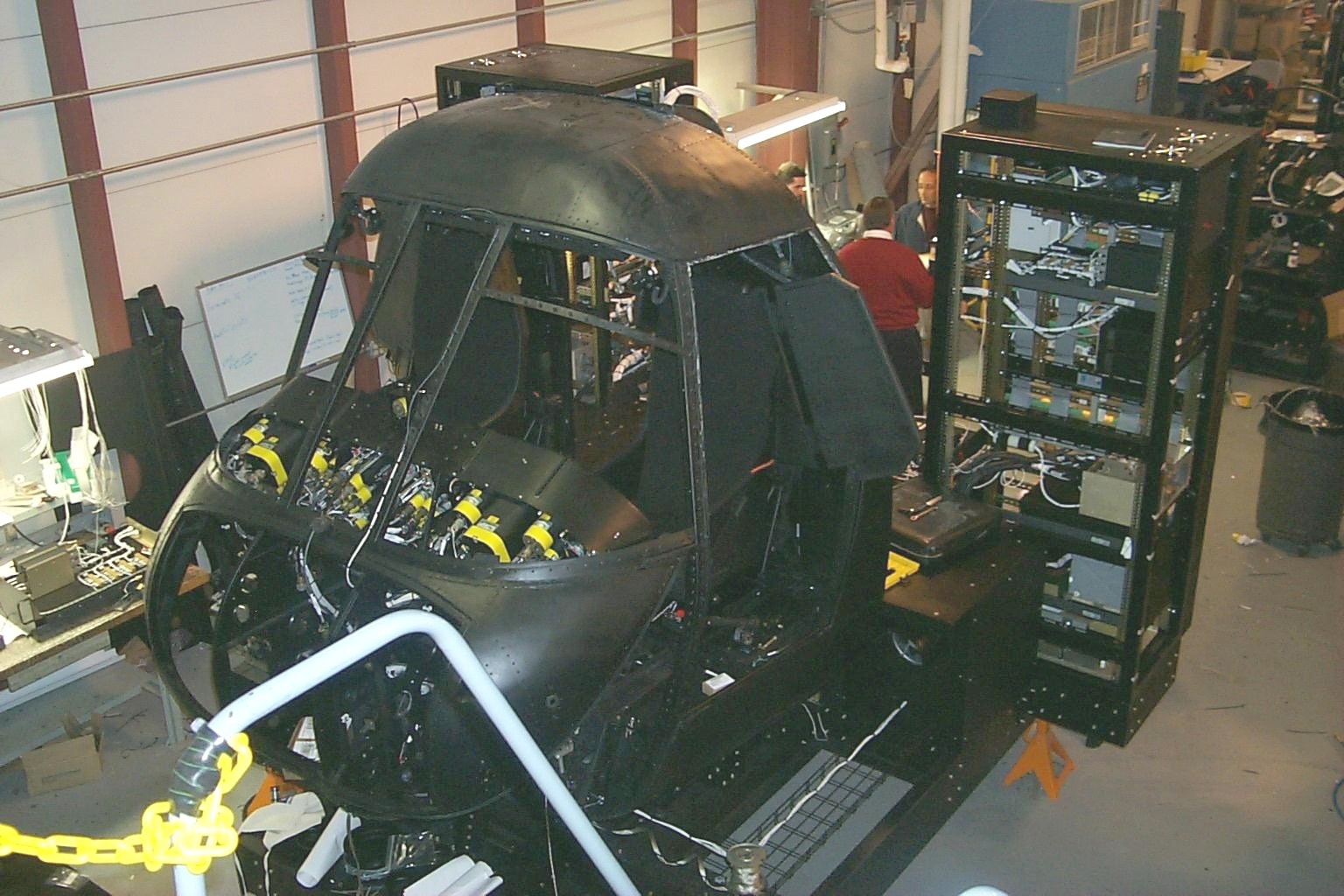
Finally, NAVAIR’s Manned Flight Simulation group proved key to the project—both as builder and partner. They built three complete cockpits, delivering them with zero-defects, per the drawings, with 17 miles of wire in every cockpit. “That is almost unheard of in this business,” says Howard. “Manned Flight works with us [PMA-205] not to compete with industry but as a government-controlled source when we’re not entirely solid on what we’re going to build as we start. They have the technical and design expertise as well as the ability to produce and build. Manned Flight partnered with us and Lockheed Martin to do much of our final design work on this project, and they did a superb job of building something fully as complex as an actual aircraft cockpit.”
There are plenty of kudos to go around on the simulator project but its success was clearly owing to the team effort. LtCol. Todd Glenn, the new MCASMP team leader, put it this way. “The new trainers give our Marine aviators greatly expanded training capabilities which go a long way to address current training challenges posed by shrinking budgets and flight hours, encroachment restrictions, shortage of adequate training areas and more complex weapons systems. The ATS concept will surely help us maximize the use and effectiveness of those capabilities.”
__________________
NAVAIR provides advanced warfare technologies through the efforts of a seamless, integrated, worldwide network of aviation technology experts. From aircraft and weapons development to carrier launch and recovery; from sensors to real-time communications to precision targeting; from aircraft and weapons sustainment to state-of-the-art training; NAVAIR provides dominant combat effects and matchless capabilities to the American warfighter.