Depot, contractor team up to service warfighter better
Cutline:
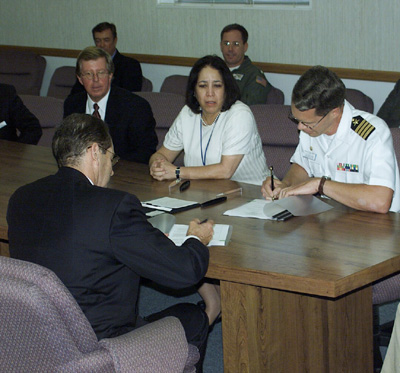
Capt. James Woolway, NAVAIR Depot North Island commanding officer, and John Borghese, vice president and general manager of Kaiser Electronics, each sign a contract awarding the company – a division of Rockwell Collins – a Navy contract for performance based logistics. Looking on are Eva Escalante, NAVAIR Depot North Island command counsel, and John Balkwill, a Rockwell Collins program manager. Photo by Scott Janes
NAVAIR Depot North Island, contractor team up to service warfighter better
By Bill Bartkus
CORONADO, Calif. – NAVAIR Depot North Island and Kaiser Electronics, a division of Rockwell Collins, have formed a partnership that further benefits the warfighter. The Depot and the San Jose, Calif.-based company signed a $12 million Performance Based Logistics Commercial Service Agreement to support the F/A-18 A-D heads up display, digital display indicator, and digital repeater indicator.
The CSA is in support of a Naval Inventory Control Point $130 million contract signed with Kaiser Electronics that includes two additional options – each a five-year period – of nearly $126 million and $103 million respectively, that brings the total estimated amount inclusive of all option years (15 years total) to $360 million.
Capt. James Woolway, depot commanding officer, and John Borghese, vice president and general manager of Kaiser Electronics, inked the deal and signed the agreement at the depot recently. “This agreement provides better quality products at a lower cost, thereby benefiting the fleet,” Woolway said. “This agreement has been a long time in coming and the depot is anxious to begin this work.”
According to NAVICP, Performance Based Logistics programs have great potential to reduce costs as well as improve the reliability and availability of the components it provides to its customers. When fully implemented, PBL will permit reduction in the Navy’s investment in infrastructure and inventory, as well as provide increased component availability. PBL will allow NAVICP to live within current resource reductions while continuing to provide the outstanding support that customers expect.
The PBL strategy is a long-term agreement that incentivizes and empowers the commercial provider to meet customer oriented performance requirements in order to improve product support effectiveness, while reducing total ownership cost.
“Currently, workload comes from NAVICP, and the depot is responsible for the material procurement, repairing, packaging and sending the finished product back to NAVICP,” said Jose Jimenez, Industrial Logistics Support Office deputy director for business services at the depot. Under this agreement, Kaiser will be responsible for the supply chain logistics. “They will deliver the repairable component, the replacement parts, package and subsequently ship the component,” he said. “Now the contractor is responsible for providing all the material our artisans need to do what they do best: hands on repair.”
Additionally, replacement factors for parts will be monitored which will provide an opportunity to increase reliability of the components. “As an example, parts that are replaced will be tracked. Parts that have high replacement factors may be reengineered for higher reliability,” Jimenez said. “The goal is to ensure that the warfighter will have these components onboard the aircraft longer versus having to pull it out. In the long run, everything works out best for the warfighter.”
Planning between the depot and Kaiser has been ongoing since 1999, Jimenez noted. He said that Walt Palmer, ILSO director, and Steve Hunten, ILSO deputy director for component capability, initiated the deal. “It’s been going back and forth over the years because it’s a new process, and it has taken this long to establish the guidelines,” Hunten said.
“NAVICP decided that direct vendor delivery – the predecessor to PBL – was a good idea. As time progressed, it became evident that performance based logistics would better help the fleet get what it needed when it needed it.” Hunten said that NAVICP contacted Kaiser Electronics in early 1999 and started the ball rolling.
According to Hunten, the depot had been working on putting together a model and working some partnerships that weren’t related to PBL but with the aerospace industry. “We had been working this project since 1996,” said Hunten, “so the seeds of this whole concept started seven years ago based on some conversations the depot had with the deputy undersecretary of defense for logistics.”
Hunten, Palmer, and depot logisticians and engineers visited Kaiser Electronics in San Jose in 1999 and it immediately became evident that the PBL concept was a good idea. “NAVICP wanted to do a PBL contract and Kaiser officials believed that it would improve its posture in the avionics community,” said Hunten. “All of us were convinced that the fleet would benefit from a partnership, and the depot believed that the PBL model that included material management could be improved.”
Hunten mentioned that it has taken four years to meld the concept together. “We all firmly believe that the fleet will be the ultimate winner. This is the key point to performance based logistics!”