NAVAIR brings advanced imaging capability to Harriers
By Linda Lou Crosby
Advanced Information Engineering Systems, Inc.
The NAVAIR AV-8B Harrier Integrated Product Team delivered an advanced video downlink pod capability to Marine Corps Harrier Squadron VMA-214 just in time for Operation Iraqi Freedom deployment.
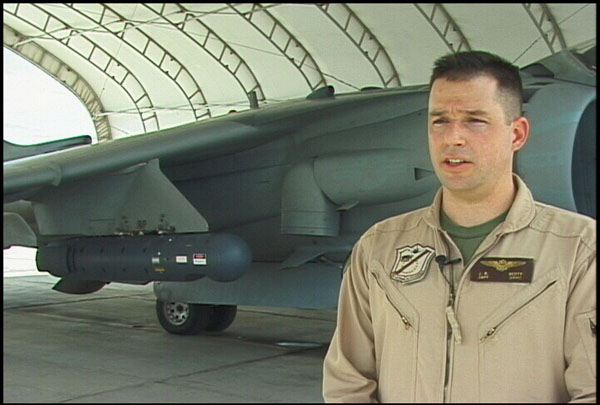
“As we prepared for war in Iraq, the timeline was compressed,” said Capt. Jeff Scott, USMC, Harrier squadron VMA-214, “We were looking for the video downlink advanced Litening Pod II to be delivered to us. NAVAIR made it happen.”
The Northrop Grumman-built Litening Pod contains a high-resolution daytime camera (CCD-TV) and forward-looking-infrared sensor (FLIR) that display images of the target to the pilot. Initially, the Marine Corps discovered that the Air National Guard had a good system called the Litening II pod, and decided to put it to work on its Harriers.
AV-8B Harrier squadrons fly offensive air support for the Marine Expeditionary Forces on the ground. With the initial introduction of the Litening Pod, Harrier pilots received sensor images in the cockpit, as well as laser designation and targeting capability. The advanced video downlink pod functionality would bring additional capability to the Harrier and its Litening Pod.
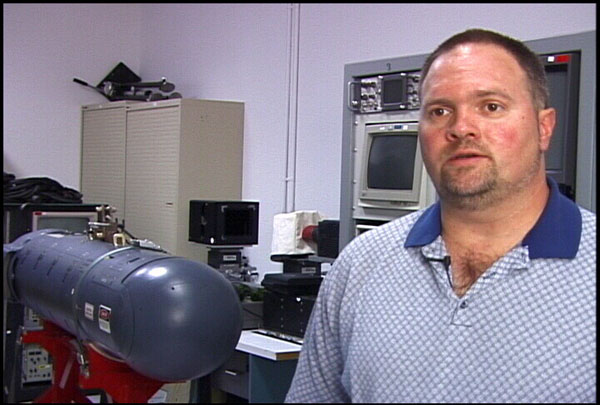
Wes Hensley, a NAVAIR China Lake systems engineer, was directly involved with bringing the advanced Litening Pod video downlink capability to the Harrier in time for its deployment in Iraq.
“The fleet had initially requested the additional capability during Operation Enduring Freedom in Afghanistan,” said Hensley.
The NAVAIR team answered the fleet request for this new capability by taking off-the-shelf transmitter devices borrowed from the Pioneer UAV program and integrating them into existing Litening Pods. The goal was to get this additional capability fielded as quickly as possible. Even though the NAVAIR team worked at an accelerated pace, the delivery timeline began to shrink. The developing conflict in Iraq indicated a need for quickly fielding the Harrier with the improved capability Pod. With the new Pods in hand, Hensley and the AV-8B class desk officer headed to Yuma, Ariz. to assist Harrier pilots in the initial integration of the advanced pod on aircraft that would soon be heading into Iraq.
“The integration between NAVAIR and the fleet helped provide us with the Litening Pod while we were in Kuwait as the war was beginning,” said Scott.
Scott added, “What makes the Litening Pod effective is the high optics on the pod. The optics are such that we are able to target and identify targets from extended ranges. It gives us incredible standoff distance, and allows us to find things that normally we would never be able to find.”
Harrier pilots now can “standoff” at safe distances from potential targets and send appropriate ordnance in for precise hits. During OIF, AV-8Bs with the advanced Litening Pod, designated targets not only for their own aircraft, but also for F-18s, F-16s, F-15s, and F-14s, all dropping laser guided munitions.
Scott tells a “before and after” story of when he first used the new improved capability Litening Pod in OIF. “The night before we used the new Litening Pod, I was actually flying the mission with a regular Litening Pod trying to find a target. The Forward Air Controller (FAC) was using an image, trying to talk my eyes onto it, and I was looking at my Litening Pod image. I did not locate it that night. But, the very next night, I flew with the video-downlink Litening Pod for the first time. Same target, same situation, same forward air controller. I was able to identify and engage that target within minutes.” And Scott could operate without having to fly in low altitude situations. With the advanced Litening Pod, pilots were dropping ordnance accurately from 5,000 to 20,000 feet.
The capability of the video-downlink litening Pod to send real time video feed to Marines and Soldiers on the ground is a significant leap in both survivability and lethality. The future of that video down-link capability in the form of a Tactical Common Data Link will bring the capability to pass live video to forward ground units, fire support coordination centers, command posts, and other attacking aircraft, enhancing survivability, lethality, and SA across the battlefield for the entire force.
Litening Pod is expected to continually improve as lessons learned from OIF are transferred into further advancements. Scott agreed, “And that will happen because of our partnership with NAVAIR.”
PHOTO CUTLINES
Marine Corps Capt. Jeff Scott, VMA-214, said the coordination between NAVAIR and the fleet made it possible to integrate the video downlink advanced Litening Pod II on the AV-8B Harrier.
Wes Hensley, a NAVAIR China Lake systems engineer, was directly involved with bringing the advanced Litening Pod video downlink capability to the Harrier in time for its deployment in Iraq.