
Landing gear shop cuts man-hour costs
By Paul Fenton
Industrial Engineering Technician
At the Naval Air Systems Command (NAVAIR) Depot Cherry Point, one of an Industrial Engineering Technician’s (IET) more important job related issues concerns various types of man-hour standards. Executed Workload Standards (WLS) is a particularly important standard since it affects customer cost and impacts the depot’s Net Operating Results (NOR).
NAVAIR Depot Cherry Point provides maintenance, engineering, and logistics support on a variety of aircraft, engines, and components for all branches of the U.S. armed forces. Employing almost 4,000 people, the depot is the only source of repair within the continental United States for many jet and rotary wing engines. It is the Navy’s center of excellence for rotary wing aircraft, providing engineering and logistics support for all Navy helicopters.
For three consecutive years, the Landing Gear Shop has realized a steady decline in aggregate component WLS norms. An analysis of fiscal year 2004-2005 WLS submittals indicates an approximate 6.6 percent decline in man-hour costs. Increased throughput potential is also a favorable attribute of man-hour reduction. We have yet to receive current individual fiscal year financial breakdown; however, statistics for last year indicate that the shop operated slightly above break-even posture. Breaking even is most desirable since we neither lose money for the depot nor inadvertently overcharge our customers.
The credit for this accomplishment can be attributed to the proactive attitude demonstrated by Shop Supervisor David Sawyer and his team of shop artisans. One could equally praise and credit supporting process shops such as machining, plating, and painting for continued improvement efforts.
One example of a declining WLS is associated with maintenance of the AV-8 nose landing gear. Recent analysis indicates that the average man-hour requirement has been reduced to approximately 152 compared to 180 three years ago. This reduction enhanced turnaround time (TAT) and was accomplished without comprising quality.
Implementation of MRPII router scrubs, increased personal accountability, improved technical documentation, engineered standards, Beyond Economical Repair (BER) and buy versus repair policies, grouped together with continued process improvement efforts, have paid dividends.
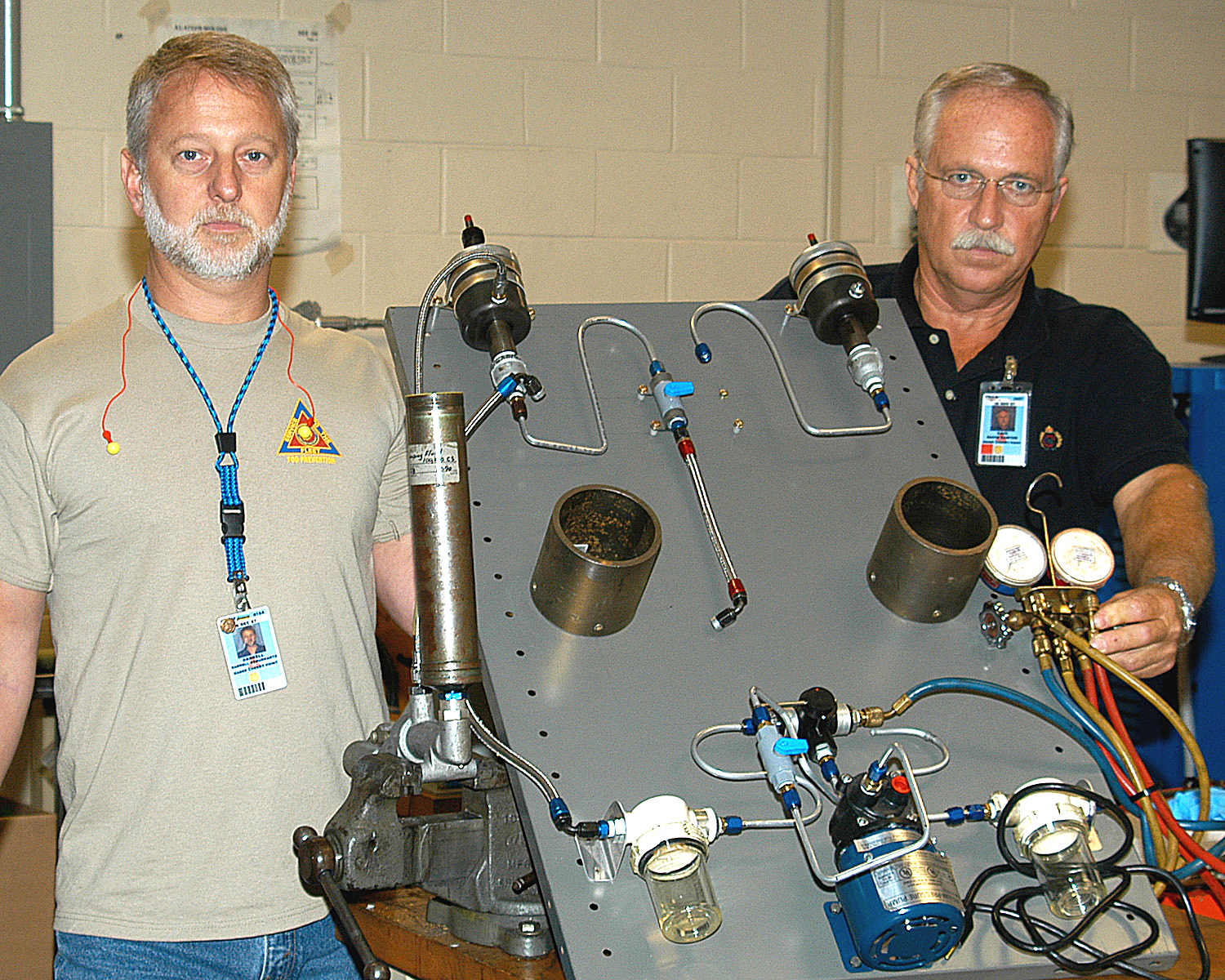
A demonstrated example of process improvement involves servicing H-53 dampners. The Landing Gear Shop is presently prototyping specialized fill and servicing equipment used to process H-53 shimmy dampners. Using vacuum filling processes versus applied pressure has greatly reduced TAT expectations. Previous servicing methods required manual pumping and required as many as four days. We are now able to automatically fill and service dampers in a little as four hours. Servicing was formerly accomplished utilizing the test stand. This is no longer necessary and enables testing to continue unabated. And since new equipment produces considerably less waste fluid, hazardous materials disposal has been reduced. Our long-range goal is to extend capacity to fill and service both strut and wheel (multiple) dampners simultaneously.
NAVAIR provides advanced warfare technologies through the efforts of a seamless, integrated, worldwide network of aviation technology experts.
Photo Caption: In the Landing Gear Shop at the NAVAIR Depot Cherry Point, Shop supervisor David Sawyer (right) and artisan Darrell DeBurkarte display their prototype dampner servicing equipment. (Photo by Larry Conley)