
Depot tests new HAZMAT tracking system
By Amy Morgan
Environmental Protection Specialist
The Naval Air Systems Command (NAVAIR) Depot Cherry Point has been selected to serve as the test site for the Navy’s new Hazardous Materials Management System (HMMS).
The depot was chosen due to its advanced expertise with using the current HMMS system. In March, personnel with the depot’s Hazardous Materials Control and Management Program began testing a new web-based version of software for tracking hazardous materials (HM) and hazardous wastes (HW).
NAVAIR Depot Cherry Point provides maintenance, engineering, and logistics support on a variety of aircraft, engines, and components for all branches of the U.S. armed forces. Employing almost 4,000 people, the depot is the only source of repair within the continental United States for many jet and rotary wing engines. It is the Navy’s center of excellence for rotary wing aircraft, providing engineering and logistics support for all Navy helicopters.
Initially, HMMS was used to track hazardous materials exclusively as a text-based system. Over the years the program advanced and became a client server database system that tracks HM from cradle to grave. The existing HMMS system is used by all three NAVAIR depots to control the receipt, issue, and disposal of all HM in accordance with local, state, and federal environmental regulations. In addition to providing the above features, the current system also provides for tracking the levels of HM exposure by depot artisans, acquiring data sheets quickly in the event of a spill or other emergency, and tabulating data for reporting requirements to the Environmental Protection Agency and state agencies.
The new web-based version of HMMS will provide even more features and add some much needed flexibility for modifying the software more quickly, as the needs arise. The existing system is difficult to update and takes long lead times, in some cases years, to accommodate changes as driven by updates with environmental laws.
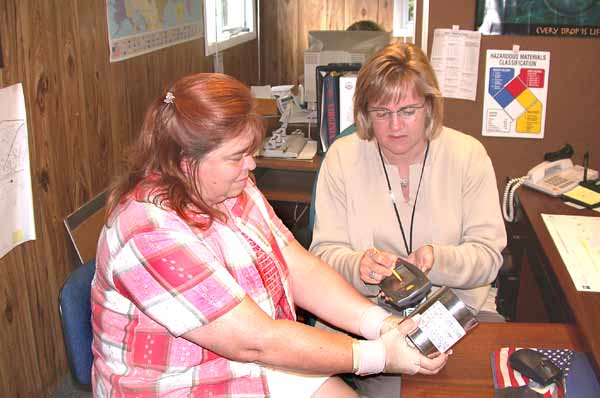
The new version also comes with the added use of Palm Pilot peripherals, which use bar coding technology to scan the information on a container. This information can then be hot synced to a desktop computer and downloaded to the main database, providing a much easier method for doing “in the field” inventories of material and waste containers. The Palm Pilot also allows for remote portability by forward deployed units, enabling them to scan containers of HM or HW and then transmit the information back to a home database via a modem or satellite web transmission.
The web version is accessed via a URL address and appears as a web page in the standard HTML format with a home page as the launching point. The user can page back and forth easily between screens and can also conduct advanced searches by using the fields for specified parameters at the top of each page.
Another added feature that the web version may provide in the future is the ability for multiple sites to share a single server for running their HMMS program and utilize common data. This would reduce data entry time for common data and would allow similar organizations to operate more efficiently. The depot and MCAS Cherry Point are currently testing this multiple user functionality, and if it works there is a possibility of all three depots running on the same server, located at Cherry Point.
Once all the bugs from this testing have been compiled and repaired within the system, all the DoD test sites will, one by one, retire the old version of HMMS and migrate to the new web-based version. The NAVAIR Depot Cherry Point will be the first Navy site to go “live” into full production with the web version and will be followed by the depots at North Island and Jacksonville.
NAVAIR provides advanced warfare technologies through the efforts of a seamless, integrated, worldwide network of aviation technology experts.
Photo Caption: At the NAVAIR Depot Cherry Point, Program Analyst Debbie King (left) and Environmental Protection Specialist Amy Morgan use a Palm Pilot to scan a bar code on a can of lubricating grease as part of their test of the depot’s new web version of the Hazardous Material Management System. (Photo by Gary Rice)