
Memory button tracks aviation components
It is a small thing that does a big job. And at the Naval Air Systems Command (NAVAIR) Depot Cherry Point, use of the Contact Memory Button will help to save both time and money.
The Department of Defense (DoD) is seeking to integrate automatic identification technology (AIT) into logistics business processes to facilitate the collection of initial source data, reduce processing times, improve accuracy, and enhance asset visibility. The Navy, however, is endeavoring to take the implementation of AIT one step further and mark serialized components and individual parts with pertinent information for use in the field.
“There is a need to put a program in place to help us track, monitor, and measure component reliability,” Bill Jolley, Integrated In-Service Reliability Program Analyst, said. “The use of AIT on components will help manage configurations, identify latent defects, manage warranties, better determine reliability, reduce misidentification and losses, and achieve total asset visibility.”
The Navy plans to implement AIT in conjunction with existing automated information systems to provide asset visibility through the maintenance and supply chains in what is termed Serial Number Tracking (SNT). SNT provides for the identification of components and tracking capability for individual aviation repairable assets through the repair and overhaul cycle to obtain maintenance and reliability data on which to base management decisions and improve asset visibility. SNT, enabled by AIT, provides a closed loop, cradle-to-grave status information on maintenance critical serialized repair parts. In short, SNT provides more accurate, timely information on which to make better decisions.
NAVAIR qualified the MacSema Company’s Contact Memory Button (CMB) for use on aviation components. CMBs are high-capacity storage devices. Made of brass and extremely durable, they are passive read and write capable. About 25,000 of them have been affixed to CH-53E components by fleet organizational and NAVAIR field teams.
“The old way we tracked components was with record cards and paperwork,” Business Office Branch Head Conrad Antaya said. “A lot of time and money was lost every year re-working components for which the hard cards and paperwork were lost. Using CMBs is a way to eliminate this loss. We load the software on our computers, attach the CMB reader, and download the information. Most of this is done on the H-53 line by mechanics who have been trained by NAVAIR.”
“Right now, the only information on the buttons is part number, serial number, gauge code, and work-in code,” Jolley said. “We’re in the early stage of the program, but as it matures, the buttons will contain all of a component’s maintenance data and history, and we should see some significant benefits to the depot as a result.”
“It will really help us in tracking components,” Antaya added. “That’s the big thing for us. All of our employees should be aware of this new technology and realize the importance it brings to the way the depots will track components in the future.”
NAVAIR provides advanced warfare technologies through the efforts of a seamless, integrated, worldwide network of aviation technology experts.
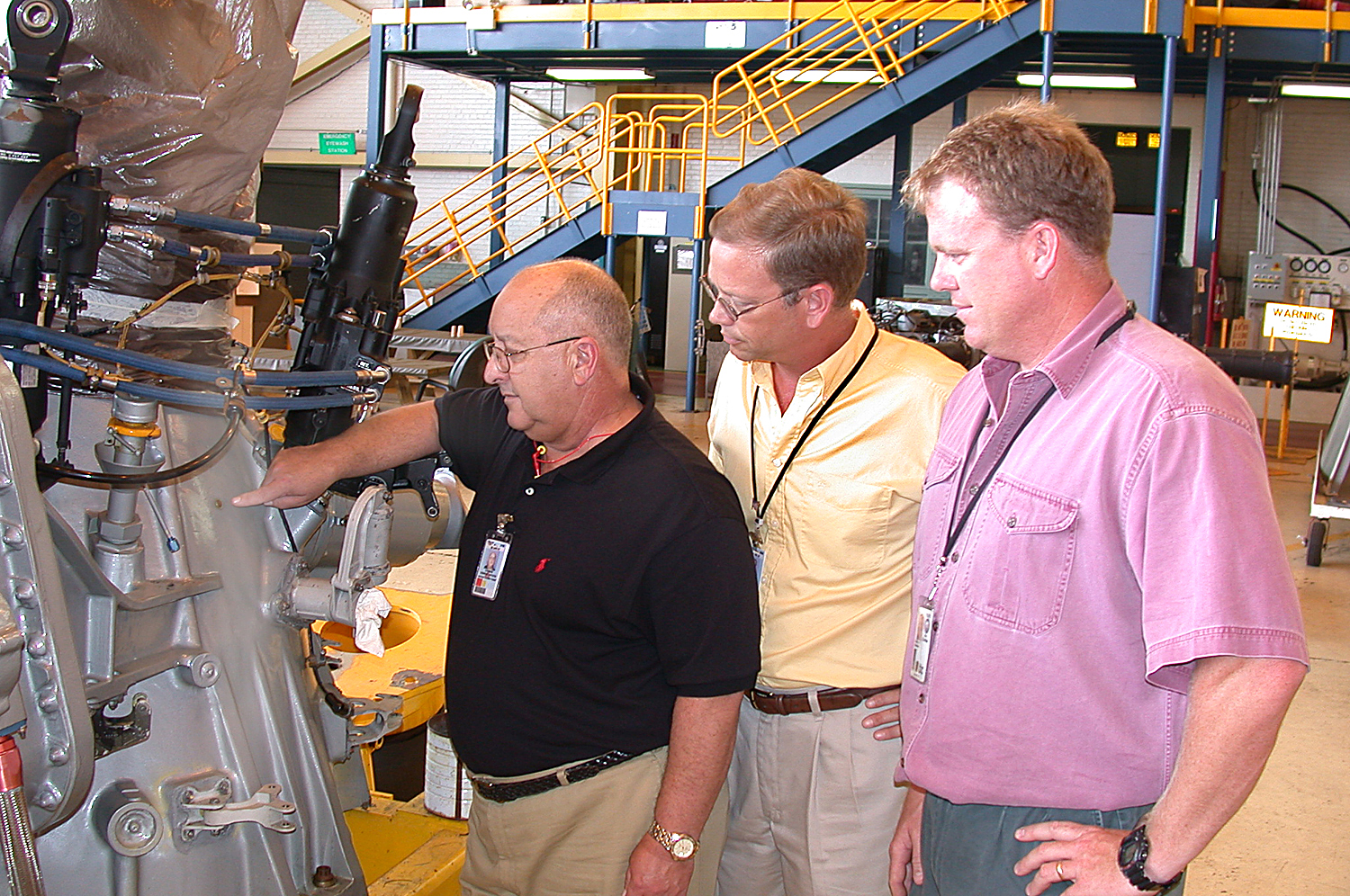
Photo Caption: In the H-53 Hangar at the NAVAIR Depot Cherry Point, Business Office Branch Head Conrad Antaya points out the Contact Memory Button affixed on a CH-53E helicopter transmission to Integrated In-Service Reliability Program Analysts William Jolley (center) and Rusty Brooks. (Photo by Gary Rice)