Kids Reach For Tomorrow and beyond at NAVAIR Depot North Island
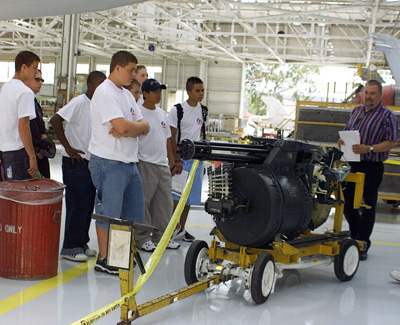
Hangar
Russell Touchette explains the mechanics of the 20 mm Gatling gun used on a F/A-18 aircraft. Photo by Joe Feliciano
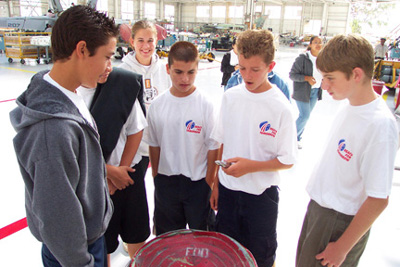
Dummy round
Ninth-grade students from San Diego examine a 20 mm dummy round from a Gatling gun. Photo by Bill Bartkus
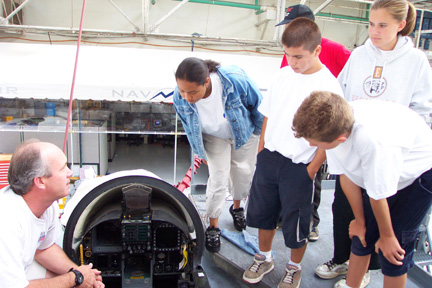
Cockpit
Students peer into a F/A-18 cockpit in Hangar 94 as John Dunn explains how the instruments work. Photo by Bill Bartkus
Kids Reach For Tomorrow at NAVAIR Depot and beyond
By Bill Bartkus
NAVAIR Depot North Island
CORONADO, Calif. – America’s youth need to look towards careers in math and science in order to get ahead in today’s technologically advanced world. NAVAIR Depot North Island teammates are helping these youngsters to learn that math and science are the critical keys to success.
Recently, middle school students from across America visited the Depot here as members of the Reach For Tomorrow program. The students came from Washington, D.C., Chicago, Clovis, N.M., and San Diego. The New Mexico students know little of the Navy since their area is dominated by farming and most of them had never seen an ocean until they came to San Diego.
“The program is focused on getting kids excited about engineering and science and making them competitive for scholarships,” said Navy Reserve Capt. Paul Shaw who accompanied the group on their tour of the plant. He said the kids must compete for RFT seats and their schools must recommend them for the program.
“The kids meet with their school’s counselors, and they must perform 25 hours of community service to earn the right to submit an application for the program,” Shaw said. “They must also have the right attitude.”
RFT has impacted more than 2,000 students from the Washington, D.C., Chicago, and East Chicago areas since 1993. That is when Peter Underwood, a commercial airline pilot, started the program to improve the three A’s of education: attitude, attendance, and achievement. “This is our seventh year in San Diego, where we have brought more than 700 students and adults to share in a unique experience for one week in the summer,” Underwood said.
He said that the goal of the program is to match students with a caring adult who agrees to work with a team of five students over the first two years of high school.
According to Underwood, the summer program is merely the start of a multiyear mentoring program that is designed to achieve specific outcomes. “Each student is expected to develop a resume, take SAT prep classes and the PSAT in the first two years of high school and continue to answer RFT evaluations,” he said. “Adults are asked to track grades twice a grading period and to monitor attendance. RFT is a complementary program to what parents and teachers are already doing.”
Naval Reserve Capt. Rich Kynaston, San Diego RFT program developer, shares Underwood’s enthusiasm. “We have developed a unique program model that exposes youth to Navy resources in education and training. It has each student using as much equipment as possible, and shows them what they can achieve through higher education,” he said.
Shaw manages the evening speakers program for all students who will serve as a team leader for San Diego students. “We have seen through quantitative testing and evaluation that we are changing the three A’s, but more significantly, we know that the kids enjoy a memorable summer that changes their lives,” he said. Shaw is scheduled to assume command of the Depot’s Reserve unit sometime this fall.
At NAVAIR Depot North Island, the students saw a glimpse of what its civilians do for the Navy in rebuilding aircraft. Their tour included seeing what engineers and artisans do in the F/A-18, Manufacturing, Components, E-2 and C-2, Multi-Line, and Paint programs. They ate lunch in the Naval Amphibious Base Mess Hall where they chatted with several Sailors and Marines.
Tenth grade student Jacob Lamar, 15, attends San Diego’s Midway High School. “I hope to attend the Naval Academy and become a Marine aviator like my father,” he said. He was most interested in the F/A-18, and the E-2 and C-2 portion of the five-hour tour of the plant.
Ruben Castellanos, 16, wants to attend the Naval Academy and become an engineer. The Bonita High School 11th grader was most impressed with the mechanics of aircraft and spent a good deal of time inside an E-2C. “An awesome aircraft,” he was overheard telling another student.
Jessica Pazcasio and Ingrid Garcia, both 14, know that they want to join the Marine Corps. “We hope to become officers,” Ingrid said.
All along the kids’ tour of the plant, they asked numerous questions, and the guide explaining that portion of the program was eager to provide answers. At the Paint Complex, one San Diego student told tour guide and aircraft painter Jonathan Dell that he wants to be either a field biologist or a firefighter. Dell was quick to tell the teenager when to start taking emergency medical technician classes so that he can qualify to go on to firefighter training. Dell is a volunteer EMT for Imperial County.
In addition to their tour of the plant, their San Diego tour also included aquatic training in sailing, surfing and snorkeling at Mission Bay; firefighting training at the San Diego Fire Academy; tours of the physics, chemistry, and pediatric neuroscience labs at UCSD; and spending a half-day learning marine biology. A separate group of students, who are interested in medicine, toured the Navy hospital ship USNS Mercy.
NAVAIR provides advanced warfare technologies through the efforts of a seamless, integrated, worldwide network of aviation technology experts. From aircraft and weapons development to carrier launch and recovery; from sensors to real-time communications to precision targeting; from aircraft and weapons sustainment to state-of-the-art training; NAVAIR provides dominant combat effects and matchless capabilities to the American warfighter.