Students take first flight in Navy’s newest trainer aircraft
By Renee Hatcher
PEO(A) Public Affairs
The first student naval flight officer training flight in the T-6A Texan II was commemorated Aug. 5 at Naval Air Station Pensacola, Fla.
Navy initial operating capability (IOC) began two months ahead of schedule on June 30 at Training Air Wing 6 in NAS Pensacola. A class of four Navy, one Marine and one Air Force students began academic training in Training Squadron 10.
“What’s remarkably special about this achievement are the results of many absolute outstanding people from Training Air Wing 6, Chief of Naval Air Training, and NAVAIR who implemented an acquisition plan well ahead of schedule despite significant budget deferrals, and major programmatic changes,” said Capt. Dave Wooten, manager of NAVAIR’s Trainer Aircraft Program (PMA-273). “This is a true success story of NAVAIR-fleet cooperation.”
The T-6 is a joint aircraft, used both by the Air Force and the Navy as part of a training system in coordination with simulator technology, known as the Joint Primary Aircraft Training System. The T-6 is replacing the Navy T-34C, which has provided primary flight training for student pilots, naval flight officers, and navigators attached to the Naval Air Training Command for more than 20 years. The T-6A is also replacing the Air Force T-37 trainer aircraft.
The first few weeks of ground training combined academic and computer-based training with extensive use of state-of-art flight simulators. In the 27 weeks these students spend training in the Texan II, they will log more than 180 hours of academic training, 27 hours of graded simulator events and 60 hours of flight time. This training focuses on teaching basic aircraft control, instrument and visual navigation procedures, and formation flight.
One of the greatest advantages of the Texan is that it comes equipped with a digital cockpit. Prior to the Texan, student aviators conducted their initial flight training in aircraft equipped with an analog cockpit and then made the transition to a digital cockpit in their fleet aircraft. Now with the T-6A, students will begin their training with the technology they will actually fly in their fleet combat aircraft.
Photo by Gary Nichols
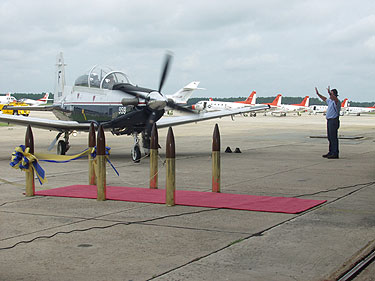
The newest addition to the Chief of Naval Air Training inventory is the T-6A Texan II.
Photo by Sheri L. Crowe
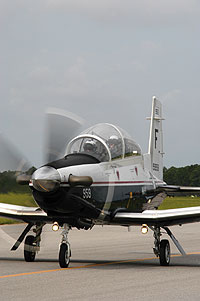
The T-6A Texan II taxies in near hangar 1853 at Naval Air Station Pensacola, Fla. on Aug. 5.
Photo by Gary Nichols
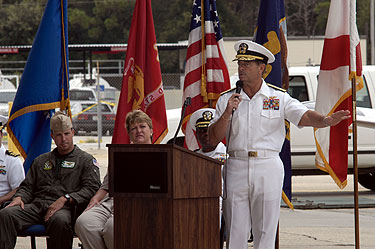
Rear Adm. John E. Boyington, Jr., chief of Naval Air Training, addresses the Flight Operating Capability ceremony audience.