Pax crew helps keep tabs on osprey population
By JAMES DARCY
Public Affairs
NAVAIR PATUXENT RIVER, MD—Steve Cardano can’t seem to kick his osprey habit. This time last year, he said he was done, hanging up his pliers after 29 years of banding and cataloging the ospreys that nest along the Patuxent River. He had seen the population creep slowly back from the devastation of DDT, had learned most of the secrets of a nomadic community that spends half its year in the Chesapeake Bay watershed, half of it in far flung lands such as Venezuela and Trinidad and Tobego. He had banded thousands of birds, logged thousands more. It was time to come off the river, to tabulate and write and analyze, to be scholarly.
It was something of a surprise, then, when Cardano contacted the air station command to ask if the Navy would like to help him band ospreys on the lower Patuxent River again this year. Then again, maybe it wasn’t.
“So what’s the story, Steve?” someone asked him Thursday as the 30-foot platform boat from Pax River’s boathouse pulled out into the river, en route to the first nest of the day.
And Cardano just shrugged. Said something about how he wanted to make it an even 30 years. Or maybe 31. Addicted, and in denial, and entirely content.
Cardano is director of activities at Charles County’s Nanjemoy Creek Environmental Education Center, and is a master bird bander licensed by the United States Geological Survey’s Bird Banding Laboratory in Laurel. He has been banding ospreys on the Patuxent River since 1973, and for the past three years has done it with the Navy’s help.
“Steve initially contacted us in 2001, when his boat went down for repairs and it didn’t look like he was going to be able to complete his study for the year,” explained Tim Smith, Pax River executive director. “We offered the use of a boat and crew from our boathouse, and we’ve been participating ever since.”
The collaboration fits in well with Pax River’s overall environmental stewardship mission, but is also self-serving. Aviators at Pax River share the air space over the Chesapeake with more than 300 species of birds throughout the year, according to Jim Swift, a Pax River natural resources specialist. When birds and aircraft meet at speed, the results are expensive at best, tragic at worst.
Swift coordinates the station’s Bird-Aircraft Strike Hazard program, and is charged with finding ways to fulfill NAVAIR’s flying mission while reducing the threat of a strike. “You reduce the hazard by being aware of what’s out there and what’s going on with them,” he said.
With two dozen osprey nests on the air station alone and thousands of ospreys living along the Bay, the information Cardano has amassed over the years is valuable intelligence, worth its weight in aircraft aluminum.
“It’s very rare for one person to have that much experience and that much data,” Swift said.
To help with this year’s effort, Swift and fellow natural resources specialist Jackie Smith joined Cardano for bird handling duty. BM1 Patrick Hart captained the boat, and Nanjemoy Creek teacher Gloria Heisserman rounded out the crew.
The drill was familiar for Hart and Swift, who have both gotten their hands dirty – and occasionally bloody – on previous years’ outings. As the boat cruises along the river, Cardano scouted nests with his binoculars, knowing all the commonly used sites by heart. When Cardano spots an active nest, usually on a channel marker, pylon or man-made nest platform, Hart guides the boat alongside and someone grabs the ladder.
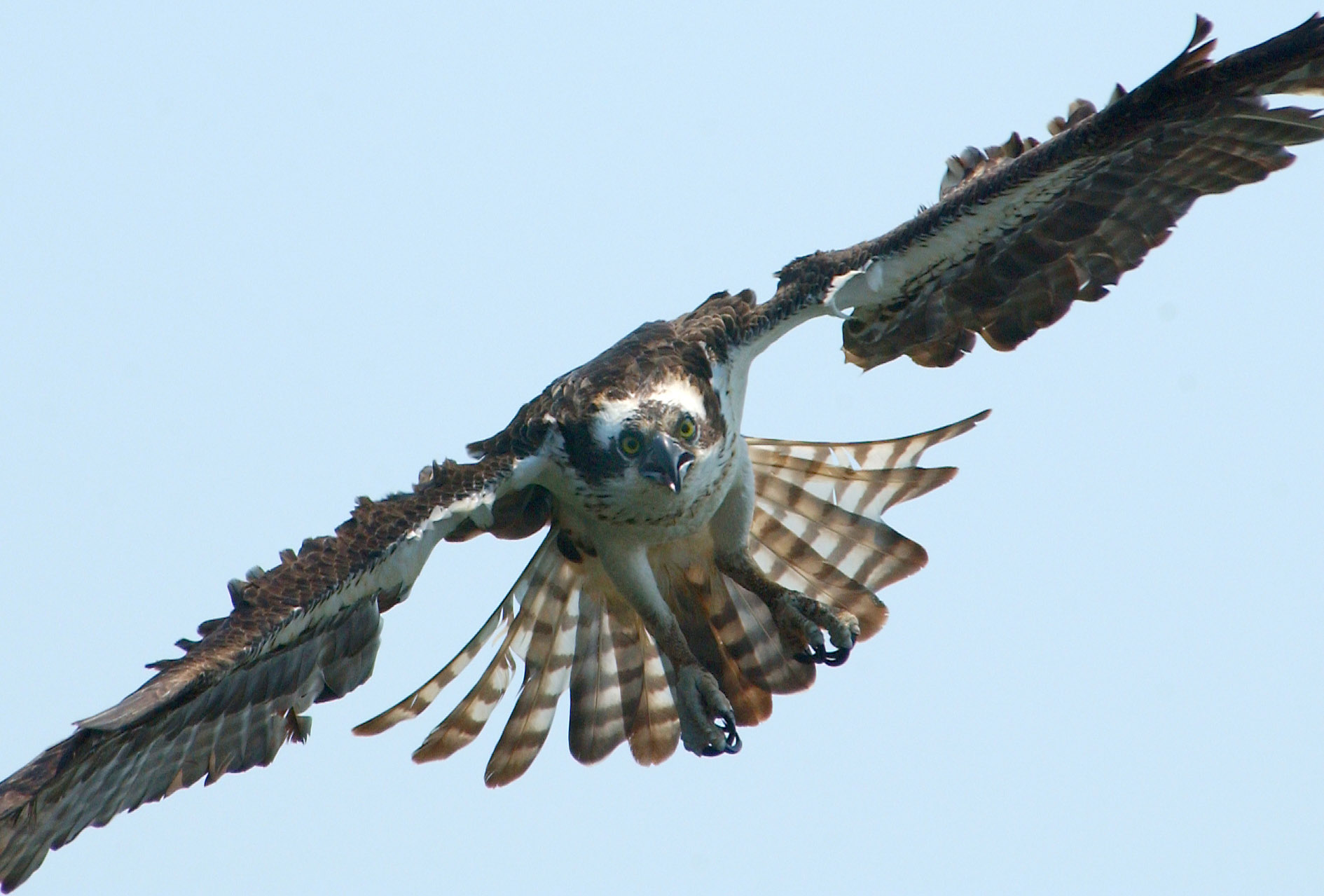
Though capable of doing tremendous damage to a human, the adult ospreys usually fly off when the boat approaches. Humans are viewed as predators, Cardano explained, and evolution favors the birds that will return to mate another day rather than fight to the death in defense of a nest. Not all the birds have read their Darwin, however, and sometimes things get a bit contentious.
As the adults wheel and dive overhead, someone climbs the ladder to the nest and begins handing down the young. Cardano bands the birds when they are five to seven weeks old, too young to fledge but old enough to have fully developed legs – and talons.
“When you first look into the nest, the young are trying to stay out of sight and laying just as flat as they can, so they’re easy to lift out,” Swift explained. “They’re incredibly soft; their muscles aren’t real strong to hold their wings up, and their legs aren’t very strong for standing. All their feathers are new, and you’re struck by how soft and delicate these animals are.
“On the other hand, they still have very sharp talons and sharp, strong beaks,” he added.
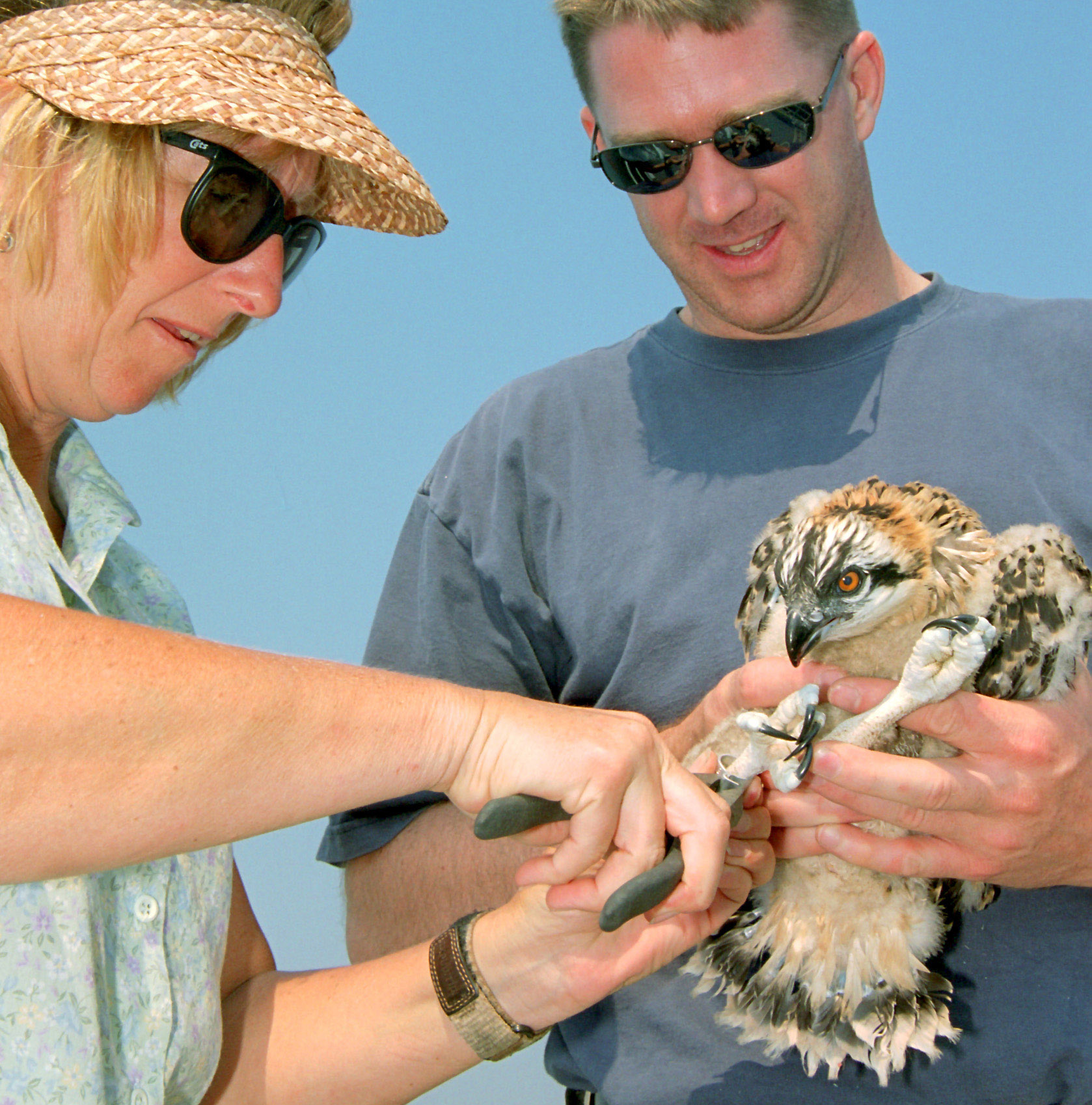
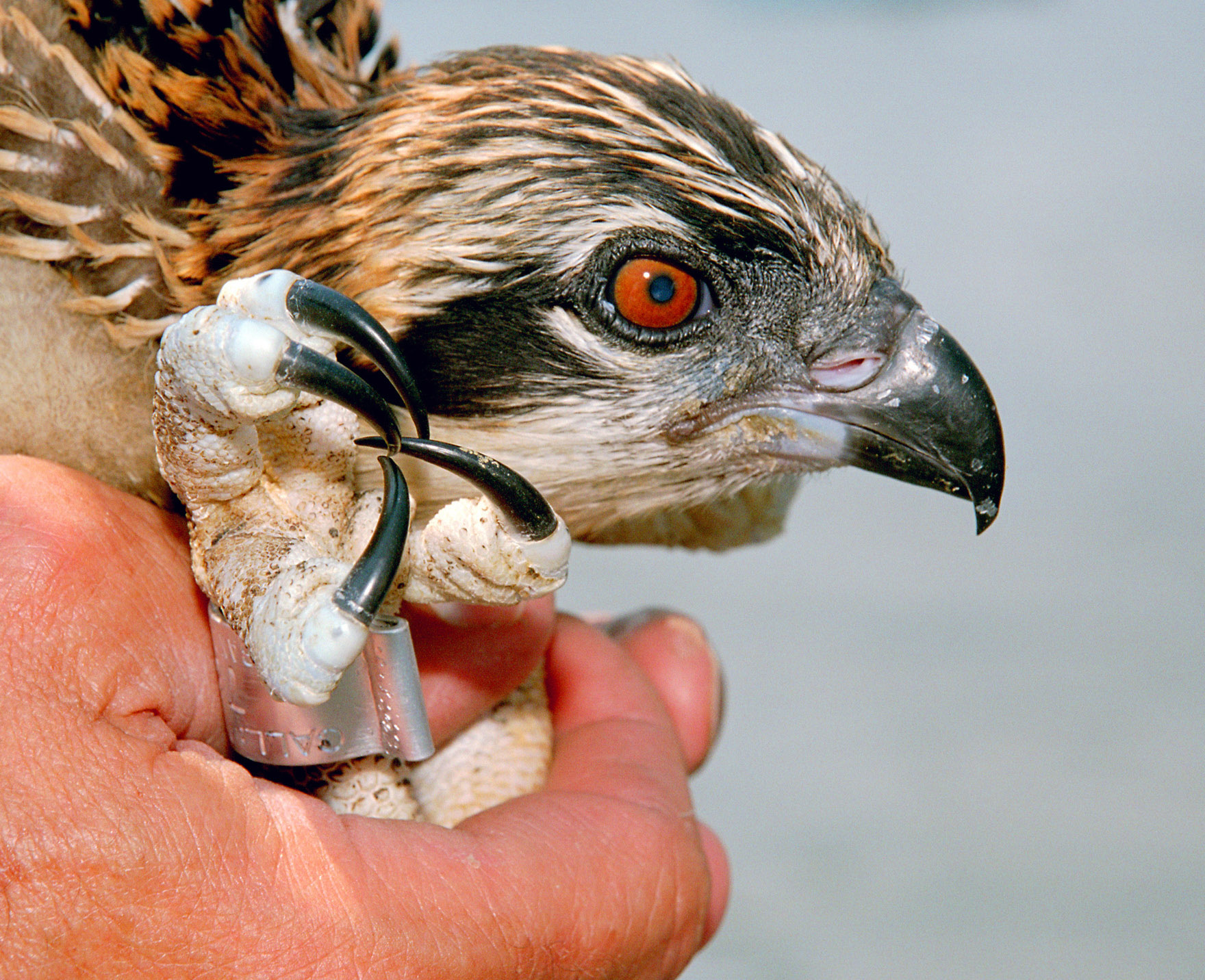
With the birds gently restrained, Cardano and Heisserman use pliers to secure the loose-fitting metal bands above the young raptors’ ankles. The numbered bands are issued by the USGS and bear a phone number to call if the birds are ever recaptured or found dead.
“The band recovery data helps us put together the life history of these ospreys,” Cardano explained. By tracking where the ospreys are found and how and when they die, researchers can estimate life spans, assess threats and map migratory routes. Recently, Cardano has received several band recovery reports from Cuba, an artifact of improved communications between the island nation and the United States, he suspects.
Before being returned to the nest, the birds are weighed, and the results are recorded in a log book along with band number, nest location and any interesting observations. In a nest along the air station shoreline, he finds a dead grackle. Because ospreys don’t usually predate other birds, the supposition is that the grackle attempted to pillage eggs in the nest and was caught by an angry parent, which made short work of the intruder.
Cardano also collects “ornamentals,” odd bits of decoration the ospreys hoard for their nests. Some are hazardous – discarded fishing line and lures are common, and on last year’s trip several chicks were found entangled in line, maimed or starving. Others are more whimsical.
“Hey, these birds are stealing cable,” Cardano called down as he pulled a six-foot length of coaxial cable out of one nest Thursday. Previous finds include a shoe and a toy machine gun, the latter probably stolen from a yard in family housing here.
As the day wore on and Cardano tallied up results, he concluded that this was an average year for ospreys on the Patuxent. The chicks were a little younger than expected for the time of year, a product of the unusually cold spring. Still, the population is thriving.
“In 1973, there were 22 active nests on the entire Patuxent River,” Cardano recalled. Widespread use of the pesticide DDT after World War II had decimated both bald eagle and osprey populations. In 1972, the newly formed Environmental Protection Agency banned the use of DDT, and both eagles and ospreys began a slow recovery.
For the past several years, Cardano has seen well over a hundred active nests on the river. And though the Bay is “a shadow of its former self,” Cardano said, the ospreys tell a tale of resilience for the ecosystem.
“Sitting at the top of the food chain, ospreys are good environmental barometers,” he explained. “If there’s something wrong with the ecosystem, it will usually be reflected in the top predators.”
In that regard, the birds also serve as a report card for Pax River’s environmental programs. “Steve’s study is very unusual and important,” Swift said. “In his data, we see the long term effects of what we’ve done to try to help the ospreys or to benefit the environment here in general.”
In the coming days and weeks, the adolescent ospreys of the Patuxent River will take flight for the first time. The mother of one brood will lead her children from the nest to a nearby salt pond, which happens to be on executive director Smith’s property. Every year the ritual is the same, as osprey parents and fledglings use this sheltered spot for what Smith describes as flight training. “When I go home and I look at my chicks,” he said paternally, “I know that they are here at least in part because we are doing something right.”
Photo slug – Pax crew photo 1.jpg
A mother osprey launches from her nest to stage feigned attacks against the human intruders intent on banding her two chicks.
Photo by James Darcy
Photo slug – Pax crew photo 2.jpg
Gloria Heisserman, a teacher at Nanjemoy Creek Environmental Education Center, fastens an identification band around the leg of a pre-fledgling osprey in the hands of Pax River natural resources specialist Jim Swift.
Photo by James Darcy
Photo slug – Pax crew photo 3.jpg
As naturalists from Nanjemoy Creek Environmental Education Center and NAVAIR Patuxent River band young ospreys, the angry parents dive and charge, breaking off their attacks at the last minute.
Photo by James Darcy
—USN—
NAVAIR provides advanced warfare technologies through the efforts of a seamless, integrated, worldwide network of aviation technology experts. From aircraft and weapons development to carrier launch and recovery, from sensors to real-time communications to precision targeting, from aircraft and weapons sustainment to state-of-the-art training, NAVAIR provides dominant combat effects and matchless capabilities to the American warfighter.