Engineer carries on family tradition
By JOSH PHILLIPS
NAS Patuxent River Public Affairs
NAVAIR PATUXENT RIVER, MD—For H-1 Upgrades Flight Test team leader Robin Locksley engineering is something that runs in the family.
Both his grandfathers were engineers; one was an electrical engineer for General Electric, the other an engineer for a British based shipbuilding company.
With a family tradition steeped in the science of engineering, it’s little wonder that Locksley was named the recipient of the 2003 Wernecke Award for technical excellence in rotorcraft test and evaluation. The award was given June 3 in the Officers’ Club during the meeting of the American Helicopter Society, Pax River Chapter.
Named after Dick Wernecke, a project engineer with 34-years of rotorcraft testing and the first technical director of Rotary Wing, the award is presented to an individual who demonstrates exceptional performance in advancing the principles of engineering, planning, testing, reporting, leadership, teamwork and innovation in rotorcraft test and evaluation.
“Robin has been a leader at H-1 Upgrades since the team stood up,” said Air Test and Evaluation Squadron 21 technical director Joe Carbonaro. “He has managed every aspect of the H-1 Upgrades Test Team establishment and has directly influenced team composition, optimizing the organization for superior performances despite scarce resources.”
After graduating Drexel University in 1989, Locksley began working as a flight test engineer here at the Rotary Wing Aircraft Test Directorate, now known as HX-21. Six weeks later, Locksley enrolled in the Avionics Test and Evaluation short course. The class allowed incoming flight test engineers to be trained without having to first attend U.S. Naval Test Pilot School.
Following the program, Locksley found himself back at Rotary Wing, only this time he was assigned to work on the SH-2F Seasprite and SH-3 Sea King anti-submarine helicopters, testing torpedo presetter programs as a project engineer.
However, he would soon make the transition to the Naval Ship Ground Station as a lead engineer and station manager.
“I’m kind of a gap filler,” Locksley said. “If it looks interesting and it looks like a challenge, then I’m all up for it.”
While at NSGS, Locksley worked on an integration project for the Light Airborne Multipurpose System SQQ-89 signal processor, which provided shipboard sonobuoy processor support for detecting submarines and providing accurate classification and targeting data, with the DDG-51 Combat Direction System.
Locksley’s understanding of the complex systems was a prime factor in making the project work, according to Carbonaro.
“That undertaking required detailed knowledge of both the airborne systems as well as the intricacies of the then UYK-43 computers and their associated software Weapon System Program and Weapons Auxiliary Program,” Carbonaro said.
In 1995, Locksley received a master’s degree in electrical engineering from the Florida Institute of Technology. In 1998, he graduated from the U.S. Naval Test Pilot School as a member of Class 112, in the Airborne Systems Curriculum.
“I came out of TPS with confidence,” Locksley said. “To graduate from TPS means you are an expert in test and evaluation.”
In October 1998, Locksley made the transition from Rotary Wing to H-1 Upgrades for his work with the Hellfire missile systems installed on the SH-60B aircraft.
“The Navy was looking to do things leaner and meaner then because the budget was getting smaller,” Locksley said. “So I structured a program for the Hellfire integration that was requirements based and requirements driven. The Air 1.6 program management folks saw that and said that they needed a test and evaluation guy on their upgrades program.”
By providing answers to budget problems, while still meeting standard requirements for aircraft, Locksley had designed a blueprint for projects to come and gave the Navy some much-needed financial breathing room.
At H-1 Upgrades, Locksley serves as the test team leader and head of a diverse team of developmental test and evaluation experts. He also serves as the NAWCAD senior representative of the H-1 Upgrades program, where he oversees and consults with test team members concerning test documents and their quality, cost and performance.
Although Locksley has been an asset for the station since he began working here in 1989, it’s his recent work at H-1 Upgrades that stands out most.
“If anything got me this award, it’s for the work on the H-1 Upgrades program,” he said. “This is the best job at NAVAIR. We have really built a cohesive integrated team here with the contractors and the government. I think that H-1 Upgrades has upped the magnitude in integration.”
-USN-
Photo by Josh Phillips
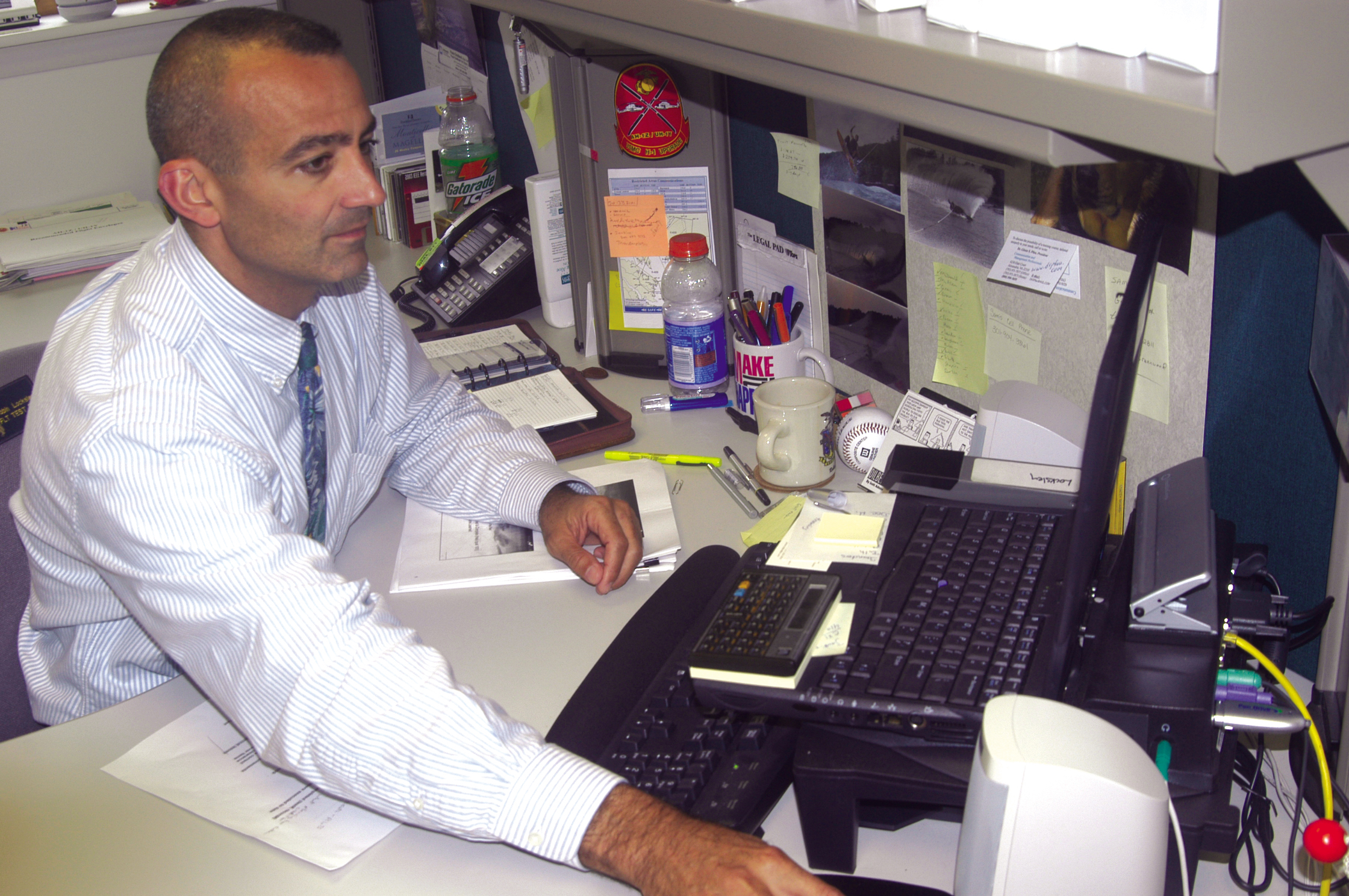
This year’s recipient of the Wernecke Award, Robin Locksley, H-1 Upgrades Flight Test team lead, checks some data submitted by his integrated test team.