
NAVAIR Engineer’s Support to Fleet is “Stuff of Dreams”
By Vicky Falcón
NAVAIR Public Affairs
When Benjamin Walsh was a boy, he dreamed of what he would do and where he would go when he grew up.
Never in any of those dreams, though, could he have imagined himself on board the amphibious assault ship USS Tarawa (LHA 1) during Operation Iraqi Freedom, assisting in the repair of a UH-1N Huey helicopter. Nor did he ever envision having the opportunity to fly aboard the USS Constellation (CV 64) on a C-2 transport to evaluate damage to an F/A-18 Hornet.
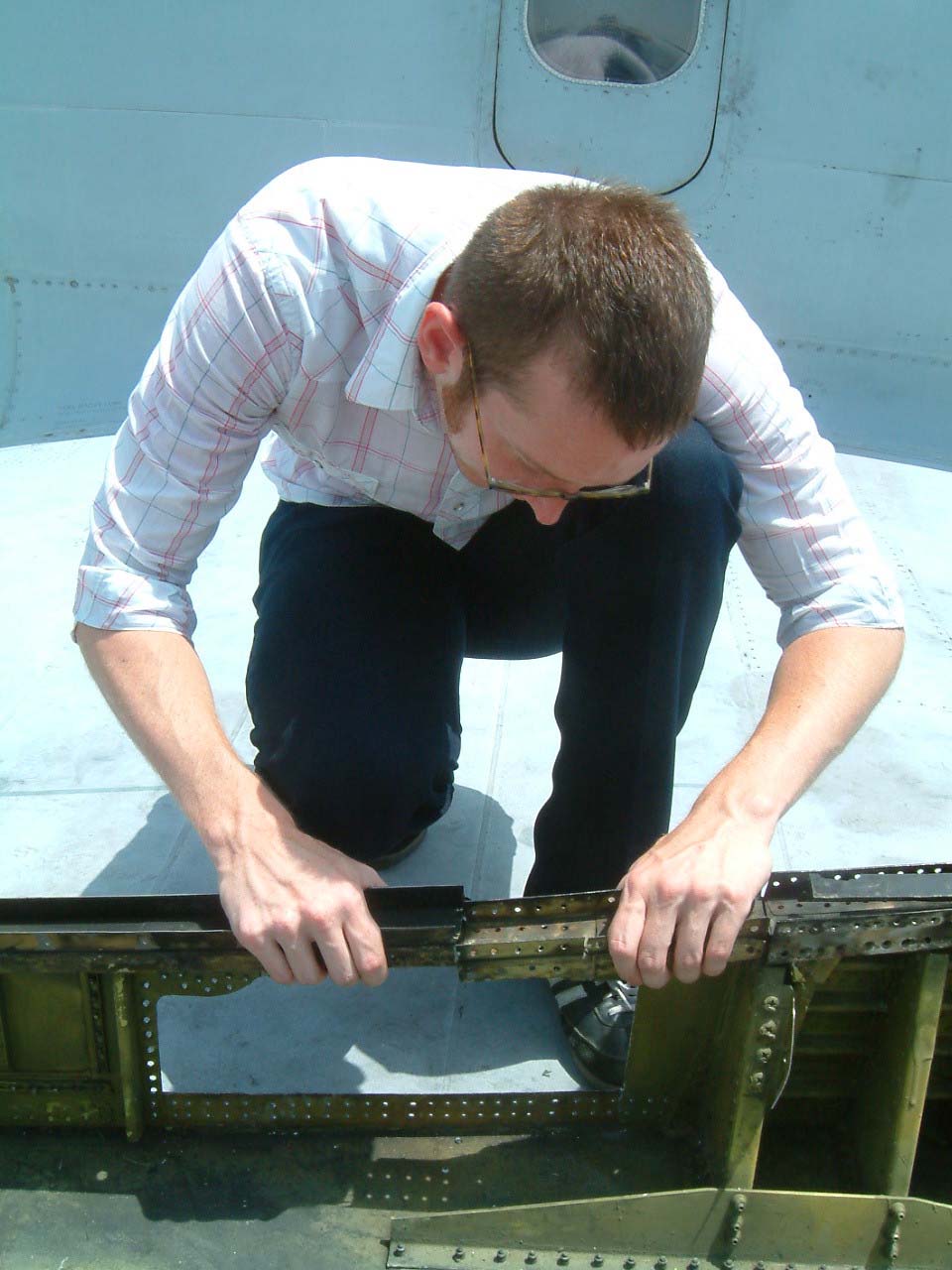
But there he was, flying on and off ships, working in Bahrain and Kuwait, in the middle of a war, writing Temporary Engineering Instructions (TEIs) to repair aircraft damaged during wartime operations.
After graduating from University of California Berkeley in 1998, with a degree in mechanical engineering, Walsh went directly to work doing something he loves – fixing aircraft.
“My first job after graduating from college was with the Naval Warfare Assessment Station in Corona, Ca. After working there for 11 months, I moved to NAVAIR North Island (in Coronado, Calif.) to work with the F/A-18 Fleet Support Team,” he said.
Naval Air Systems Command (NAVAIR) provides advanced warfare technologies to the American warfighter. Sustaining that technology is the job of the engineers and artisans at the three NAVAIR depots (NAVAIR Cherry Point, N.C., NAVAIR Jacksonville, Fl. and NAVAIR North Island) and two repair facilities in Naples, Italy and Atsugi, Japan. Both the Naval Air Mediterranean Repair Facility (NAMRA) and the Naval Air Pacific Repair Facility (NAPRA) perform unplanned maintenance and in-service support, provide field teams and oversee depot-level repairs to maintain deployed carrier battle groups in the Western Pacific/Indian Oceans and Mediterranean/Europe/Navy Central Command areas of operation.
Walsh took pleasure in his job at NAVAIR North Island, but he was young and single and when an opportunity came to work in Japan doing more of what he enjoyed, he couldn’t pass it up.
“I had the opportunity to travel to Japan in November, 2001 on a temporary duty assignment,” said Walsh. “I liked the atmosphere at NAPRA and learned about a vacancy that they were trying to fill. I figured that a chance to work in Japan comes along once in a lifetime, so I jumped at the chance.”
Walsh, who has lived in Japan since last September, has a three-year overseas tour commitment with the option of extending for another two years. He says working at NAPRA not only allows him to experience a new culture, but it is giving him new career opportunities, as well.
“NAPRA offered me the chance to expand my engineering knowledge to cover the Navy’s entire inventory of aircraft,” he said – another opportunity too good to let pass.
Commander Louis “Murph” Borno III is the Executive Director at NAPRA. “Our artisans are hired based on a broad background due to the requirement to repair all Type/Model/Series aircraft. Unlike the depot artisans back in the United States, our personnel are exposed to requirements that span the entire naval aviation inventory,” he said.
That broad area of expertise is what enables the NAVAIR facility to so adequately meet the very diverse needs of the fleet.
“We live and work hand-in-hand with our forward deployed Naval and Marine Corps forces,” said Borno. “Since our focus is to keep the warfighter ready 24/7, we are experts at providing responsive and immediate support over our nine time-zone-wide area of operation.”
An example of that commitment to responsiveness is evident through the In-Service Repair (ISR) capability. According to Borno, NAPRA’s ISR teams can immediately respond to any emergent depot repair requirement, from Guam to the Persian Gulf.
“NAPRA has organic depot artisans that can evaluate and repair most structural requirements on all Type/Model/Series aircraft in the Navy and Marine Corps inventory,” said Borno. “We have even responded to NAVAIR Foreign Military Sales requests to evaluate other nation aircraft.”
During Operation Iraqi Freedom NAPRA coordinated and deployed seven teams – five to carrier battle groups, including USS Kitty Hawk (CV 63), USS Carl Vinson (CVN 70), USS Constellation, USS Abraham Lincoln (CVN 72) and USS Nimitz (CVN 68). Two detachments from NAPRA were also fielded to the Central Field Detachment (CFD) in Bahrain and the Remote Field Detachment (RFD) in Kuwait.
Walsh was an integral part of those detachments, providing engineering support and generating designs to repair extensive damage to Navy and Marine Corps aircraft. One such event involved an AV-8B Harrier that had a damaged ventral fin after a hard landing in Kuwait. A Planner/Estimator on the scene took pictures and initiated the repair instructions, sending Walsh photos and a description of the damage. After Walsh wrote the TEI, the field team performed the repair. Walsh coordinated his instructions with another engineer from NAVAIR Cherry Point who had worked on a Harrier with similar damage.
“I think the best part of this experience has been the opportunity to work alongside a great group of artisans, machinists and planner/estimators from throughout the NAVAIR community,” said Walsh. “The success of this detachment can be attributed to everyone’s versatility and willingness to work together to support the warfighter.”
Besides the In-Service Repair capability, NAPRA also provides in-depth maintenance for both scheduled and un-planned repair support for 27 aircraft platforms and variations. NAPRA maintains and operates U.S. Navy facilities and executes contracts to perform depot-level rework on designated weapon systems, support equipment and associated components. In-theater engineering, logistics and program management are also provided, using a multinational industrial base.
Though their responsibilities are many and diverse, less than 200 people perform those duties – another benefit for those who work at NAPRA, says Borno.
“Since NAPRA is a small organization the leadership (both civilian and military) are able to be actively engaged in addressing the needs and well-being of the workforce,” he said, adding, “The majority of our employees complete at least five years onboard – with many staying for ten years or longer.”
But according to Borno, the best benefit to working at NAPRA is the satisfaction derived from directly supporting the fleet.
“No other depot organization has the level of personal involvement with the customer that we have,” he said. “Being located with and in direct support of the forward deployed Navy and Marine Corps forces makes this a most rewarding job.”
Walsh agrees. But having been away from his Atsugi home since March he is ready to let someone else take his place for a while supporting the warfighter on the front lines.
The three-month experience has been like a dream, but he adds, “I’m ready to go home.”
NAVAIR provides advanced warfare technologies through the efforts of a seamless, integrated, worldwide network of aviation technology experts. From aircraft and weapons development to carrier launch and recovery; from sensors to real-time communications to precision targeting; from aircraft and weapons sustainment to state-of-the-art training; NAVAIR provides dominant combat effects and matchless capabilities to the American warfighter.
Photo Caption: Benjamin Walsh, an engineer with NAVAIR's Naval Air Pacific Repair Facility (NAPRA), evaluates damage on a P-3 Orion before preparing the Temporary Engineering Instruction for repair in Bahrain.