
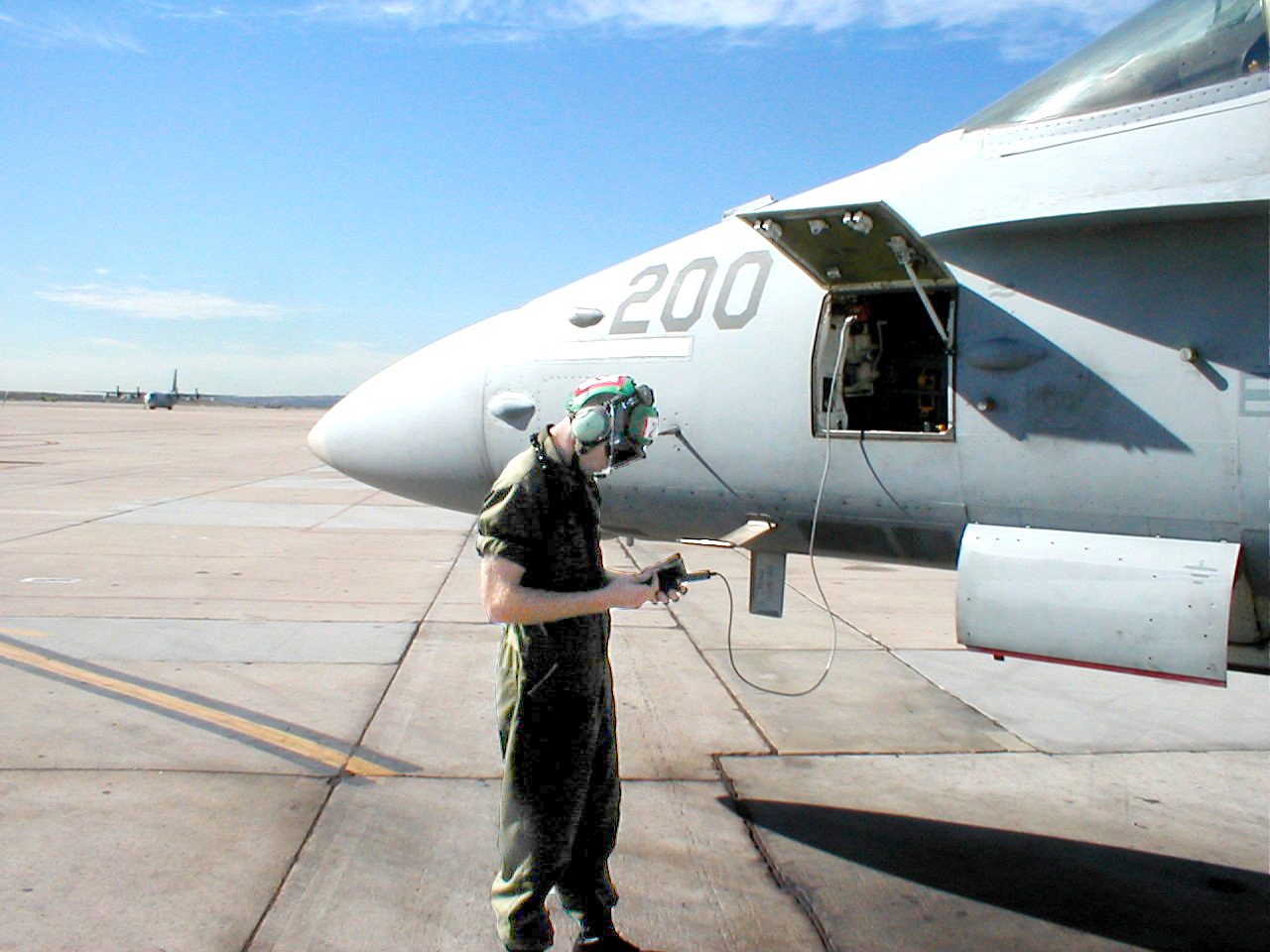
MFOQA Data is downloaded from the flight data recorder by a squadron technician using a small, hand-held device. The data was collected during regularly scheduled training from an F/A-18 during a "hot turnaround" event at Marine Corps Air Station Miramar (engines and aircraft systems operating). (U.S. Navy photo)
NAVAIR set to demonstrate new operational quality assurance program
When US Airways adopted Flight Operations Quality Assurance (FOQA) five years ago its aircraft engines were frequently operating at higher than recommended temperatures. Since implementing FOQA, those overtemps have been reduced by 87% - resulting in more than $100 million in maintenance savings.
Delta Airlines also experienced significant procedure improvements after putting FOQA into practice, reducing flap over-speeds (employing wing flaps at higher than recommended speeds) from 46 to 10 occurrences per quarter.
During a FOQA program demonstration, Bristow Helicopters Limited, an offshore helicopter operator in the North Sea, identified a simple aircrew standard operating procedure that was the primary contributing factor to the near loss of an aircraft and aircrew. Using quantitative data provided by the FOQA program, the aircrew was debriefed about the cause of the problem to prevent a repeat occurrence.
By building on such proven commercial aviation safety success, the Naval Air Systems Command (NAVAIR) is poised to increase the safety of naval aviators, advance squadron training, enhance maintenance capabilities and improve operations through Military Flight Operations Quality Assurance, known by its acronym MFOQA (pronounced Em-fo-qua).
“MFOQA is a concept of operations that provides the warfighter with timely and quantitative information regarding aircrew and system performance,” said Capt. Mike Williamson, program manager for NAVAIR’s Air Combat Readiness program office. “It can be used to improve safety and operational efficiency on every flight.”
MFOQA began as an effort to more efficiently tap into the Navy’s and Marine Corp’s information collection capability. Every naval aviation platform currently gathers data – to varying degrees – but modern digital aircraft and recorder technology allows for collection of virtually all aircraft data. By developing the tools to take that raw data from the aircraft and deliver meaningful, manageable information, Williamson’s team can give the fleet improved decision-making capabilities.
With MFOQA, Navy and Marine Corps leadership will be empowered to make assessments based on specific data; training needs can be uncovered and targeted; and the ability to exploit strengths and minimize weakness can enhance operations. Most importantly, though, problems or risk areas can be identified and addressed prior to a mishap.
According to Williamson, his team has been working closely with the Office of the Deputy Assistant Secretary of the Navy for Safety (DASN-Safety) to proactively pursue improved operational capabilities – and safety is an intrinsic part of any unit’s operational capability.
Through the efforts of DASN (Safety), the focus on MFOQA as an initiative to decrease the human error rate and reduce aircrew skill-based errors throughout the Department of Defense (DOD) aviation community has been elevated to the Secretary of Defense.
“We view MFOQA as a critical new initiative that will potentially give naval aviation the tools required to break below the current plateau in aviation mishaps,” said Connie DeWitte, Deputy Assistant Secretary of the Navy for Safety. “Naval aviation has designed and incorporated a number of major improvements over the years that have resulted in significant and sustained reductions in our aviation mishap rate.”
According to DeWitte, the development of angled carrier flight decks is but one example of those improvements, adding, “I feel MFOQA has the potential to join that list.”
“MFOQA provides a way to identify, effect and reduce human error,” said Williamson. Human error is a causal factor in more than 80% of Class A accidents. “MFOQA alone will not solve safety issues – it is not a silver bullet,” he said. “It gives data and information to leadership and they can then apply safety measures as necessary.”
“There is a lot of interest throughout the Navy and DOD to have a demonstration of the product and determine what can come out of it,” said Williamson. “There is joint interest in the endeavor – the safety professionals we’ve talked to are strongly in favor of a demo.”
Kurt Garbow agrees. Garbow is the Director of Aviation and Operational Safety within DASN (Safety). “The Department of the Navy has been working with industry and the other services during the past decade to evolve the concept of MFOQA to what it is today,” he said.
“We’ve recently conducted very successful MFOQA flight demonstrations using an F/A-18 assigned to VMFAT-101 at (Marine Corps Air Station) Miramar, but never before have we seen the level of interest MFOQA is currently receiving at very senior levels within the Office of the Secretary of Defense (OSD),” said Garbow. “We are optimistic that OSD funding will be provided to each of the three military departments to conduct detailed MFOQA demos in the near future.”
According to Garbow, Williamson and the NAVAIR team will play a critical role in those demonstrations by providing strategic planning, single point coordination within NAVAIR and by developing implementation strategies for MFOQA fleet integration.
And those MFOQA demonstrations could come as early as this summer.
“We’re ready to go if and when a demo is requested,” Williamson said. “There is enormous potential yield that deserves our attention. I want to make sure it is something that integrates across the fleet.”
The proposed demonstration includes six tactical aircraft and helicopters – multiple platforms that have been targeted by the team for the purpose of demonstrating analysis tools that allow for simple and obvious understanding of issues at the operational level. The demonstration would also include new analysis tools for the data repository – a key component to MFOQA.
A central data repository for naval aviation is a new concept – one that would allow varied departments (such as maintenance or operations) to simultaneously look at the data and compare statistics.
For instance, an aviator could sit in his squadron ready room and replay a detailed animated version of the entire flight he just finished; reports could be automatically generated; the maintenance department could immediately evaluate selected aircraft system performance; and operations personnel could look at flight data to improve training and modify standard operating procedures all at the same time – something that can’t be done now.
“And over the long term, the repository would allow us to look for trends in analysis,” said Williamson. “We could compare statistics from 20 or 30 flights and see whether a specific aircraft has a tendency toward a safety related issue – long before that issue actually occurs.”
FOQA has proven effectiveness, as documented by improvements and savings in the commercial aviation industry. Now NAVAIR is set to take MFOQA beyond industry standards and offer the fleet even more benefits.
“MFOQA provides information and analysis for decision makers,” said Williamson. “It gives meaningful, manageable information for day-to-day operations and long term planning.”
But more importantly, he added, it can save lives – using black box data to prevent mishaps, not just investigate them.
NAVAIR provides advanced warfare technologies through the efforts of a seamless, integrated, worldwide network of aviation technology experts. From aircraft and weapons development to carrier launch and recovery; from sensors to real-time communications to precision targeting; from aircraft and weapons sustainment to state-of-the-art training; NAVAIR provides dominant combat effects and matchless capabilities to the American warfighter.
For more information about the Naval Air Systems Command, go to www.navair.navy.mil.