NAVAIR Depot Personnel Volunteer to Serve Fleet During War
By Vicky Falcón
NAVAIR Public Affairs
Tim Hoffmann just returned from an opportunity of a lifetime – actually, as Hoffmann calls it – his second opportunity of a lifetime.
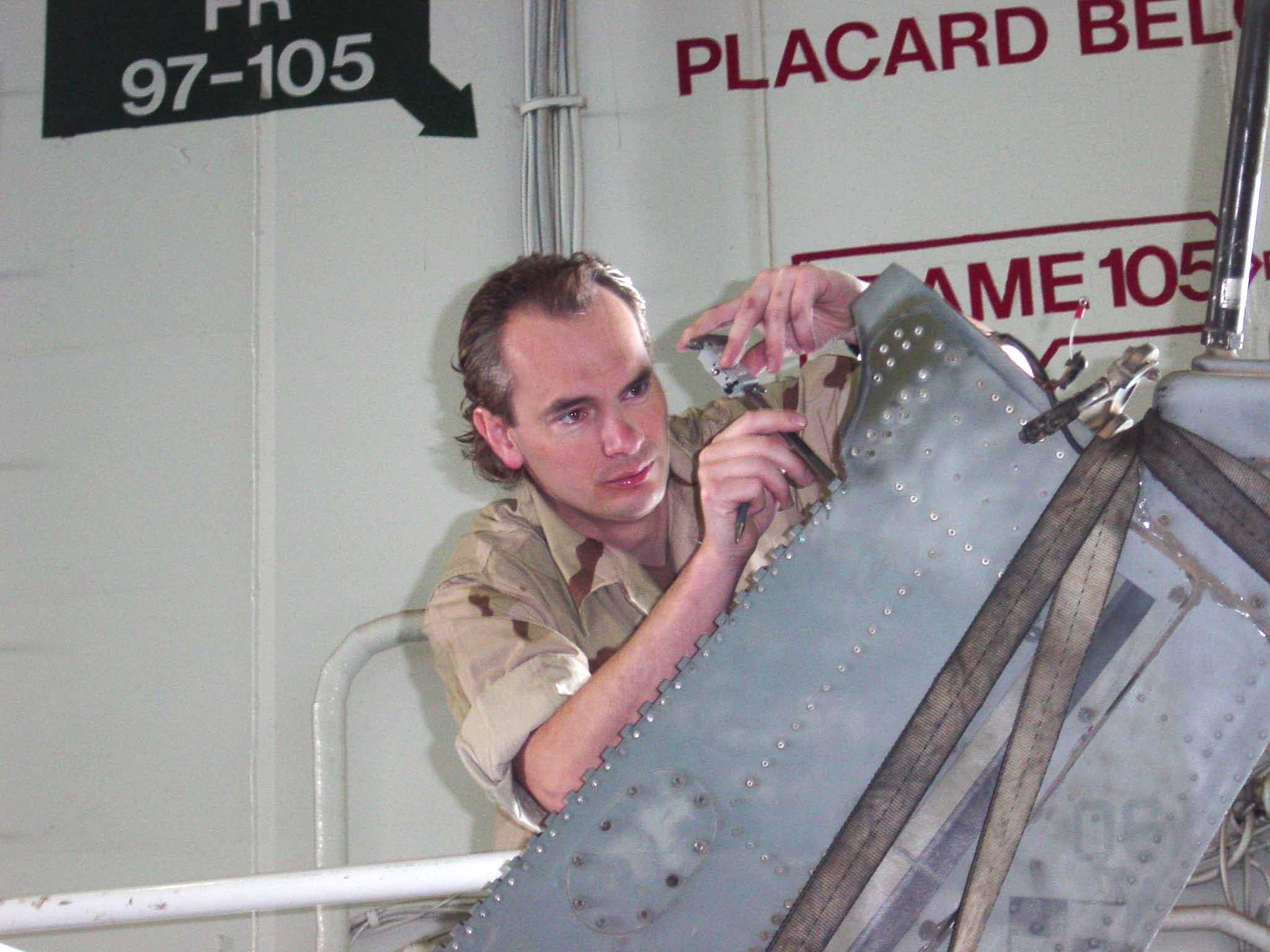
“Working in-theater in a civilian capacity with the military during a war is an incredible experience,” said Hoffmann, an aerospace engineer with the Naval Air Systems Command (NAVAIR) Depot in North Island, Calif. Hoffmann spent three months with the fleet during Operation Iraqi Freedom (OIF) designing depot level repairs for forward deployed Navy and Marine aircraft. He performed the same duties during Desert Storm and Desert Shield.
“Most people don’t ever get the experiences I’ve had – not once, but twice,” he said.
Hoffmann is just one of 52 NAVAIR depot personnel who willingly left their homes to serve closer to the front lines of warfare than many military personnel. As non-combatants they carried no arms and took no oath. They had no obligation to their country but a moral one. They did not even receive the special pay that others received for service in the same geographical area.
They are NAVAIR’s forward-deployed, in-service repair personnel providing depot-level maintenance where it is most needed – on the carrier, on the field, in the midst of the action. As engineers, planner/estimators and skilled artisans these men and women were responsible for the Aircraft Battle Damage Repair (ABDR) and routine maintenance needed to keep fleet aircraft operating safely during OIF.
“I was everywhere they needed me – on ships, in Italy, Bahrain and Kuwait,” said Hoffmann, “They sent me wherever they needed me.”
According to Cmdr. Ken Campitelli, NAVAIR Deputy for Industrial Production, NAVAIR has been putting depot artisans on carriers for years. But the increased operations and the number of carriers and aircraft operating in-theatre required additional fleet support.
“Though we are committed to maintaining absolute combat power for the warfighter through the support and expertise of our depot artisans,” said Campitelli, “we were not routinely staffed to take care of six carriers and the shore detachments (in Kuwait and Bahrain) that would be necessary in the event of war,” he said.
“That increase in operations meant we needed to come up with a course of action to supplement our NAMRA and NAPRA depot personnel,” said Campitelli. NAVAIR’s Naval Air Mediterranean Repair Facility (NAMRA) in Naples, Italy and the Naval Air Pacific Repair Activity (NAPRA) in Atsugi, Japan perform unplanned maintenance and in-service support, provide field teams and oversee depot-level repairs to maintain deployed carrier battle groups in the Western Pacific/Indian Oceans and Mediterranean/Europe/Navy Central Command areas of operation.
A plan to provide adequate support personnel and facilities in-theater developed by a NAVAIR Industrial Operations team late last year was signed and in place by February.
“We planned before hostilities began and developed a matrix – how many bodies and skills we would need to provide the necessary in-theatre support,” said Campitelli. “We took advantage of the large depot family within NAVAIR and were able to put out a call for the experience and expertise we needed.”
Hoffmann was one of those experts.
Since he had already filled the role during Desert Storm/Desert Shield, Hoffman knew he could be valuable.
“I was happy to get back in the role,” he said, “it fit like a glove.” Though, he added, it was a different experience from his first trip to the area.”
Ten years ago Hoffman spent a lot of time on carriers supporting fixed-wing aircraft. “This time I supported a lot of Marine squadrons and helicopters in close-air support roles,” he said. “And there was significantly more ABDR than the last time.”
According to Hoffmann, a key to broadening his expertise was the support he received from the NAVAIR depots back home.
“I couldn’t have all that technical data in my head,” said Hoffmann. “But wherever I would be, regardless of the aircraft, if I needed help all I had to do was call,” he said. “I was very impressed with the support from all of our depots and the experts within the Fleet Support Teams. I can’t tell you how helpful and responsive they were.”
Hoffmann was able to call upon the expertise of three NAVAIR depots within the United States. NAVAIR Depot Cherry Point, N.C., provides maintenance, engineering and logistics support on a variety of aircraft, engines and components for all branches of the U.S. Armed Forces. NAVAIR Depot Jacksonville, Fl., performs a complete range of depot level rework operations, manufactures parts and assemblies and provides engineering support. NAVAIR Depot North Island, San Diego, Ca., performs overhaul, repair and modification of naval aircraft and supports naval aeronautical and related technology systems.
“Over the course of operations, we had volunteers from all three depots,” Campitelli said, “and we activated ten NAMRA and NAPRA reservists.”
Though often taxed to the extreme, the depot personnel were able to successfully handle the many challenges they faced.
Onboard the USS Abraham Lincoln (CVN 72), a three-man NAPRA team provided a range of services, including: repairing a crack in a helicopter tail cone fitting; removing corrosion; patching a hole in the skin of an E2-C Hawkeye; and welding the tail-hook skin on a S-3B Viking.
Two depot calibration lab artisans sent aboard the USS Constellation (CV 64) were able to repair a malfunctioning test bed on the ship and get fleet personnel the tools they needed to support S-3B and F/A-18 Forward Looking Infrared (FLIR) radar.
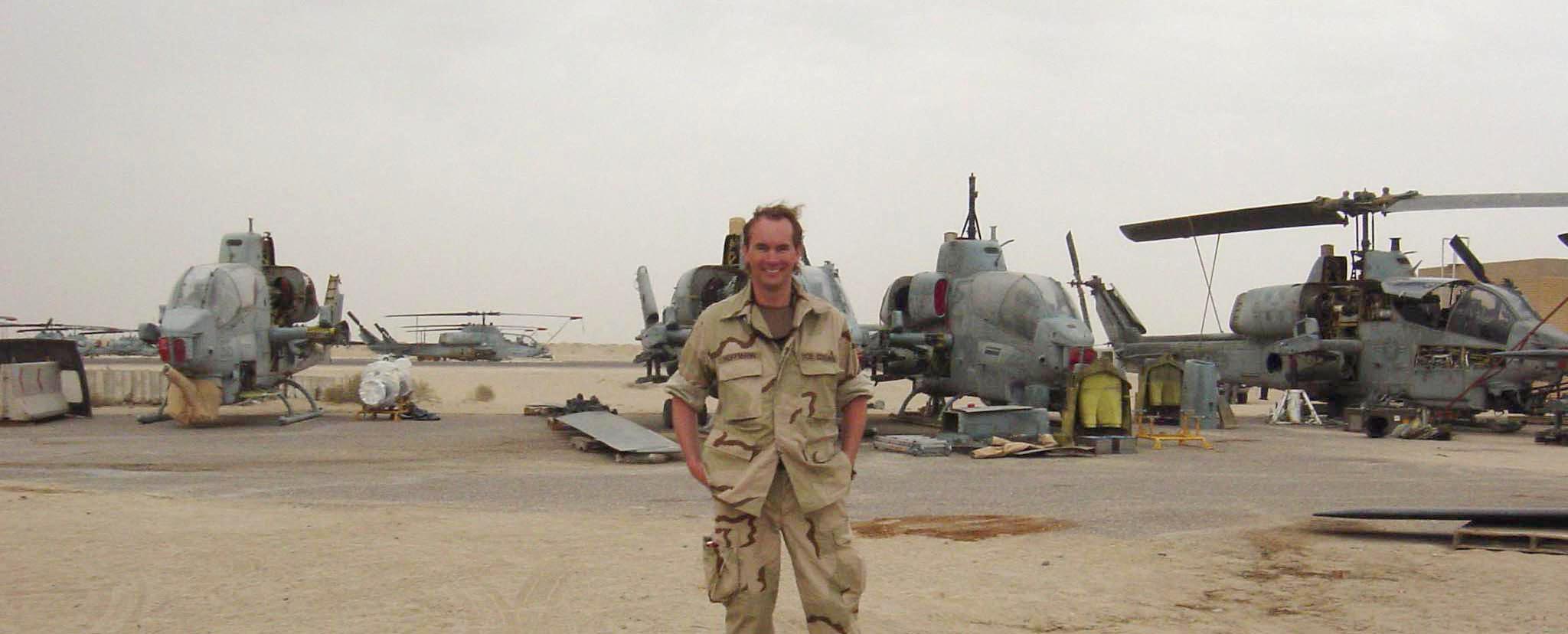
On the ground in Kuwait forward-deployed NAMRA personnel even repaired bullet holes to helicopter rotor blades while listening for air raid alerts.
“Our people were fixing the normal things that go wrong, like failures from routine wear and tear, as well as repairing damage from enemy fire,” Campitelli said.
“Everything went well,” he added. “We’ve been performing in-service repair for years – this was more of the same – except under wartime conditions. We had to pull in new people and their performance was outstanding.”
For Hoffmann, this second opportunity of a lifetime left him with a tremendous sense of pride and accomplishment.
“Everyone throughout NAVAIR and the depots works to support the warfighter,” he said. “But not everyone gets the chance to support them so directly – and that’s what I got to do. It was an excellent experience.”
NAVAIR provides advanced warfare technology through the efforts of a seamless, integrated, worldwide network of aviation technology experts. From professional training to carrier launch and recovery; from sensor data to precision targeting and real-time communications; from aircraft and weapons development to successful deployment and sustainment; NAVAIR provides dominant combat effects and matchless capabilities to the American warfighter.
For more information about the Naval Air Systems Command, go to www.navair.navy.mil.
Photo Caption 1: Tim Hoffman, an aerospace engineer from NAVAIR Depot North Island in San Diego, Calif., stands at the maintenance line at Ali Al Salem Air Base in Kuwait. Hoffman is one of 52 NAVAIR depot personnel who volunteered as forward-deployed, in-service repair personnel to provide depot-level maintenance during Operation Iraqi Freedom.
Photo Caption 2: Tim Hoffman, an aerospace engineer from NAVAIR Depot North Island in San Diego, Calif., evaluates damage to an UH-1 onboard the USS Saipan just off the coast of Kuwait/Iraq during Operation Iraqi Freedom. Hoffman was one of 52 NAVAIR depot personnel who volunteered as forward-deployed, in-service repair personnel to provide depot-level maintenance during Operation Iraqi Freedom.