
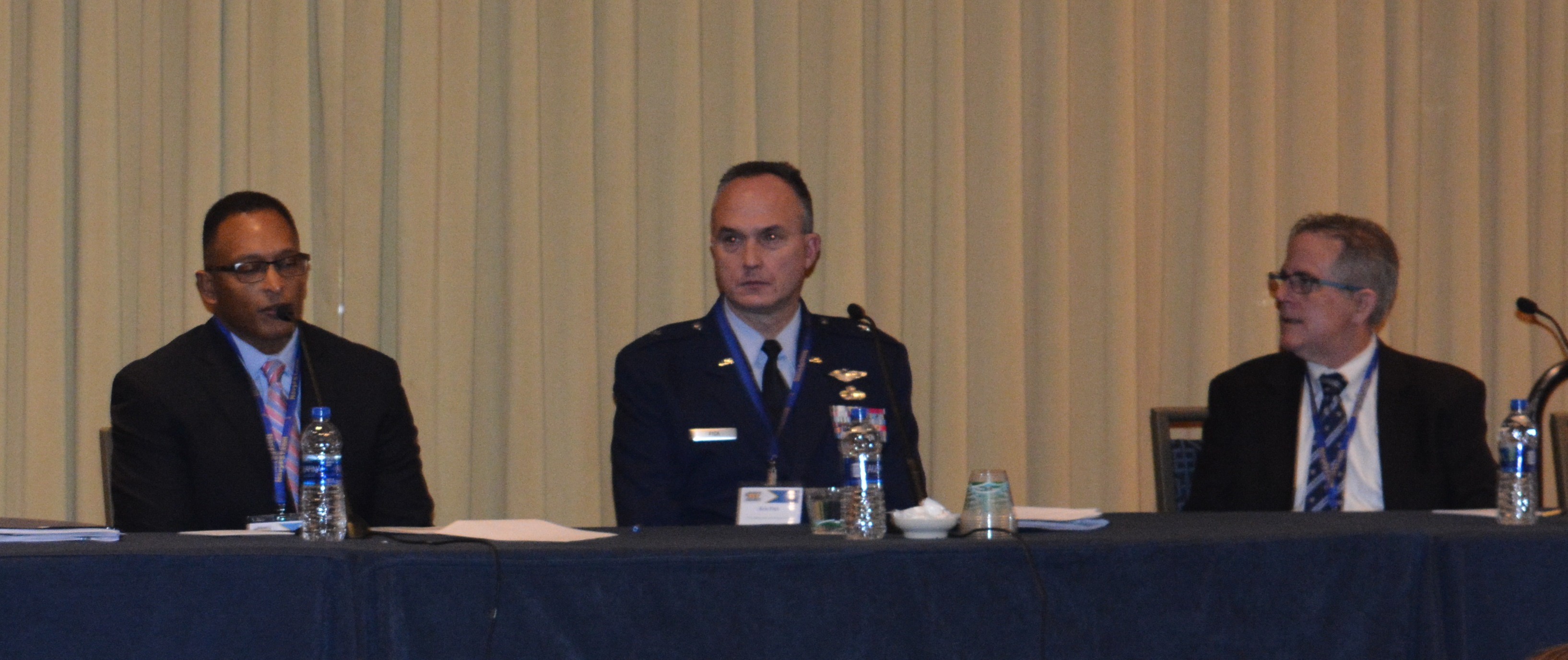
Martin Ahmad, Deputy Commander, Fleet Readiness Centers, left, speaks during a panel discussion about the use of technology to solve sustainment challenges to provide aircraft to the fleet during the Navy’s Forum for Small Business Innovation Research/Small Business Technology Transfer (SBIR/STTR), or Navy FST, April 11, 2018. Air Force Brig. Gen. Eric Fick, deputy program executive officer for the F-35 Lightning II Joint Program Office, center, and panel moderator Robert L. Smith, director of the Navy’s SBIR/STTR office, invited industry and technology leaders to provide ideas to make military aircraft more affordable and sustainable. (U.S. Navy photo/released)
COMFRC Deputy talks innovation and sustainment at Navy FST
NATIONAL HARBOR, Md. – Being innovative when creating new and upgraded aircraft and components is one thing; creating innovation to support Naval aviation sustainment is another. Getting ideas and solutions to solve complex sustainment issues is the challenge Martin Ahmad, Deputy Commander, Fleet Readiness Centers (COMFRC), had for business executives during the Navy’s Forum for Small Business Innovation Research/Small Business Technology Transfer (SBIR/STTR), or Navy FST, held April 9-11, 2018.
Ahmad and Air Force Brig. Gen. Eric Fick, deputy program executive officer for the F-35 Lightning II Joint Program Office, participated in a panel discussion titled “SBIR/STTR Processes Support to Reduce Sustainment Costs” April 11. Fick provided an update on the F-35 program to include capability upgrades as production increases and moves toward sustainment.
“(Most) of the Navy SBIR (funding) is spent on the brand new platform,” said panel moderator Robert L. Smith, director of the Navy’s SBIR/STTR office. “What are we doing for deployed systems that have already been in the fleet for 25, 35 years?”
Ahmad spoke about how improved equipment benefits aviation readiness. He pointed out half of the test equipment used in depots is 25 years old and is experiencing reliability and obsolescence issues, which contributes to delayed repair time for aircraft and components.
“We use advanced technology toward maintaining and getting more life out of our aircraft,” he said. “We are increasing our investment in equipment and we are looking for partners in industry to come in and help us. We’re looking at replacing equipment, establishing future capabilities with the most advanced equipment and supporting workforce training.”
Ahmad discussed some current projects including cold spray, which provides the capability to repair parts that would otherwise need to be scrapped; zinc nickel plating, which reduces heavy metal hazards and is more corrosion resistant that previous methods; and non-destructive inspection (NDI), which helps technicians detect material anomalies below the surface that might create fatigue or failures and reduces turn-around time.
He said technology helps in the sustainment of vital airframes such as the F/A-18.
“We’re using F/A-18s much longer than was planned and we’re seeing failures and wear-and-tear that was never expected based on the initial anticipated life of the aircraft,” Ahmad said. “Our engineers are very active in finding ways to reduce our cost of sustainment and increase our ability to get aircraft back to the fleet sooner.”
COMFRC hosted an equipment industry day at FRC Southwest in San Diego in March and has events scheduled at FRC East and FRC Southeast in the third week of April to educate industry on FRC needs and seek potential partnering for solutions.