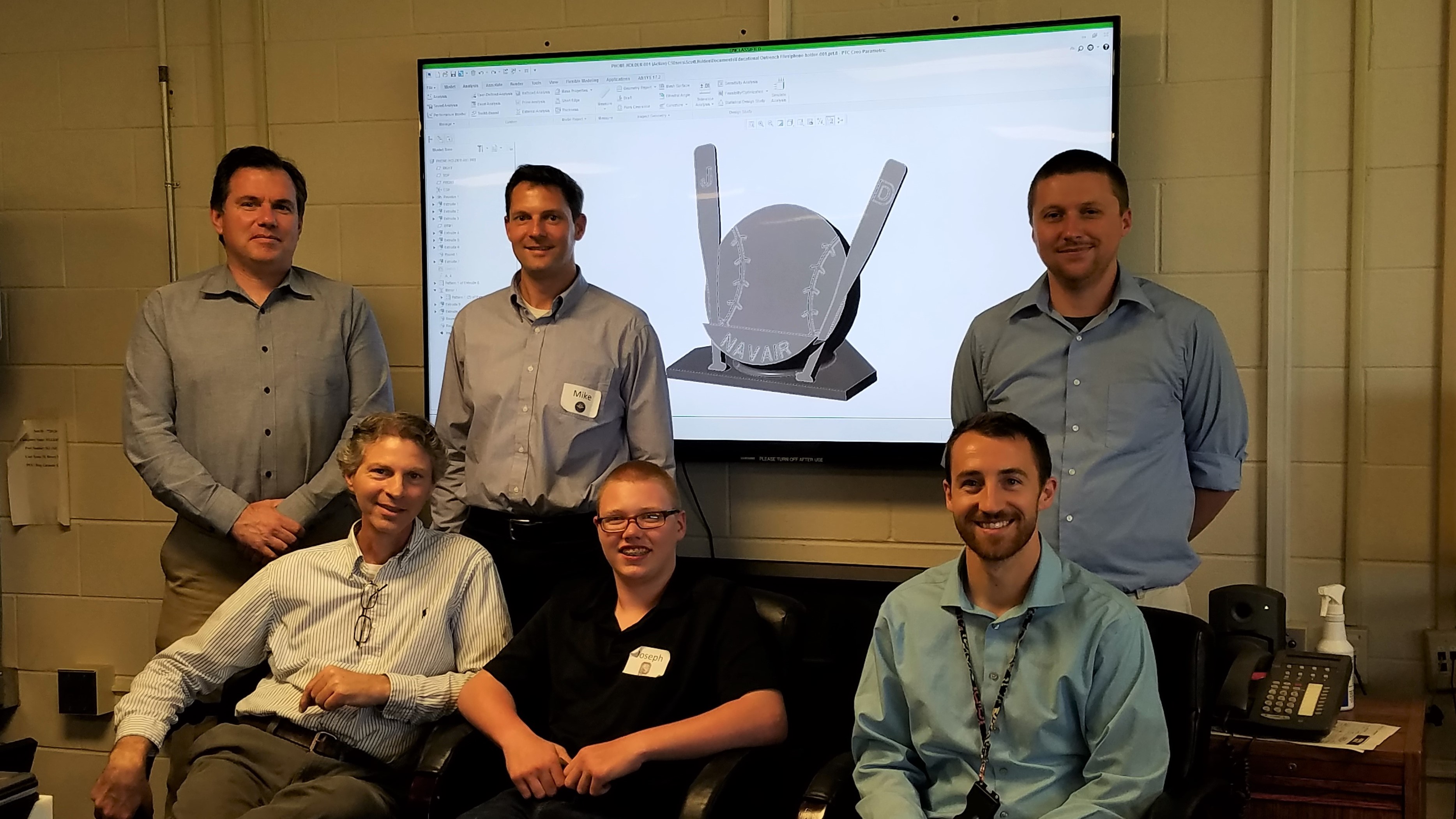
NAWCAD Lakehurst engineers worked with a local student to design and model a custom cell phone cradle that was later 3D printed for the student to keep, during the Additive Manufacturing workshop at Joint Base McGuire-Dix-Lakehurst, New Jersey May 9. (U.S. Navy photo)
NAWCAD Lakehurst hosts 3D printing workshop for students with disabilities
JOINT BASE MCGUIRE-DIX-LAKEHURST, N.J. – Local middle and high school students with disabilities got a chance to learn the science of 3D printing and experience it first-hand during a workshop hosted by the Naval Air Warfare Center Aircraft Division (NAWCAD) Lakehurst here May 9.
The workshop evolved out of a partnership between the NAWCAD Lakehurst Individuals with Disabilities Advisory Team (IWDAT), the NAWCAD Lakehurst Education Outreach Office and the Naval Civilian Managers Association (NCMA) to educate students on the science of Additive Manufacturing (AM), more commonly known as 3D printing.
The goal was to provide a fun and educational experience for local students with disabilities in order to spark their interest in Science, Technology, Engineering and Math (STEM) careers and in Naval Aviation, said Michael Brazinski, IWDAT team member who organized the workshop.
“We are always striving to have an inclusive culture at NAWCAD Lakehurst and share that inclusiveness with our local community,” said Kathleen P. Donnelly, Naval Air Systems Command (NAVAIR) Support Equipment (SE) and Aircraft Launch and Recovery Equipment (ALRE) director. “The engineers who put this workshop together epitomize that ideal and our commitment to developing the Navy’s future scientists and engineers.”
The workshop consisted of lessons on the relevance and science of AM and a tour of NAWCAD Lakehurst’s Prototyping and Manufacturing capabilities to show how NAWCAD Lakehurst is researching using AM to print 3D components for aircraft.
Due to last minute transportation issues, only one student was able to participate in the workshop.
“What was an unfortunate turn of events,also allowed us to provide a unique, one-on-one experience for the student attendee,” said Brazinski. “He arrived ready to immerse himself in the experience and expressed his excitement at the prospect of a career with the military.”
The workshop culminated in a hands-on exercise in which the student worked with engineers to design and model a custom cell phone cradle that was later 3D printed for the student to keep.
IWDAT plans to use this first workshop pilot as a model for future workshops, which may incorporate different technology themes and different populations of students, said Brazinski.
“Workshops like this will contribute to increased student interest in STEM career paths and in Naval Aviation, enriching the future of NAVAIR's workforce,” said Brazinski.