
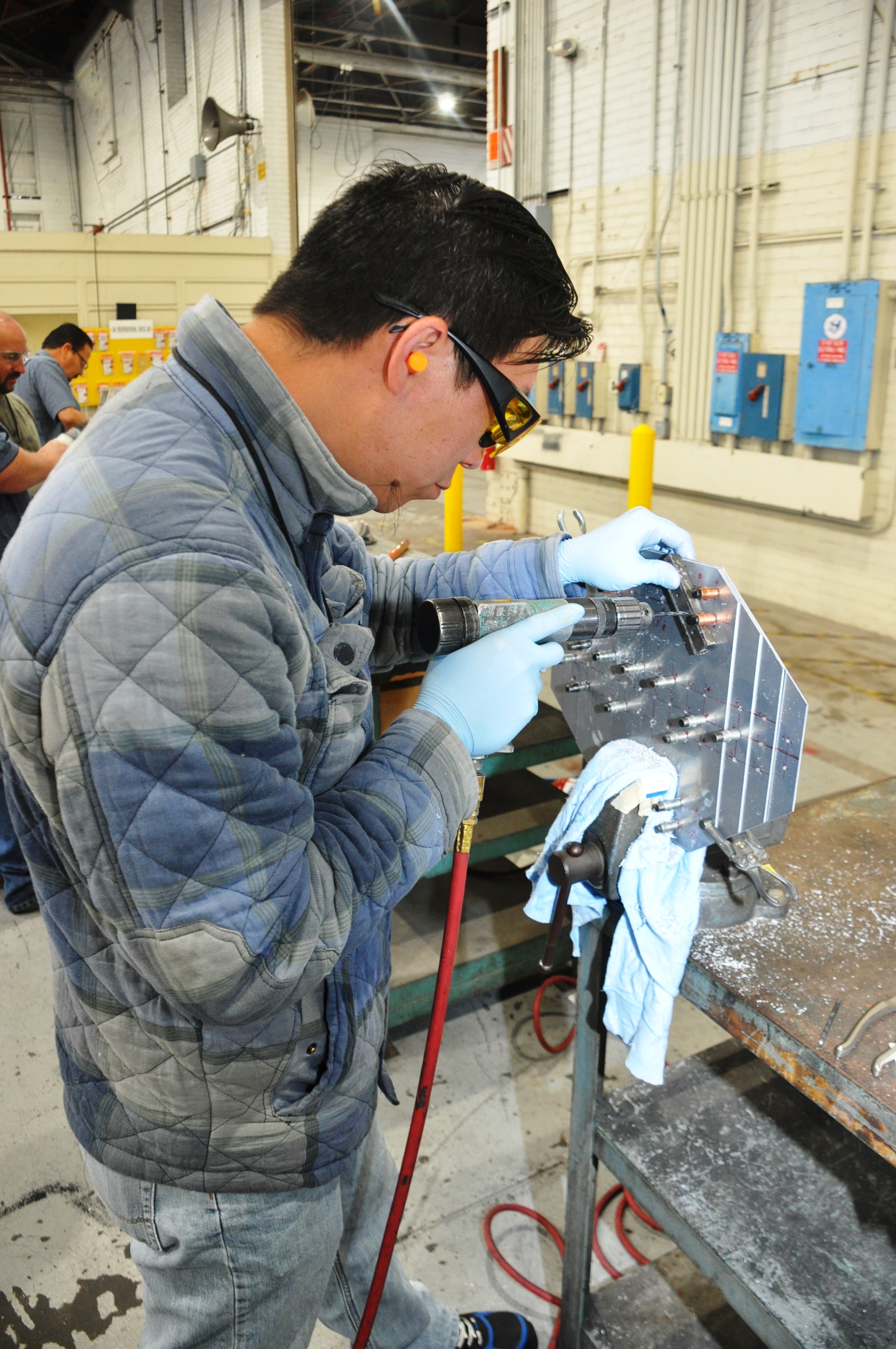
Sheet metal mechanic Lam Chung drills fastener pilot holes as part of a timed and graded exercise working with fasteners of varying lengths and diameters. (U.S. Navy photo)
FRCSW Launches Artisan Training Program
NAVAL AIR STATION NORTH ISLAND, Calif. - A new level of artisan training is on the horizon at Fleet Readiness Center Southwest (FRCSW).
With the intention of ensuring the quality of its production and workforce, the command kicked-off its first artisan training class in April beginning with sheet metal work.
“The concept of this started about six months ago. In the past, a lot of sheet metal work was learned through on-the-job-training when we had the numbers of experienced workers to pass those skills on. But since many of them have retired or left for other reasons, we need to make sure our folks have those depot-level skills needed to work on the aircraft here,” said Production Trades Division supervisor Christopher Venable.
Working in conjunction with human resources and Industrial Production Support, Venable said that this maiden class targeted the sheet metal field because it’s the largest division of all the trades at FRCSW.
The class is entering its fourth week and is held in Building 27 where seven students use scrap pieces of metal to practice and learn on.
The students are not trained in composite repairs.
“It’s really not unlike the `A’ schools of active duty personnel. But we are still in the process of establishing the course criteria,” Venable said. “The students are taught to meet the specifications for drilling holes and fasteners for all of the airframes requiring sheet metal repairs that we work on here.”
“We want to make sure that people are up to speed, so that if someone is working on an H-53 helicopter, for example, and when that work gets done, then they can go work on a legacy Hornet if needed,” noted work leader/trainer Gary Grela.
The class employs three work leaders/trainers whose ultimate goal is to train up to 12 students per class.
As the program evolves, Venable said that the length of the class will probably last from four to six weeks.
“But we’ll need to figure how we’ll handle people who are faster learners; do we approve them as early as two or three weeks? Also, what about slow learners? Do we give them a time limit to come up to speed? These are some of the things we’re working on,” he said.
Venable said that the program currently operates via an Industrial Production Support job order number, but will enjoy a much larger budget next fiscal year of up to $10 million.
He added that classes for the paint department, machinists and electricians are in the works.
FRCSW is the only FRC conducting an artisan training class.
FRCSW is Commanded by CAPT Craig Owen.