
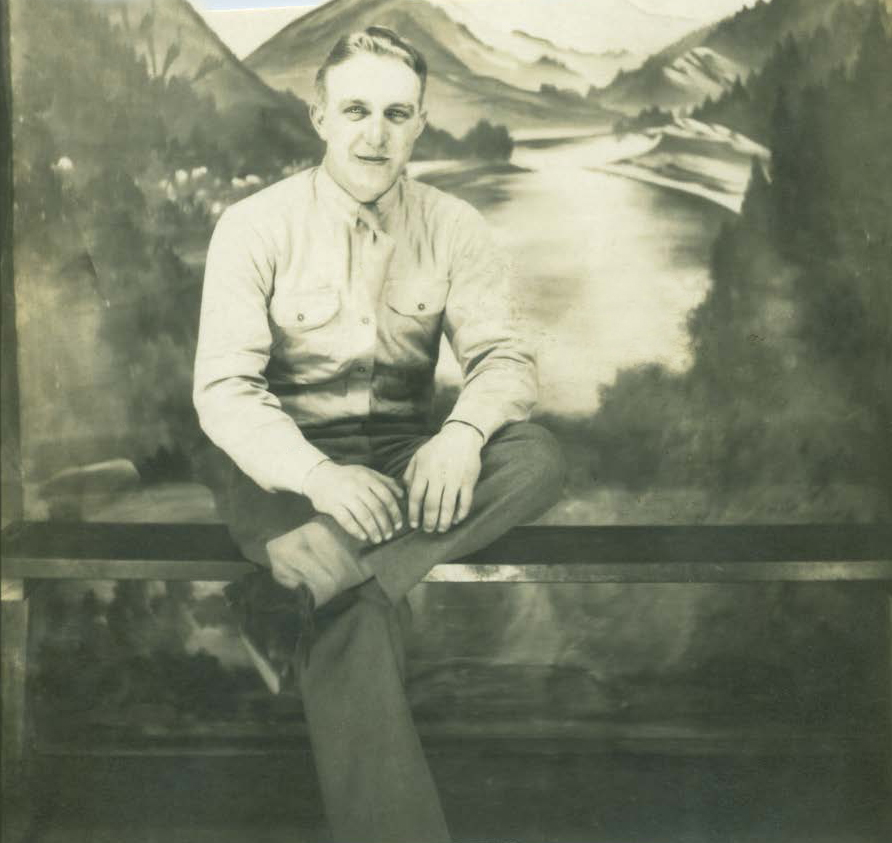
NORTHERN IRELAND (1944) PFC Leroy Thomas, poses for a photo while his unit, the 7th Engineer Combat Battalion was training in Northern Ireland in early 1944. Thomas was killed Jan. 18, 1945, when a German 88mm artillery shell exploded nearby during the Battle of the Bulge. (Photo provided)
FRCSE Artisan Finds Family Link to Fallen Soldier in Dusty Shoebox
JACKSONVILLE, Fla. – As dawn stretched its fingers across the frozen banks of the Sûre River near the town of Gilsdorf, Luxembourg, the idyllic landscape was exploded by the crash of German 88mm artillery rounds.
It was Jan. 18, 1945, and the German army’s last-gasp attempt – known to history as the Battle of the Bulge – to throw back the allies’ inexorable march to their homeland, was in its death throes.
Gen. George Patton’s Third Army had broken through the German lines to relieve the 101st Airborne at Bastogne, and was now headed north to cut off any Wehrmacht soldiers remaining in the bulge the German’s advance had created in allied lines. To do that he had to cross the Sûre River, just five miles west of the German border.
Among the group of U.S. Army combat engineers on the south bank was Pfc. Leroy Thomas.
“I never knew who Leroy Thomas was,” said Fleet Readiness Center Southeast sheet metal worker Dale Holt. “But my mom, whose health is failing, told me the other day ‘I have something that was my mom’s that I want you to have.’
“She broke out this little box, and here was this little letter she handed me.”
The box contained two yellowed, faded letters and a photo of a grinning, auburn-haired young soldier in his class-B uniform.
“The letters were from her stepbrother Leroy Thomas, when she was about 10 years old,” Holt said. “She told me she wanted me to have them because my grandmother kept them until she passed away, so they obviously meant something to her.”
All that his mother knew, Holt said, was that Thomas had been killed in the war. The details were fuzzy – if ever known completely – but involved a boat, and what the family thought was an underwater mine.
“The body never came home,” Holt said. “My mom told me they had a few friends come by with food and condolences, but they never had a funeral.”
Holt wanted to know more about the family member he’d never known, and immediately began to examine the letters.
The first was dated March 31st, 1944. The 7th Combat Engineer Battalion, to which Thomas belonged, was still in Northern Ireland for training. In the letter to his father, Thomas sent the photo of him in uniform, and asked for candy, gum, magazines and a lighter. He also noted the fact he was engaged to be married.
He mentions the Japanese, perhaps believing they would be his future opponent, with the bravado characteristic of soldiers before they see combat.
In closing, he also had a special request for his stepmother, Holt’s grandmother, to send some makeup.
“Tell Mable to put a tube of lipstick, rouge and a box of powder in it,” Thomas wrote. “I would like to doll my girlfriend up a little to see how she looks.”
The contrast in the second letter is striking.
After fighting his way across France for the last six months, his mood was melancholy. Written using the Victory Mail or “V-Mail” system, Thomas’ longing for home bleeds through in the letter to his parents that is post-marked Jan. 10, 1945.
“I haven’t heard from you in quite a while, it can’t be you have forgotten your son all the way over here,” he wrote. “It seems that nobody writes me any more, not even my best girlfriend.”
Whether his lack of mail was due to a failure in the postal system to keep up with Patton’s blistering pace during those months is unknown. Yet Thomas clearly noticed, like any service member, the decrease in mail. He also acknowledged his own failure to write home.
“I know I hardly ever write, but that can be explained,” he wrote. “Not now, but when I come home.
“Seems like I’m getting tired of being over here.”
From the letters and photo, Holt now had a starting point to look for more. He knew Thomas’ name, unit and that he served in Europe. Armed with that information, he brought the heirlooms to show his coworkers – one of whom is Todd Taylor.
Taylor, a Gold Star father himself, is familiar with digging into military records, and immediately went to work on his home computer.
There, he found a website dedicated to the 7th Engineers created by George Baldwin, who served in the unit in Vietnam. The site featured first-hand accounts of 7th Engineer soldiers.
Astonishingly, one of the men who contributed an account, Tom Tucker, was there that freezing January morning in 1945 on the banks of the Sûre River.
“At daylight the Germans started shelling the crossing site,” Tucker wrote of that morning. “The ground was frozen so it was impossible to dig in.”
The engineers had moved elements of the 5th Infantry Division across the river in boats in the pre-dawn hours. Several of them had been instructed to stay with the boats in case reinforcements or supplies were needed.
“There were large trees at the edge of the river so we were getting some tree bursts,” Tucker said. “There was a small stone building at the edge of the river that we used for cover.”
As the shells rained down fatal shrapnel, Tucker made a dash for the building and saw Thomas.
“I was almost in the door of the building but looking in his direction,” Tucker said. “He had hit the ground, there was a tree burst, he stood up and shouted ‘I've been hit,’ ran about three steps dragging one leg, then collapsed.
“The shelling lasted only a few minutes, but when we reached Thomas he was dead.”
Holt’s mother was right. Leroy Thomas never made it home to tell his parents about what he’d seen and what he endured.
Holt learned Thomas was buried, along with more than 5,000 of his fellow soldiers, in the Luxembourg American Cemetery in Luxembourg City. Eleven months later, he would be joined by his commanding officer, Gen. George Patton, when he succumbed to injuries suffered in a car crash in Heidelberg, Germany.
“It means a lot to me to know what happened to him,” he said. “If my mother hadn’t given me those letters, I’d have never known she lost a brother in the war.
“I think it’s important to remember these guys. Otherwise, their sacrifice is lost to history.”
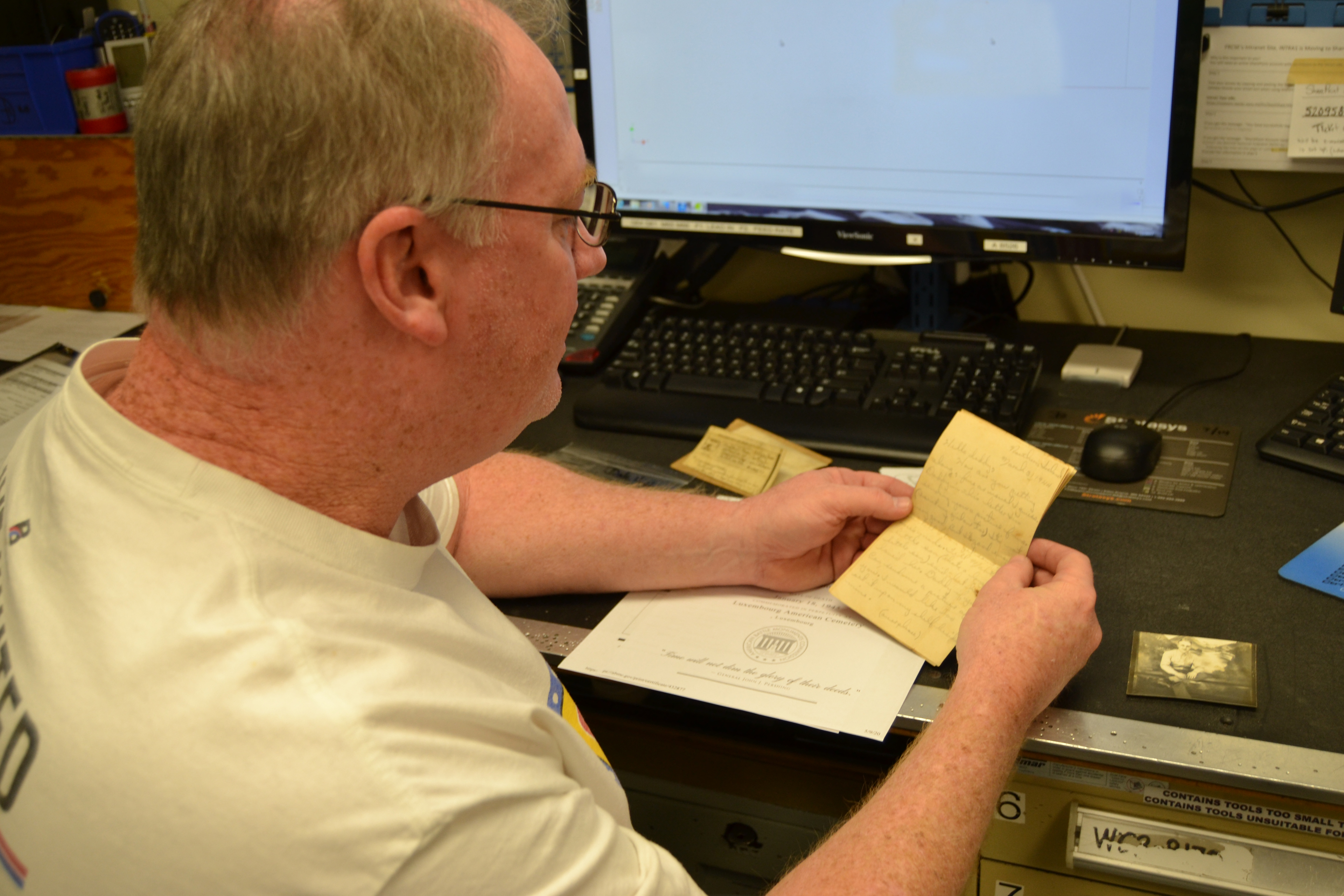
JACKSONVILLE, Fla. (May 10, 2017) Fleet Readiness Center Southeast sheet metal worker Dale Holt examines one of the letters left from his mother’s stepbrother, Leroy Thomas. Holt’s mother gave him the letters recently, and sparked a curiosity to find out more about the man whom he never knew. Thomas was killed in Luxembourg, during the Battle of the Bulge. (U.S. Navy photo/Released)
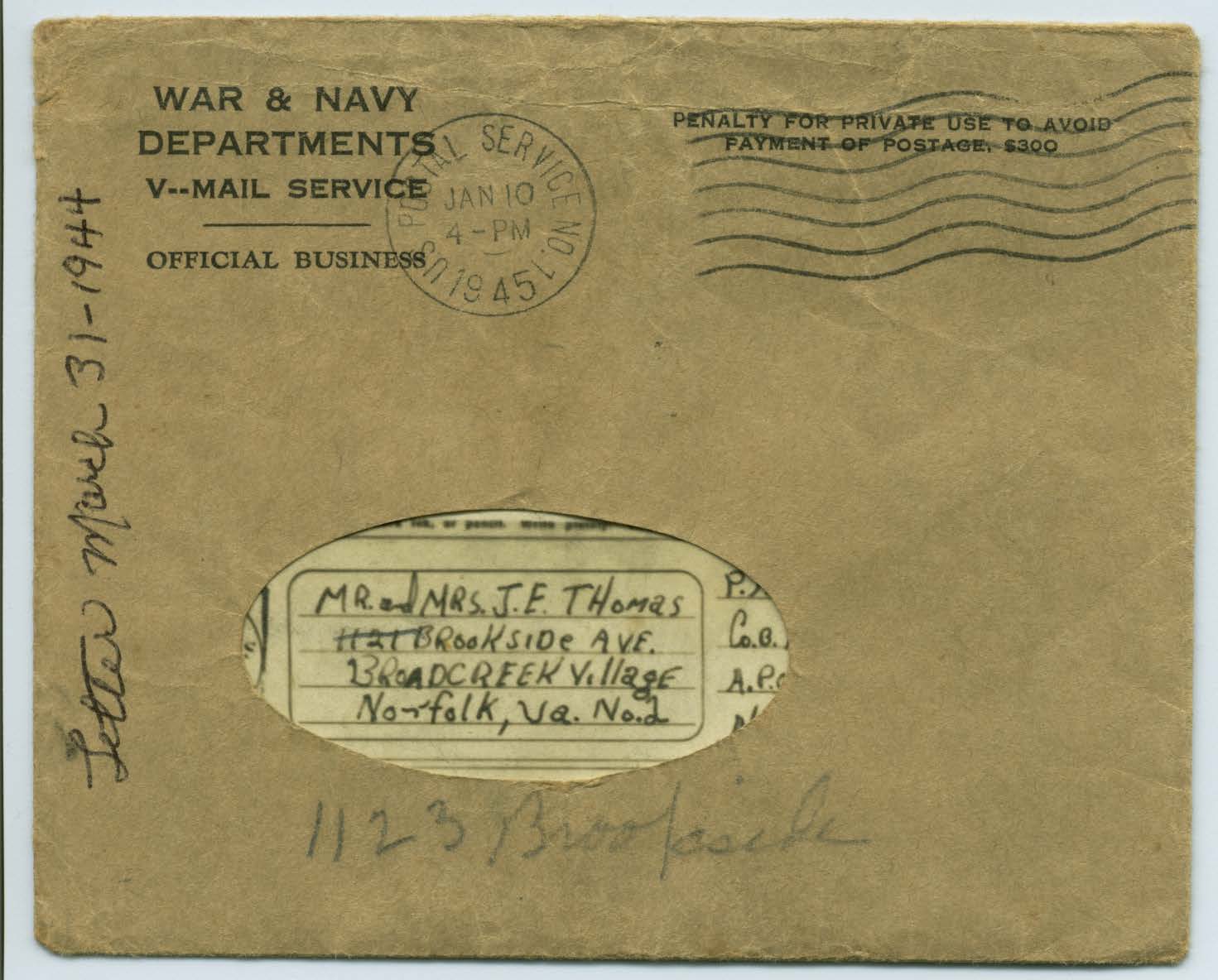
The last letter PFC Leroy Thomas was known to have sent, post-marked Jan. 10, 1945, just eight days before he was killed during an operation to cross the Sûre River in Luxembourg during the Battle of the Bulge. The writing, along the left side of the envelope, belonged to Holt’s grandmother, and noted the date of another letter tucked inside from 1944. (Photo provided)
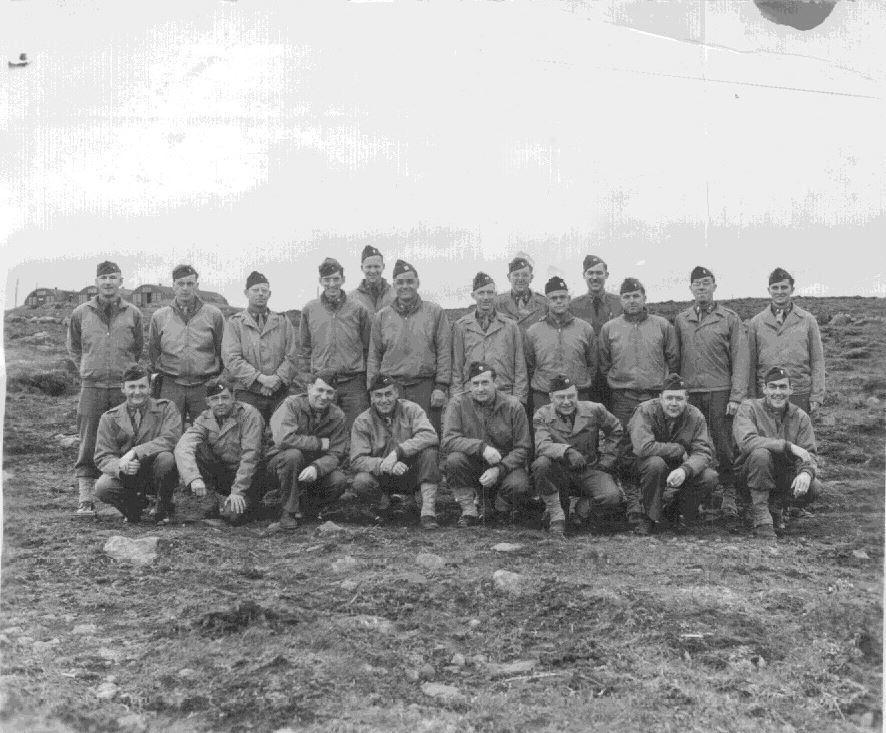
EUROPE (1944) A section of the 7th Engineer Combat Battalion poses for a photo while training in Europe in 1944. Leroy Thomas is second from left, back row, standing. Thomas was killed the following year during the Battle of Bulge. (Photo provided)