
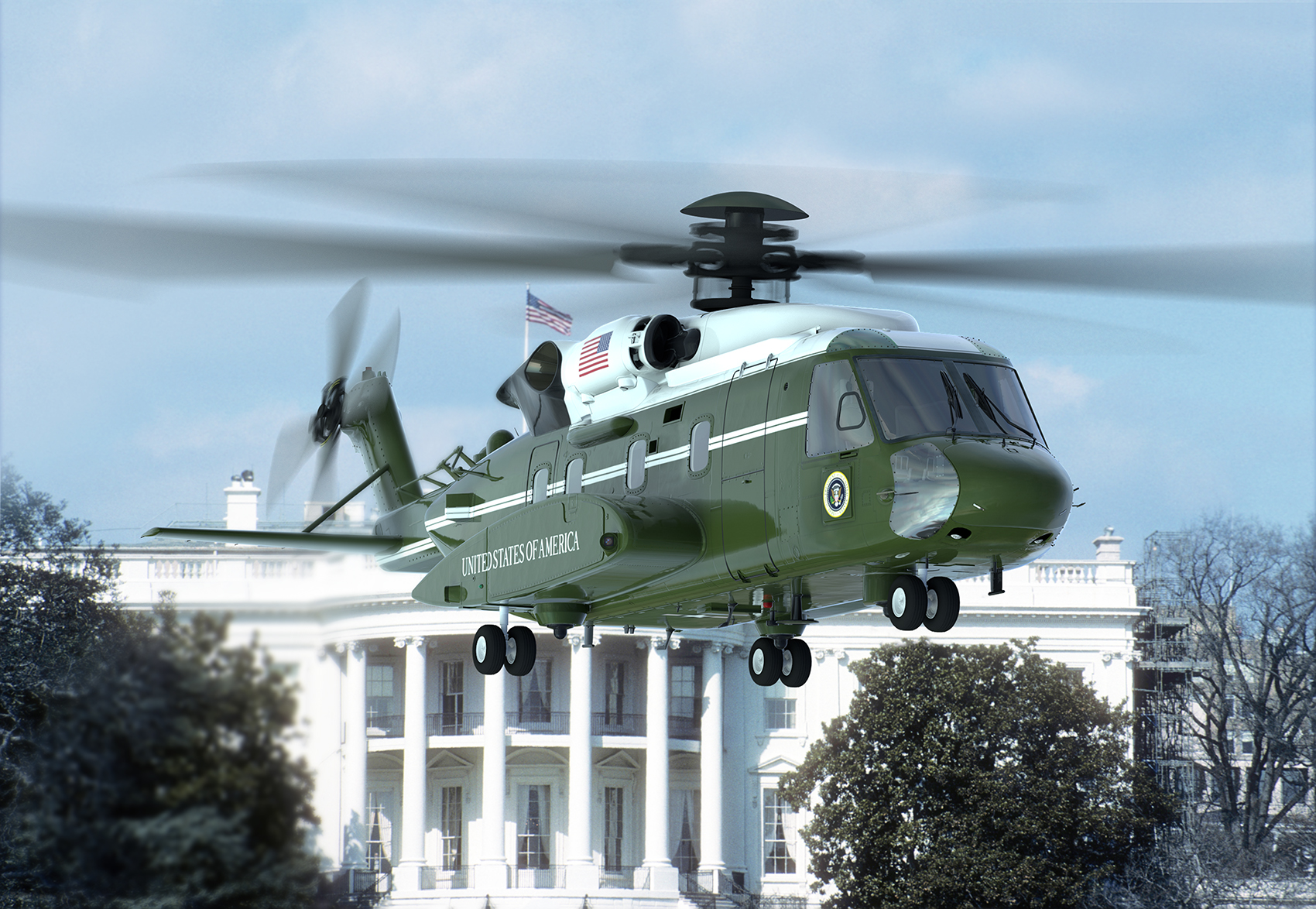
Artist's rendering of the future VH-92A presidential helicopter. (Artist's rendering courtesy of Sikorsky)
Navy considering proposal for 17 Presidential Helicopters
NATIONAL HARBOR, Md.—Four years into a $1.2 billion development contract for the new VH-92A presidential helicopter, the Navy has flown two initial test aircraft and is considering a proposal to acquire a full fleet of the new presidential helicopters.
That’s according to Col. Eric J. Ropella, who became the new Marine Corps program manager for the Presidential Helicopters Program on March 22. Ropella provided an update on the program April 9 during the first day of the 2018 Sea Air Space Exposition.
The most notable recent news, according to Ropella, was the flying of the Navy’s first two VH-92A test aircraft, engineering development models (EDMs) 1 and 2, last July and November, respectively. The aircraft are now in a Lockheed Martin facility in Owego, New York, for painting and interior installation.
“Once we get the aircraft this summer, we will conduct government tests, mostly validating and verifying the [aircraft’s] unique requirements,” Ropella said.
According to Ropella, the program office has pursued an acquisition strategy of identifying an in-use commercial helicopter and then working with the contractor to integrate a “government-defined and developed mission-systems package.”
“[With Sikorsky’s S-92], that’s exactly what we’ve done, and we’re following that acquisition strategy very successfully,” Ropella said.
In May 2014, the Navy awarded the contract for the VXX Presidential Helicopter program to Sikorsky for six S-92 test aircraft and associated support equipment with production options. Sikorsky has since been acquired by Lockheed Martin.
Ever since the development contract was awarded, the VH-92A “has been on a fast track,” said Rear Adm. G. Dean Peters April 10 during the 2018 Sea-Air-Space Exposition. Peters oversees the presidential helicopters program as program executive officer for air anti-submarine warfare, assault and special mission programs.
In 2016, the design passed its critical design review, clearing it for production. Now the Navy is working on a proposal to buy 17 production aircraft, for a total fleet of 23, which will ultimately replace the fleet of eight VH-60Ns and 11 VH-3Ds that currently support the president.
“The proposal that we have is for a total of 17 aircraft to be purchased in three years,” Ropella said.
Toward the end of 2018, the first two test aircraft will undergo operational assessment by VH-92A operational test pilots from Marine Helicopter Squadron (HMX-1). Findings from that assessment will inform the decision to procure the remaining production aircraft, known as Milestone C, which the program expects to reach in 2019, Peters said.
With the first two test aircraft now flown, the other four test aircraft are being transformed from S-92s into VH-92As in Stratford, Connecticut. Unlike the first two, these four will be fully configured for mission support.
In 2019, the Navy will also begin cadre training with a unique VH-92A training system of electronic courseware and simulators to get pilots up to speed.
“As you can see, there is a lot of stuff going on over the next year,” Ropella said. “We were in the ‘run’ phase last year. Now we’re in the ‘sprint’ phase.”
He expects the four fully configured aircraft to be delivered in summer 2019. Eventually those aircraft will become mission aircraft.
As for the program’s in-service aircraft, both the VH-3D and VH-60N will “continue to support the White House for quite a few years,” Peters said. Both aircraft have received engine upgrades, while the VH-3D has also received new rotor blades and is undergoing an interior cabin replacement, he said.
“The upgrades that we’ve put in these aircraft have really been a major performance improvement,” Peters said.
Even so, the VH-3D and VH-60N have been in service for 44 and 29 years, respectively, which means “it’s time to replace them also,” Peters said.
“As we get our production contract and then, within a couple years after that, we start delivering these, we’ll work with the White House on a transition timeline for when we actually put the VH-92A in service.”