
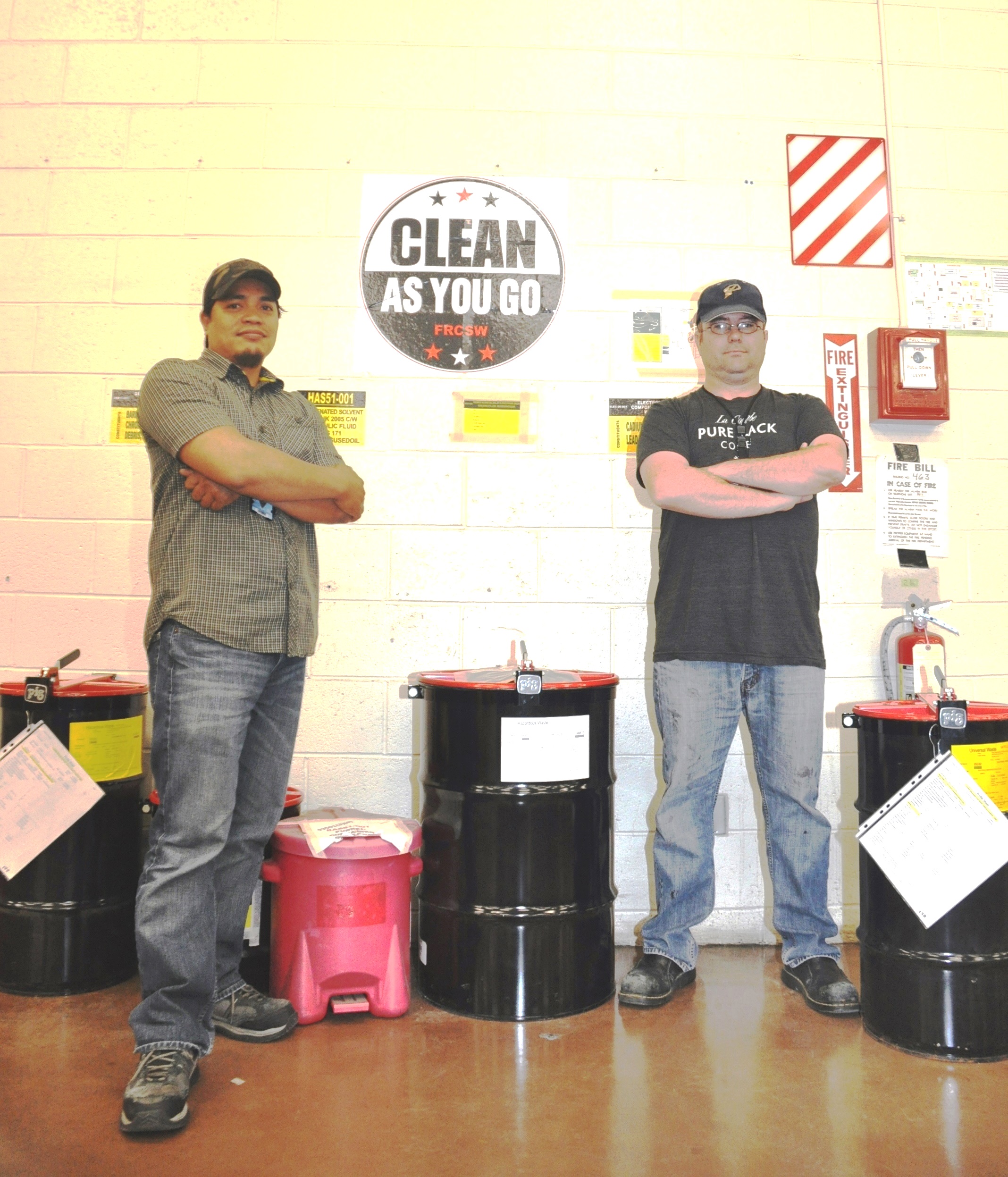
MMS Viniedor Cabandon, left, and rotodome shop environmental coordinator Russell Vaughan stand among new HAZMAT containers in Building 463. 
 (U.S. Navy photo)
FRCSW EPO Gives Kudos to Rotodome Shop
NAVAL AIR STATION NORTH ISLAND, Ca. - Fleet Readiness Center Southwest (FRCSW) shops typically use a number of hazardous materials (HAZMAT) that must be processed after maintenance, repair and overhaul procedures to naval aviation assets.
The command’s rotodome shop in Building 463 was recently commended by the FRCSW Environmental Program Office (EPO) for its exemplary handling of HAZMAT and waste.
The rotodome is a 24-foot round radar system which is “piggybacked” on E-2C aircraft to serve as an airborne early warning system against enemy aircraft and surface threats to aircraft carrier strike groups.
“We use an epoxy or resin in performing repairs on the rotodomes. Our artisans mix and apply the resin to the needed number of layers to make the patch, and whatever is left over is considered hazardous waste which is when the maintenance management specialist (MMS) steps in,” said Russell Vaughan, electronic integrated system mechanic and environmental coordinator for the rotodome shop.
MMS Viniedor Cabandon is responsible for the handling, storing and collection of waste in Building 463 for the hazardous center. He supports two other work centers located in the building.
“FRCSW instruction 5090.1D provides procedures for the handling of HAZMAT and documenting hazardous waste. Each building manages its own procedures to achieve compliance to the instruction,” Cabandon said.
“We get training from our Environmental Protection Specialist (EPS) for this building. He gives me the training and then I train the work centers,” Cabandon noted.
“There is HAZMAT and hazardous waste. Each one has its own EPS and procedural instruction in handling. We have less of this than most other buildings because we don’t generate as much waste as the paint shop, for example.”
When Cabandon assumed the MMS position for Building 463 about one year ago, he conferred with the shops and determined that assigning a representative for each would be the most efficient way to oversee HAZMAT and waste management.
A former Navy avionics electronics technician, Vaughan said he applied his fleet experience to the environmental duties of managing the rotodome shop’s HAZMAT inventory and shelf life, and to preparing for inspections.
Working together the teammates created a system of logs to maintain HAZMAT accountability, usage, safety data sheets, as well as updated environmental bulletins and monthly inventories.
“The shop environmental coordinator and the maintenance management specialist (MMS) have implemented model methods of organization that ensures proper document control and processing of hazardous waste and hazardous materials. All areas with environmental aspects were clean and demonstrated best practices we have not seen elsewhere.” --- FRCSW environmental engineer Tiffany Sevilla
“All of this follows under documentation: Tracking what the artisans use and accounting for the waste that is generated,” Vaughn said. “We want to make sure the artisans have what they need and that it is not past shelf life, and that the containers are in good condition.”
He said that high-use items are ordered approximately six to eight weeks prior to the end of shelf life. The move ensures against shortages and the consequent loss of manhours due to lack of materials.
The rotodome shop is comprised of seven artisans who are sheet metal mechanics and electronics technicians. Much of the HAZMAT they handle is alcohol and acetone based.
Vaughan said that adhesives used in repairs generate the most hazardous waste and are usually held in the shop’s 55-gallon storage drum which is processed about every six weeks. A number of 30-gallon drums are also used for storing waste.
“A lot of managing this just boils down to communication,” Vaughan said. “There are certain time frames that we have to deal with like expiration dates for the waste bins. If something comes near due, the MMS will let me know and we’ll get it disposed of so we don’t exceed the date.”
“Ultimately, we created a process where we assist each other in the procedures,” Cabandon noted.
Including Foreign Military Sales the shop services eight to 12 rotodomes per year.